At least 32 shanties at a Rohingya refugee camp in Nuh district were gutted after a massive fire broke out on Wednesday night, displacing more than 100 people. It appears to be a case of electrical short-circuit, officials said, adding that no casualty was reported in the incident.
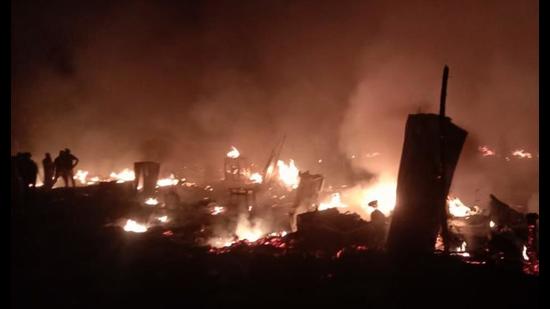
Police said the incident was reported from Chandeni camp 2 at Ferozepur Namak village around 8pm.
Sahoon, in-charge of Nuh fire station, said that three fire tenders, two from Nuh and one from Tauru, were sent to the spot within minutes after they received a call. “The fire was controlled in two hours. A short circuit of a wire in one of the shanties is suspected to be the cause. All the shanties made of bamboo, jute and plastic materials were completely gutted,” he said.
According to the officials, the district administration has arranged for temporary accommodation, medical camps, and police deployment for the victims.
Varun Singla, superintendent of police, Nuh, said that 10 teams were sent to the village. “We immediately arranged for relief material and ensured their safety and security. We are mobilising NGOs for their rehabilitation,” he said.
Shakti Singh, deputy commissioner of Nuh, said that the administration has organised accommodation and food for the 106 displaced people. “Some of them were shifted to a school building and the others to a few houses of villagers. The victims were also given blankets. Today, we arranged for their breakfast, and dry ration kits which will last for 15 days were distributed to each family,” he said.
{{/usCountry}}Shakti Singh, deputy commissioner of Nuh, said that the administration has organised accommodation and food for the 106 displaced people. “Some of them were shifted to a school building and the others to a few houses of villagers. The victims were also given blankets. Today, we arranged for their breakfast, and dry ration kits which will last for 15 days were distributed to each family,” he said.
{{/usCountry}}Singh said they are coordinating with state authorities and NGOs to rebuild their shanties and financial aid would also be provided to them for the structures. “Medical facilities have also been provided to them and a team of doctors has been deployed,” he said.
According to the officials, 1,695 Rohingya refugees (around 500 families) have been living in 10 refugee camps in Nuh since 2012. These camps are situated in Shahpur Nangli, Ferozepur Namak, Chandeni, Saddik Nagar and Punhana.
The victims said that the damage was already done by the time fire tenders reached the site.
Kamal Hussain, one of the victims, said that they were preparing dinner when the incident took place. “Our houses were burnt down to ashes within an hour. Nothing is left now. We will have to start all over again,” he said.
Ali Johar, a Rohingya youth leader and a resident of the camp who has seen three fire incidents since 2018, said, “Such incidents are bound to happen with the poor living conditions.”
Sabber Kyaw Min, founder and director of Rohingya Human Rights Initiative, an NGO that works for the betterment of the community, said that the victims have lost all their belongings, including the documents issued by the United Nations High Commissioner for Refugees (UNHCR). “We request the government agencies and the UNHCR to provide them a safe shelter and to fulfil their daily basic needs. It is not the first time such a tragedy has taken place. We urge the Government of India to independently investigate the matter so that no such tragedy takes place in the future,” he said.
Jafarullah, a counsellor of the Rohingya Human Rights Initiative, said, “Except three shanties, all have been gutted in fire. People are now homeless. Fortunately, there was no human loss as people ran out of shanties as soon as the fire broke out. A total of 106 people, including children, have been displaced. The authorities and nearby villagers are making arrangements for temporary accommodation in a school, a madrasa and nearby houses for the refugees,” he said.
The Rohingyas are a Muslim minority community from Myanmar. According to the UNHCR, Rohingya refugees are spread across six locations in India — Jammu, Nuh, Delhi, Hyderabad, Jaipur and Chennai.