E-Paper



Foreign devotees embrace Mahakumbh spirit
As globalisation and the internet have bridged cultures, the Kumbh has gained global attention, inspiring a growing number of international visitors each time it is held.

 Prefer HTon Google


As Sadhus, Kalpvasis, and Mandaleshwars take center stage in Sangam city, the Mahakumbh also draws global attention, attracting foreign devotees eager to immerse in the sacred waters and the world’s largest spiritual gathering.
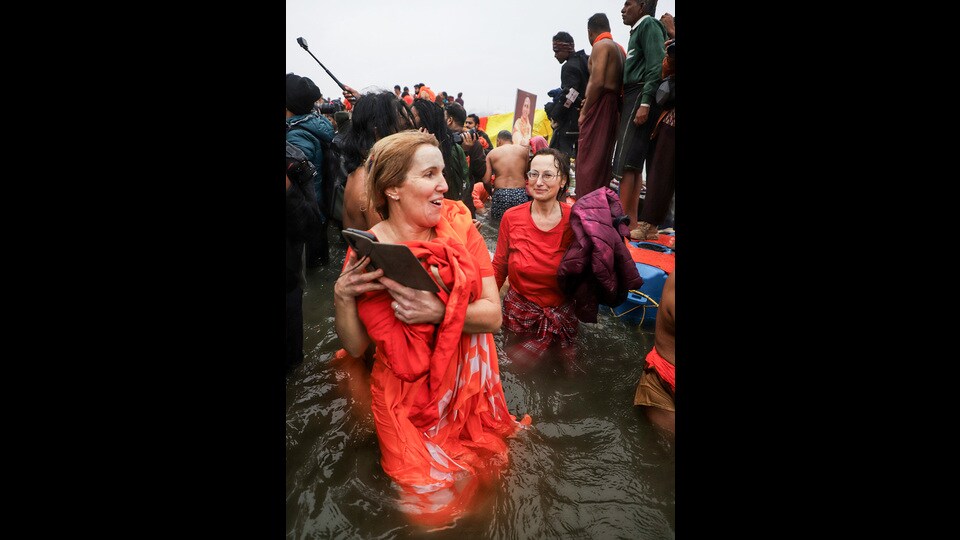
As globalisation and the internet have bridged cultures, the Kumbh has gained global attention, inspiring a growing number of international visitors each time it is held. Whether through social media, travel documentaries, or personal stories shared by fellow travelers, the event has become a beacon for those seeking a deeper spiritual connection and an opportunity to partake in a transformative experience.
Tallulah, 25, from Britain, arrived in Sangam city to be a part of the Mahakumbh. “I’m here to stay for more than 15 days as this is my first experience. Back home, mainly the Hindu communities are aware of Kumbh, but I doubt if the British know about this event and its wide canvas.”
Foreign visitors like Tallulah are often drawn to the Kumbh for the opportunity to bathe in the sacred Ganges, listen to teachings from revered Sadhus, and absorb the energy of the event.
“I’ve had the blessing of being in the presence of Sadhus and hearing their teachings. It’s been incredibly special. It is for the second time that I have come to India, and I really found solace in Rishikesh,” she said. When asked which global event comes to her mind if she were to compare it to the Mahakumbh, her answer was the Olympics in terms of scale and the number of people, or the Rio Carnival.
For many, such lifelong aspirations are only now being realized as increased access to information has made the Kumbh’s significance more widely known.
Karen Neumann, 58, who adopted the Indian name Krishnapriya, is a Sevak at Parmarth Niketan. She is from the USA and plans to stay for eight days. “I’ve been dreaming of attending the Kumbh Mela since the 1990s. Decades ago, I came upon a brochure for the Kumbh in a bookstore. Though I knew very little about India, the image of a Sadhu standing in the Ganga among thousands of other people caught my attention. It said, ‘Come bathe in Mother Ganga.’ In that moment, I said to myself, ‘One day, I’ll go there.’ Now, after 30 years, that dream is about to come true, and I couldn’t be more excited.”
Rohan James Maclaren, 36, from Australia, will be staying in Prayagraj for five weeks. “I am a Sevak at the Parmarth Niketan Ashram, and we are hosting a large camp at the sacred Sangam. Much of our ashram has temporarily relocated to this Kumbh camp, where we will conduct a variety of seva initiatives, including medical camps that will serve tens of thousands of people, as well as events bringing together Indian leaders to address critical societal issues. During this time, Kumbh will become the spiritual capital of the world—a place of divine opportunity to serve this great country in countless ways.”
Sadhvi Bhagawati Saraswati, 53, a spiritual leader, best-selling author, and social activist from America, is staying for the full duration of the Kumbh. For her, the Kumbh is more than just an event—it is the soul of India brought to life. It represents the eternal truth of connection, faith, and devotion.
“For me, attending the Kumbh is an opportunity to immerse myself in this divine confluence of rivers, spirits, and sacred traditions. It’s about being part of something timeless, something that transcends the boundaries of culture and nationality,” she said.
This Sadhvi claimed that she has been blessed to experience every Kumbh in both Prayagraj and Haridwar since 1998! “I have even experienced the Ujjain and Nashik Kumbh. However, every Kumbh feels like a new chapter in a never-ending story of devotion and grace. Each time, I feel like a pilgrim discovering the sacred for the very first time,” she said.
Originally from Los Angeles, California, Sadhvi Bhagawati Saraswati has lived in Rishikesh, India, for almost 30 years. “I came at the age of 25 with a backpack! I had graduated from Stanford University and was in the midst of completing my PhD when I came for what I thought would be a travel break! But when I got to the banks of Maa Ganga, I knew I had found my home! Each day here deepens my love and reverence for this sacred land. Every visit, every moment spent here, feels like coming home,” she said.