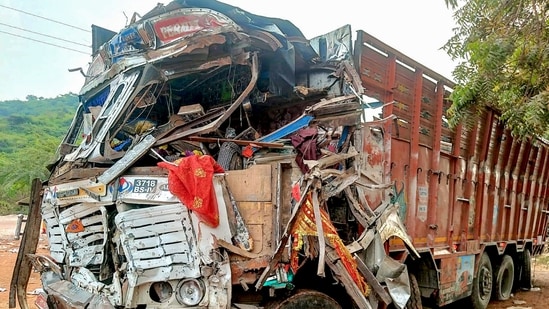
The driver of the truck that crushed 15 people to death near a temple in Gwalior on Sunday allegedly used Google Maps to avoid paying ₹3,000 in toll tax, police said on Monday, adding that the vehicle lost control after its brake pressure dropped on a sloping curve.
Wreckage of a truck after it ploughed into several devotees before crashing into a temple's entry gate, in Gwalior, Madhya Pradesh. (PTI)
{{^htLoading}} {{/htLoading}}
According to police, driver Dilbag Singh told investigators that he lost control around 50 metres from the shrine, mowing down devotees waiting in a queue and ploughing through prasad stalls before crashing into the temple gate.
{{^usCountry}}{{/usCountry}}
“He tried to stop the truck just 50 metres away at the police check post, but by then the truck had gone out of control on the sloping curve leading to the temple. He said pressure reduced a lot,” Gwalior superintendent of police Dharamveer Yadav said.
The SP said Singh, who had been driving heavy vehicles for four years, was unfamiliar with the route. Police have arrested Singh and truck owner Harpreet Singh from Ludhiana. The trucks, travelling together, were carrying paddy from Dabra grain market to Punjab.
{{/usCountry}}
{{#usCountry}}
The SP said Singh, who had been driving heavy vehicles for four years, was unfamiliar with the route. Police have arrested Singh and truck owner Harpreet Singh from Ludhiana. The trucks, travelling together, were carrying paddy from Dabra grain market to Punjab.
{{/usCountry}}
Police also found alleged negligence at a check post 500 metres from the temple, where two constables were reportedly absent. The driver was not intoxicated, the SP said, adding that a mechanical forensic report was awaited.
Chief minister Mohan Yadav announced compensation of ₹4 lakh for each deceased victim’s family, ₹2 lakh for the seriously injured and ₹50,000 for other injured people. Eight policemen were suspended and city SP Ravi Bhadauria transferred. A departmental inquiry has been ordered.
I have spent over a decade chronicling Madhya Pradesh’s political and social landscape, covering politics, investigative journalism, crime, human interest, and government policy, blending sharp insight with ground‑level depth. I have closely tracked three assembly elections, three Lok Sabha elections, leadership transitions in MP while exposing governance lapses, tender irregularities, and flawed policy rollouts. My reports have revealed gaps in the Cheetah project, irregularities in medical education, rigging in recruitment exams, and loopholes in policy implementation. In crime reporting, I have moved beyond FIRs to map systemic patterns — from organised crime networks and gender‑based violence to custodial accountability — balancing urgency with sensitivity. My journalism is defined by a commitment to human interest. I have profiled the marginalised Bancchda community, documented atrocities against tribal groups, and highlighted efforts to preserve their culture through heritage liquor and revival of spiritual practices. I have reported on farmers struggling with failed MSP promises, giving voice to those often reduced to statistics in policy files. Passionate about field reporting, I have reported on rampant sand mining in Chambal and Narmada, pharmaceutical companies supplying medicines under altered names, the dire condition of schools and colleges, the plight of commercial sex workers, and skewed sex ratios in specific districts. Beyond deadlines, and as HT’s state correspondent and assistant editor in Madhya Pradesh, I engage with ministers, farmers, students, and activists, believing the best policy stories begin with a single human voice. A postgraduate in Journalism and Mass Communication, I also hold a diploma in sports journalism.