
 E-Paper



Google Maps, design flaw or AAP-era planning? Barapullah traffic mess triggers blame game
The Phase-III corridor connects Mayur Vihar Phase-I on Noida Link Road with Sarai Kale Khan on Ring Road and was expected to ease congestion significantly.

 Prefer HTon Google


It hasn't been long since the Barapullah Phase-III flyover was thrown open to the public, but instead of becoming a means to ease congestion, it is in focus over a traffic mess.
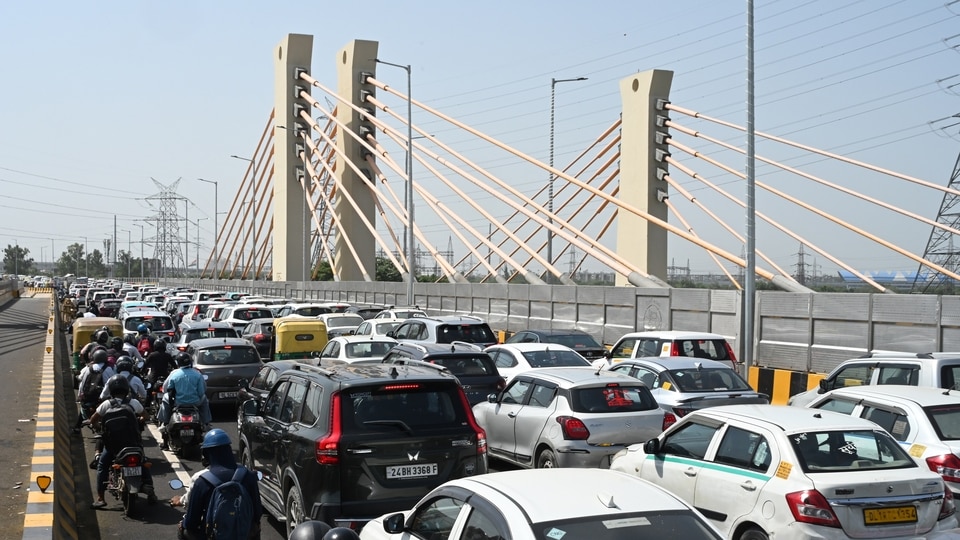
While the Delhi Traffic Police and the Public Works Department pointed to multiple factors behind the congestion, BJP minister Parvesh Verma blamed the previous Aam Aadmi Party (AAP) government for the project’s design and planning.
The finger-pointing has also turned to Google Maps. The traffic police and PWD officials allege that the navigation platform hasn't been reflecting real-time congestion, leading more commuters to the already-busy route.
“Cause: Congestion on Barapulla Phase-III is not being reflected on Google Maps, due to which commuters are continuing to use this route. This has resulted in heavy traffic and a bottleneck at Barapulla Junction,” the Delhi traffic police said on Wednesday.
ALSO READ | Barapullah Phase-III gridlock: Traffic Police ask PWD to redesign merger point | Exclusive
Traffic police blame structural bottleneck
The Delhi Traffic Police on Monday said the primary reason for the congestion was a structural bottleneck on the Old Barapullah Flyover. On X, the department said: “Main cause of traffic jam after opening of Barapullah Phase-III is structural bottleneck at Old Barapullah Flyover.”
The post was later deleted.
Joint commissioner of police (traffic) Sanjay Tyagi told HT that the post was taken down “just to verify the facts.” He said an aerial survey on October 1 identified the abrupt merger of the new flyover with the existing Barapullah corridor near the Sundial as a bottleneck.
“Following our aerial survey on October 1, we had already pointed out that the abrupt merger of traffic of the new flyover with the existing Barapullah corridor near the Sundial is leading to the formation of a bottleneck and that there is a significant mismatch in lane capacity at the merging point, with multiple streams of traffic converging towards the existing Barapullah flyover, which has competitively limited lane capacity,” Tyagi told HT.
Earlier, the traffic police said multiple streams were merging into a narrower stretch, with inaccurate navigation data further aggravating the congestion. To ease pressure at Barapullah Junction, traffic from Phase-III is being diverted towards NH-24/DND, with personnel deployed to regulate movement.
ALSO READ | In letters to PWD, Delhi traffic police seeks design changes on Barapullah Phase-III
This had come amid reports of severe congestion, including a nearly 2-km jam from Mayur Vihar towards AIIMS, with an ambulance also reportedly stuck.
PWD says Google Maps is adding to the problem
The PWD is yet to finalise a plan to address the recurring congestion. A PWD official told PTI that merging issues were contributing to the problem, while inaccurate Google Maps data was also worsening the situation.
"There is some misinformation on Google Maps; apparently, it is not updating real-time traffic information for commuters to properly navigate, causing more congestion on the stretch," the official said.
ALSO READ | Barapullah Phase III: A decades-long traffic plan left to solve a 2026 problem in Delhi
A recent meeting between the PWD, traffic police and NHAI failed to yield a final solution. Parvesh Verma said the department was in touch with Google Maps.
"Google Maps algorithm takes around 15 days to update the traffic situation of a road, so that will happen soon; we are in touch with them," Verma said.
BJP minister blames AAP-era planning
Delhi PWD minister Parvesh Verma blamed the previous AAP government for the project’s design, saying the current administration was working to rectify the shortcomings.
"We recently held a meeting and discussions were on short-term and long-term solutions that have been suggested by traffic police; we will work on that," Verma said, as per PTI. "All tender specifications, technical feasibility were done by the AAP government. How can this be our design fault?" he added.
Verma said the PWD would address the faults "as soon as possible", with administrative issues already resolved.
The phase-III corridor was opened to the public on September 29 after several years of delays. Built at a cost of ₹1,635 crore, the new elevated road connects Mayur Vihar Phase-I on the Noida Link Road with Sarai Kale Khan on Ring Road. It was designed to merge with the existing Barapullah network, creating a continuous 10-km, signal-free corridor up to the AIIMS roundabout.
The project was expected to ease pressure on the Delhi-Noida Direct Flyway and Akshardham stretches and reduce travel time between east and south Delhi. Instead, commuters have faced daily traffic snarls since its opening.


