With the giant pair of faux lungs installed at a busy junction of Ludhiana on November 30 turning dark black from chalk white in just nine days is raising concerns amongst citizens about the health impacts of breathing in polluted air.
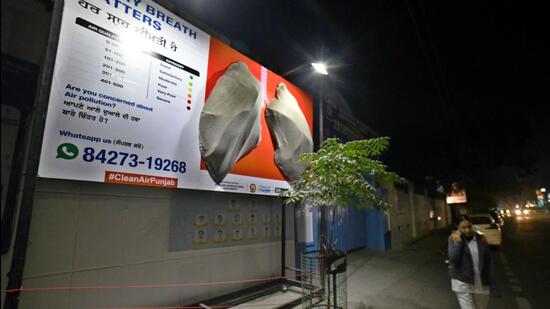
As a part of the larger campaign initiated by the Clean Air Punjab, along with EcoSikh, BCM Arya Model Senior Secondary School and Punjab Agricultural University (PAU), the lungs billboard has been installed to raise awareness about deteriorating air quality in the Malwa belt. Titled ‘The Billboard that Breathes’, these ‘artificial’ lungs were put up outside the BCM Arya Model Senior Secondary School, Shastri Nagar.
Experts, as well as local residents from Ludhiana, have asked the Punjab government to consider this ‘experiment’ as a warning bell and take strong measures to improve the air quality in the area.
According to Gurpreet Kaur, campaign manager, EcoSikh, the lungs billboard turning black in a week should be an eye-opener for all to imagine what’s happening to residents’ lungs. “We are fully aware of the worsening air quality in Ludhiana. We expect that efforts to lower pollution levels will be coordinated by the government and the general public as the health of many are at stake due to the toxic air,” she said.
Over a thousand students and educators visited the lungs billboard last week and voiced their concerns about the increased air pollution. Meanwhile, the billboard has also drawn the attention of locals who have been making a beeline to the billboard. Local residents like Anju Chhabra who visited the lungs billboard called it one of the best ways to depict the health impacts of air pollution to create mass awareness.
{{/usCountry}}Over a thousand students and educators visited the lungs billboard last week and voiced their concerns about the increased air pollution. Meanwhile, the billboard has also drawn the attention of locals who have been making a beeline to the billboard. Local residents like Anju Chhabra who visited the lungs billboard called it one of the best ways to depict the health impacts of air pollution to create mass awareness.
{{/usCountry}}Principal of BCM Arya Model Senior Secondary School Anuja Kaushal lauded the efforts by Clean Air Punjab for taking steps to raise much needed awareness on air pollution and suggested that adopting sustainable steps in daily routine is the need of the hour.
“Rising air pollution is a wake-up call for everyone to adopt preventative measures to minimise health risks,” said environment manager of BCM Arya School Vipra Kal.
‘A smart idea to demonstrate damage’
Senior pulmonologist, DMC, Ludhiana, Dr Akashdeep, said using these white ‘breathing lungs’ turning black to represent the damage caused by the hazardous particles that are deposited in our lungs to demonstrate how pollution is damaging people’s lungs was a smart idea.
“The number of people complaining of shortness of breath, a persistent and recurrent cough, chronic bronchitis, obstructive airway disease, rhinitis, cancer, cardiovascular disease, and high blood pressure is closely correlated with the amount of pollution,” he said.
Dr Amandeep Bains said, “The litmus test came positive regarding the air condition of Ludhiana. Lungs installed before BCM turned black within a week that too when they were installed in an area of the city which is away from factories and major roads. This is an emergency which is not being announced because of vested interests of a few.”
A similar pair of lungs installed at Mumbai in January 2020 took 14 days to go black, while one installed in Delhi in November 2018 just took six days to go black.
What are these ‘lungs on billboard’?
The chalk- white lungs have been created using HEPA (High Efficiency Particulate Air) filters. The same filters are used inside the operation theatres, anti-pollution masks and other places to trap dust. The lungs have also been fitted with fans that will suck in air to mimic the functioning of lungs while breathing.
As pollution rises, the particulate matter from dust pollution and vehicular emissions begins getting trapped in the HEPA filters which leads to the lungs changing colour from chalk-white to brown to black.