
Sign in

MCG shares WhatsApp helpline numbers to report waste burning

In Gurugram, waste burning has been a serious issue for the last several years. Residents have alleged that toxic fumes hang heavy in the air, posing serious health risks

Updated on: Apr 19, 2024, 05:26:00 IST
Share
Share via
  • facebook
  • twitter
  • linkedin
  • whatsapp
Copy link
  • copy link

Gurugram: The Municipal Corporation of Gurugram (MCG) on Thursday shared three WhatsApp numbers —7290097521, 7290076135 and 7290088125— for city residents to register their complaints regarding waste burning and improper sanitation, officials, aware of the matter said.
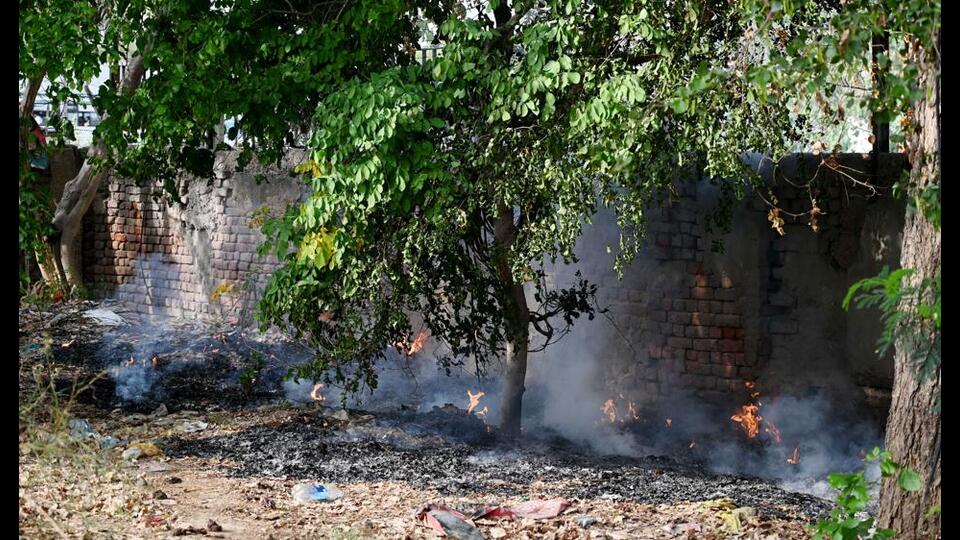
Garbage burning in an open area at Sector-38 in Gurugram. The Municipal Corporation of Gurugram (MCG) on Thursday shared three WhatsApp numbers for residents to register their complaints regarding waste burning and improper sanitation. (PARVEEN KUMAR/HT PHOTO)

MCG officials said they will also review the reports compiled by sanitation officers after mapping the prime spots.

In Gurugram, waste burning has been a serious issue for the last several years. Despite repeated warnings and appeals by the civic agency, waste burning remains a common sight in many prime areas. Both household trash and industrial waste is burnt in the open. Residents have alleged that toxic fumes hang heavy in the air, posing serious health risks. Complaints of respiratory ailments have soared, and the city’s once-pristine environment is now shrouded in pollution. Efforts to curb waste burning by civic agencies have yielded no results. In the past, the authorities have levied penalties, issued warnings but enforcement of these has not been adequate.

MCG joint commissioner Naresh Kumar said that they have released and circulated these WhatsApp numbers to curb the menace of waste burning across the city. “The idea is to resolve the issue and spread awareness so that people stay alert and send the pictures and videos immediately on these numbers so that prompt action can be taken,” he said.

Kumar said the agency has begun mapping certain areas across the city.

“We have been asking people not to burn waste in the open but in some areas, the residents collect horticultural waste and burn it in the evening. The sanitation agencies have also been directed not to take short-cuts but their workers too, often flout norms,” he said.

MCG officials said that they have urged all residents to follow proper waste disposal methods, including recycling and disposal through authorised channels. “To report instances of waste burning, people can share the location, pictures or a video. A team will connect within five minutes and will reach the spot within 15 minutes to address the issue,” said the joint commissioner.

Gurugram residents, however, said that these numbers were just an eyewash and there is no mechanism in place with which the MCG can control this menace. “A number of such helpline numbers have been issued by the MCG in the past, but there is often no response on these helplines. On waste burning, the MCG only needs to ensure that waste does not land up on the roads or vacant plots on green belts. Waste management guidelines clearly emphasise waste segregation as the first step followed by resource recovery. Recovery will only be possible when every ward has a functional system. Why is MCG not implementing those systems and SOPs already in place,” said Bhawani Shankar Tripathy, vice president, RDWA Sector 23A.

Ruchika Sethi Takkar, founder-member of ‘Why Waste Your Waste’, a civil society movement for a zero-waste city, said that burning waste for many is still the standard way of managing waste.

“Helplines can be used if we have a proper waste management system in place and these are few and sporadic. The district administration should accept that rampant waste burning is a health hazard and roll out an emergency plan, including creating health awareness amongst all. They should also set up multiple dry waste centres for sorting and waste processing,” she said.

  • Leena Dhankhar
    ABOUT THE AUTHOR
    Leena Dhankhar

    Leena Dhankhar is Senior Editor and Bureau Chief, Gurugram, at Hindustan Times, where she has spent over 17 years chronicling the transformation of one of India's fastest-growing urban regions. From starting her career as a crime reporter to leading the Gurugram bureau, her journalism has been defined by investigative reporting, in-depth storytelling and an unwavering focus on public interest. Over nearly two decades, she has reported extensively across crime, politics, civic governance, elections, real estate, environment, courts, sports, education and entertainment, covering Gurugram, Faridabad, Nuh and Palwal. Her reporting has exposed several major scams and systemic failures, including insurance frauds, waste management irregularities, illegal arms manufacturing units in Nuh, illegal mining in the Aravallis, organised crime networks and governance lapses affecting millions of residents. Known for her investigative work and exclusive stories, Leena has reported on high-impact national issues, including the Nicaragua charter flight carrying Indian migrants that was turned back amid allegations of human trafficking, exposing the growing network of illegal immigration rackets. Her work has also focused on gang wars, prison administration, juvenile crime, women and child protection systems, the functioning of the Juvenile Justice Board and Child Welfare Committee, and environmental challenges such as pollution, waterlogging and deteriorating civic infrastructure. Beyond hard news, Leena has extensively documented Haryana's rich heritage, forests and wildlife, bringing attention to the state's historical landmarks, biodiversity, conservation efforts and ecological challenges through immersive reportage and feature writing. Her journalism has consistently gone beyond breaking news. She has documented Gurugram's rapid urbanisation through long-form narratives and enterprise reporting on issues ranging from pothole-ridden roads, flooding and waste management to the changing social fabric of India's Millennium City. She also writes widely read feature columns, including The Outsider, Changemaker, and Concern for Gurugram, profiling people, places and ideas shaping the city's identity. Leena is the author of Gurugram School Murder, published by Juggernaut Books, a deeply reported account of one of India's most high-profile school murder investigations. She is currently working on her second book, an investigative work exploring some of India's most significant scams and fraud investigations. Beyond print journalism, she has expanded her storytelling through public speaking and digital media. She is a TEDx speaker and has produced podcasts exploring Gurugram's transformation, civic challenges and untold stories. Her work reflects a commitment to narrative journalism that combines rigorous reporting with compelling storytelling. A law graduate with an MBA in Human Resources, Leena brings a multidisciplinary perspective to her reporting, particularly on governance, public policy and legal affairs. She has travelled extensively across India to pursue investigative assignments, often reporting from remote locations and conflict-prone areas in search of stories that matter.Read More