For children at Jhuljhuli village, located on the Delhi-Haryana border in southwest Delhi, agricultural fields surrounding the village double up as playgrounds.
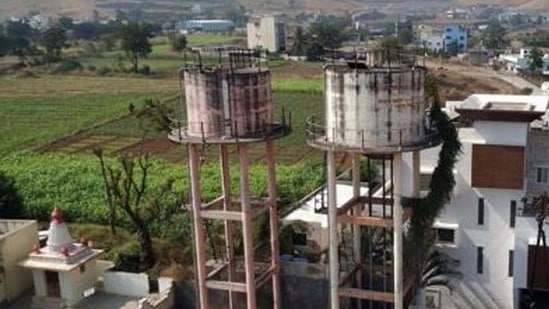
Residents said a dedicated playground is just one among many social and civic infrastructure missing in this congested rural village, which was declared urbanised in 2017 for the implementation of the land pooling policy.
“A playground, community centre, school and space for housing, are among our top demands. But for years, our needs have been ignored by various government agencies,” said Jitendar Yadav (30), a member of the village’s resident welfare association.
Two kilometres from Jhuljhuli is Rawta, a rural village in the greenbelt area, where a group of 50-odd people, mostly youth, have been working hard for the past six years to address basic problems such as sanitation, drainage, and other essential services for their village.
Rajnish (33), an architect from Rawta, said, “While elaborate plans have been worked out for the city’s development, little has been done for rural villages in the past decades despite provision of a comprehensive development scheme for villages in MPD-2021.”
The new draft Master Plan of Delhi-2041 prepared by the Delhi Development Authority (DDA), villagers said, has once again failed to address problems faced by villages, especially rural villages.
{{/usCountry}}The new draft Master Plan of Delhi-2041 prepared by the Delhi Development Authority (DDA), villagers said, has once again failed to address problems faced by villages, especially rural villages.
{{/usCountry}}Rajnish, Yadav and a few youngsters from their and neighbouring villages, brought together by Paras Tyagi (32), who runs the Centre for Youth Culture and Law and Environment - a public policy research organisation working in the rural and urban villages of Delhi, have taken upon themselves to put their villages back on the planning and development map. They have prepared a comprehensive Village Development Plan (VDP) for Jhuljhuli and are working on a plan for Rawta.
The VDP proposes setting aside land falling within 150-200 metres outside the periphery of the village for residential, commercial, dairy and educational purposes. It also demands dedicated space for schools, banks, commercial and community centres as part of the plan.
In the absence of development control norms for these villages, the MPD-2021 had sought a plan for development of villages but there has been no movement in this front so far. According to residents, MPD-2041 too has little with regard to development of over 300 villages, especially rural, in the Capital.
Rajnish said, “The plan has been prepared using planning tools to ensure sustainable development of villages even after new developments come up. We have made provision for a green buffer also.”
“Issues related to livelihood, social infrastructure etc have to be taken into consideration while planning any new developments. There are no lessons learnt from the past experiences. Villages which were urbanised in the 70’s and 80’s are suffering because of lack of basic infrastructure and have fallen victim to rampant urbanisation. We want DDA to come up with a plan similar to the VDP for the villages,” said Tyagi.
Among one of the biggest problems cited is housing, which the group says has suffered due to a rise in population and a space crunch brought about by a lack of development norms over the years.
Ram Niwas Sharma (65), a retired central government employee who has agricultural land in Jhuljhuli, said, “The residential limits (referred as lal dora in revenue records) of the village have not been redefined for decades while the population has increased. A majority of houses are constructed on small plots. There is no scope for further construction. Where will people live?”
Preeti Yadav (24), a resident of Jhuljhuli and a teacher with a private school, said that children in the village still have to travel till Najafgarh, almost 15 kilometres away, to attend school, college and for coaching. “Little has changed over the years,” said Preeti Yadav.
Jhuljhuli is one of the 95 urbanised villages where the DDA’s ambitious land pooling policy will be implemented. The policy is aimed at providing 17 lakh dwelling units to meet the city’s housing requirement and ensuring planned development in Delhi’s urban extensions. While the policy envisages villagers to pool in their agricultural land parcels, the latter wants the DDA to first plan for their development.
Tyagi said they will submit the VDP to the DDA soon. “We will also conduct a signature campaign from each village,” he added.
Five years in the making
Tyagi (32), who holds a degree in public policy and is a resident of the urbanised Budhela village, started working with rural villages in Delhi to educate and mobilise residents to improve their quality of life. What started as a one-man initiative five years ago now has a large network of people from various villages (both urban and rural) in Delhi.
Tyagi said that villagers are aware of the issue but most are not tech-savvy. He added that it is the younger generation which is trying to improve the situation by raising issues.
“Unfortunately, city planners are unaware of the ground realities. Some of the villages that are part of the land pooling policy have very little land left and there are several unauthorised colonies that have come up over the years. Development of new areas can’t be at the cost of these villages,” said Tyagi.
Sabyasachi Das, former commission planning in-charge with DDA, welcomed the VPD and said something similar was attempted by the DDA in Dwarka in early 2000.
He said the land-owning agency had prepared development plans in a 150-200 m radius from the periphery of four villages in Dwarka, with the help of locals. “But the plans could never be implemented as villagers didn’t agree with the land adjustments which had to be made to provide for passage of emergency vehicles by widening the village road etc. We had planned for schools, community centre etc in the buffer zone around the village.”
“There are several issues in the land pooling policy which need to be addressed. For getting contiguous land parcels, which is essential for comprehensive and services planning, provisions need to be made in Delhi Development Act,” he added.
When contacted, a senior DDA official said the agency is “planning for infrastructure for the entire area”. “In the planning of the sectors under land pooling, the social and civic infrastructure requirement of the participating villages will be catered to in the sector itself,” said the official.