Odisha chief minister Naveen Patnaik and his Andhra Pradesh counterpart YS Jagan Mohan Reddy on Tuesday decided to set up an institutional mechanism to deliberate on a host of interstate disputes, including the long-pending water dispute issue over the construction of the Neradi barrage over Vamsadhara river, officials said.
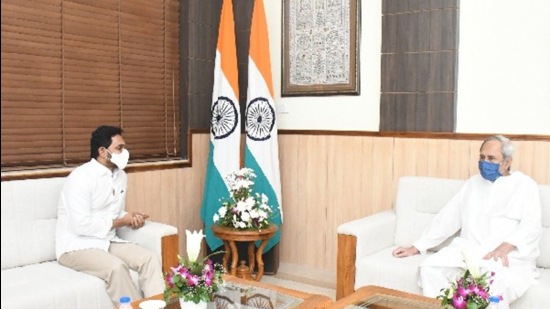
Reddy, who flew down to Bhubaneswar on Tuesday afternoon, held a meeting with Patnaik in Kharavela Bhawan where both decided to work closely to resolve the contentious issues in the fields of water resources, boundary, energy and Left-wing extremism.
A joint statement issued by Patnaik and Reddy after their meeting said that they have decided to work in cooperation with each other to solve all the issues amicably. The joint statement said the issues over disputes regarding Kotia group of villages, Neradi barrage, Jhanjavathi reservoir, Polavaram, the release of water for Bahuda river and mutual NOCs for the Balimela and Upper Sileru in the energy sector were discussed.
“The chief secretaries of both the states will set up an institutional mechanism to deliberate on outstanding issues and find a solution that is in the best interest of the people
of Odisha and Andhra Pradesh,” the joint statement said.
{{/usCountry}}of Odisha and Andhra Pradesh,” the joint statement said.
{{/usCountry}}Officials said among all the issues, the discussion on the construction of the Neradi barrage over Vamsadhara river took precedence as Odisha has filed clarification before the Vamsadhara Water Disputes Tribunal and Special Leave Petition (SLP) before Supreme Court objecting to the final orders of the water tribunal. In September this year, the Supreme Court sought a response from the Andhra Pradesh government after the Odisha government challenged the September 2017 orders of the tribunal allowing the Andhra Pradesh government to construct the Neradi barrage across the river with ancillary structures.
With the SLP due for hearing in SC this month, Reddy had recently written to Patnaik seeking his cooperation in the construction of Neradi barrage by publishing the final orders of the tribunal in the state’s official Gazette under ISRWD Act 1956.
The Neradi barrage being constructed over Vamsadhara river would help irrigate 2.5 lakh acres in Srikakulam district. In 1977, the AP government constructed the Gotta Barrage under Phase 1 of the project to utilise 30 thousand million cubic feet of water to irrigate nearly 2 lakh acres of land. Under Phase 2, the construction of Neradi barrage, about 48 km upstream of Gotta barrage was proposed. The barrage is also expected to provide water to 30,000 acres of land in Odisha.
But Odisha government has been opposing the project arguing that it would leave hundreds of acres of many farmlands in Rayagada and Gajapathi districts submerged. The Vamsadhara river originates in Kalahandi district of Odisha and joins the Bay of Bengal at Kalingapatnam in Andhra Pradesh. While 154 km of the river lies in Odisha, 82 km flows in Andhra Pradesh.
The water dispute led to the formation of Vamsadhara Water Disputes Tribunal in 2010 which in its final order in 2017 allowed the Andhra government to construct the barrage and directed Odisha to acquire 106 acres of land in Odisha and hand it over to Andhra for construction. The tribunal also ordered the yield of 115 TMC of the river at Gotta barrage should be shared equally by both states.
Despite the tribunal’s orders, the Odisha government has not made any land acquisition. Amid the ongoing dispute, the Andhra Pradesh government built a side weir in 2018 to utilise 8 TMC of water of the 70 TMC that was going unused.
The two chief ministers also discussed Jhanjabati and Polavaram projects that have become a major source of dispute between Andhra and Odisha. Though Andhra plans to use 4 TMC water from Jhanjabati river to irrigate over 24000 acres of land in Vizianagaram district, Odisha has been objecting to it arguing that several tribal villages will be submerged.
Polavaram project, an under-construction multi-purpose project on the Godavari river in Andhra Pradesh is also being opposed by Odisha with the Naveen Patnaik government arguing that it would lead to submergence and displacement of several villages in the state. First envisaged by the British in 1941, the Polavaram project aims to construct a dam on the Godavari River and divert large quantities of water through a 174-km link canal to the Krishna River. The matter concerning the height of the proposed dam and reconstruction of the reservoir without the consent of the Odisha government is now pending before the SC.
The two chief ministers also discussed the dispute over villages in Kotia grampanchayat of Koraput district of Odisha that escalated since last year. In August this year, the Supreme Court advised the Odisha and Andhra Pradesh governments to resolve the dispute over ownership of border villages through mutual discussions following a contempt petition filed by Odisha.
Of the 28 villages in Kotia gram panchayat, Odisha did not survey 21 villages when it was formed in 1936. The same 21 villages were also not surveyed by Andhra Pradesh when it was formed leading to a dispute over these bordering villages.
The Supreme Court in 1968 first ordered maintenance of status quo in the disputed area and in 2006 the apex court passed a permanent injunction on the disputed area. However, the dispute escalated when Andhra Pradesh on March 5 last year issued notification for panchayat elections in 3 of the villages in Kotia and held polls in February this year. Odisha told the court that these villages are under its administrative control and in the 2019 elections, the Kotia villages voted as part of Koraput Lok Sabha constituency and Pottangi assembly segment in Odisha.
The two chief ministers said the states will work towards setting up a chair for Odia and Telugu languages in BR Ambedkar University, Srikakulam and Berhampur University, respectively. Besides, the appointment of language teachers in schools in border districts of the two states, supply of books and conduct of language examination will also be taken up to promote brotherhood.
Both the states will continue the legacy of mutual cooperation and in the true spirit of federalism discuss issues between the two states.
...