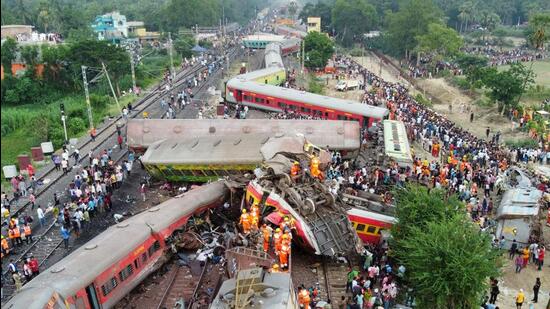
Authorities on Friday morning began the demolition of a school building, where bodies of those killed in the train crash at Bahanaga in Odisha's Balasore last week were kept, saying the students were reluctance to return to the institute as it served as a makeshift morgue.
The crash scene is about 100 metres from the Bahanaga High School. (REUTERS)
{{^htLoading}} {{/htLoading}}
The crash involving three trains, including Chennai-bound Coromandel Express, left 288 people dead about 100 metres from the Bahanaga High School.
Rajaram Mohapatra, a school managing committee member, said the rooms where the bodies were kept were sanitised but the students and their parents remained unconvinced. "Once the new building is ready, a priest would sanctify the place so that the children are not scared after the opening of the school."
A teacher at the school told news agency ANI the collector visited the building the day before. “There is nothing to be scared of… no spirits here. It's just superstition. Still, this will be taken down and a new building will be built.”
{{/usCountry}}
{{#usCountry}}
A teacher at the school told news agency ANI the collector visited the building the day before. “There is nothing to be scared of… no spirits here. It's just superstition. Still, this will be taken down and a new building will be built.”
{{/usCountry}}
{{^htLoading}} {{/htLoading}}
On Thursday, Balasore district collector Dattatraya Bhausaheb Shinde visited the school and said it would be demolished if the committee submits a resolution. The committee accordingly submitted the resolution following which the demolition started.
Schools in Odisha are due to reopen on June 19 after summer break.
Blood-soaked and dismembered bodies were kept in three of the rooms at the school for identification.
Odisha school and mass education department secretary Aswathy S said that counselling of students and teachers will also be organised. "Many of the teachers took part in shifting of the bodies. So they would also need to be counselled," she said.
Debabrata Mohanty is a senior assistant editor of Hindustan Times who works as state correspondent from Odisha covering the state's politics, governance, public policy, natural disasters, environment and its society for close to three decades. With his long years of reporting from the state capital of Bhubaneswar, Mohanty has been known as one of the most experienced and credible journalists covering Odisha for the national English dailies. His reporting combines on-ground detail with deep institutional knowledge detailing the state's changing politics, governance issues, administrative reforms and the functioning of its public institutions. He has regularly reported on issues ranging from legislative developments and public policy implementation. Politics is his core areas of expertise as he closely tracks Odisha's political landscape, including the rise and transformation of the Bharatiya Janata Party (BJP), the Biju Janata Dal (BJD), the two principal political parties in Odisha. His long association with the state's political establishment enables him to write on contemporary developments in a larger political context. Mohanty takes a deep interest in writing human interest stories, environmental issues and documenting the impact of cyclones, floods, heatwaves, and other climate-related events in one of the most disaster-prone states. His coverage extends to public health, governance reforms and stories on accountability of government institutions. Before joining Hindustan Times, Mohanty worked with The Indian Express, Mail Today, and The Telegraph, where he covered at least six general elections and as many assembly elections. In 2007, he was selected for the prestigious Chevening Young Indian Print Journalist Programme at the University of Lincoln, United Kingdom, where he received advanced training in print journalism. In 2009 he won the Press Institute of India-International Committee of Red Cross award on conflict reporting for his on-ground reportage of 2008 Kandhamal riots.
Get the latest India News, breaking headlines, and real-time updates from across the nation. Stay informed on politics, government policies, crime, weather, and CEC Gyanesh Kumar row Live.
Get the latest India News, breaking headlines, and real-time updates from across the nation. Stay informed on politics, government policies, crime, weather, and CEC Gyanesh Kumar row Live.
Home/India News/Odisha school that held train crash bodies razed over 'superstition' | VIDEO
{{^htLoading}}
Advertisement
{{/htLoading}}
SHARE THIS ARTICLE ON
{{#usCountry}}{{/usCountry}}
Notifications
Get breaking alerts directly from the newsroom
Notifications are on!You'll be notified when news breaks