
 E-Paper



AI model enables early wheat yield prediction, aiding farm decisions
Scientists have developed AI-based system that can predict wheat yields early and with high accuracy using handheld field sensors and deep learning

 Prefer HTon Google


Scientists have developed an AI-based system that can predict wheat yields early and with high accuracy using handheld field sensors and deep learning, a development that could strengthen India’s food security planning.
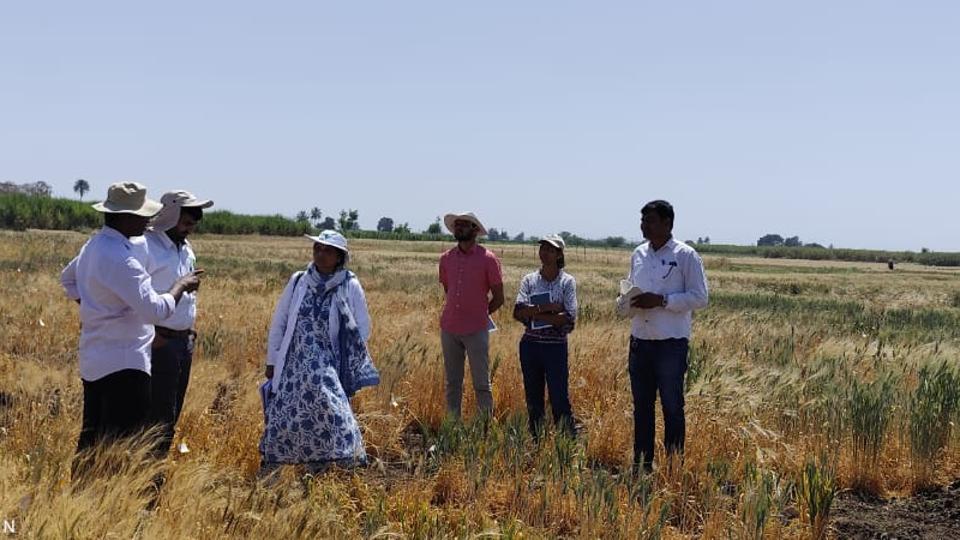
Published on February 25, 2026, in Theoretical and Applied Genetics, the study outlines a framework that combines real-time field data with advanced AI to improve crop forecasting precision.
The research was led by Gyanendra Pratap Singh, director of ICAR–National Bureau of Plant Genetic Resources (NBPGR), with principal scientist Jyoti Kumari and Girish Kumar Jha from ICAR–Indian Agricultural Statistics Research Institute (IASRI). Pune’s Agharkar Research Institute (ARI) scientists Sudhir Navathe and Yashavantha Kumar, along with ICAR–Indian Agricultural Research Institute (IARI) teams, were key collaborators.
Accurate yield estimation is vital for managing food supply, stabilising markets, and guiding policy. Traditional methods, satellite imagery and statistical crop models face challenges such as cloud cover, low resolution, and limited ability to capture complex interactions between weather, soil, and genetics.
To address these gaps, researchers developed a hybrid AI framework called the Genetic Algorithm-Optimised Deep Neural Network (GA-DNN). The model combines deep neural networks, which detect complex patterns in large datasets, with genetic algorithms that optimise model parameters through principles of natural selection.
“This system continuously improves its predictive accuracy while learning intricate relationships between plant traits and final grain yield,” said Navathe.
Unlike conventional approaches, the study relied on proximal sensing, handheld or vehicle-mounted devices like GreenSeeker sensors, to collect real-time field data on NDVI (plant greenness and vigour), canopy temperature (plant stress), and plant height (biomass growth).
The AI was trained on data from 3,350 wheat genotypes grown under irrigated and rain-fed conditions in New Delhi and Pune. NDVI readings at three key growth stages, ground cover, flowering, and maturity, were the most reliable predictors of yield. GA-DNN outperformed conventional machine learning models and maintained high accuracy even under rain-fed conditions.
“This framework can be integrated into digital advisory platforms for real-time decisions on irrigation and nutrient management,” Navathe added.
The system offers multiple benefits: breeders can identify high-performing varieties early, farmers gain reliable pre-harvest yield estimates, and policymakers can make more accurate production forecasts for procurement and storage.
Researchers said this is the first application in India of a genetic algorithm-optimised deep learning model using handheld sensor data for wheat yield prediction. The study supports precision agriculture initiatives and could help ensure stable wheat production amid climate variability, reducing uncertainty in India’s agricultural systems.


