PUNE: With at least 762 cases of lumpy skin disease reported across 10 districts and 10 deaths reported across Jalgaon and Pune districts, officials from the animal husbandry department have decided to ban all interstate transport of cattle including cows and buffaloes, in the wake of fast rising cases of the disease.
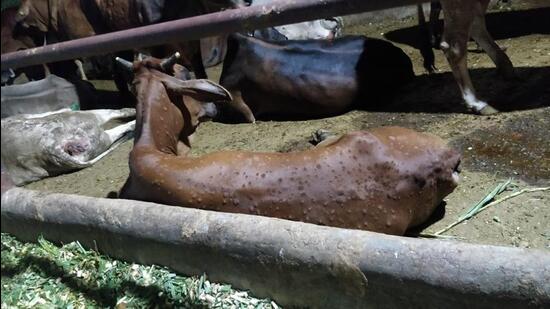
Sachindra Pratap Singh, commissioner, Animal Husbandry, said that the first case of lumpy skin disease this year was reported at Raver taluka in Jalgaon district. “As cases are increasing, we will be banning interstate cattle transport. As of now, we have seen two instances where cattle from Gujarat and Rajasthan were sold here. Further spread has been noticed in Ahmednagar, Akola, Pune, Dhule, Latur, Aurangabad, Beed, Satara, Buldhana and Amravati districts of the state. In 2020-21, 26 districts in Maharashtra have reported cases of the disease,” Singh said. According to officials, as many as 71 villages are in the grip of the disease this year.
“A total of 100,342 livestock in 301 villages within a 5 km radius of the infected area have been vaccinated. Out of this, 762 livestock have been affected. Out of the 762 cases, a total of 560 livestock have recovered after treatment,” said Singh. Ten deaths have been reported so far, with nine of them from Raver taluka of Jalgaon district and one from Pune district, officials confirmed.
“We have reported fewer cases in areas where vaccination was carried out previously. Farmers are advised to isolate the cattle and disinfect and spray the surrounding areas to avoid mosquitoes and flies near the infected animals. The disease is curable with medication and so we have advised farmers to contact the nearest veterinary dispensary. Farmers can call 18002330418 or the toll-free number 1962 for more assistance,” said Singh.
{{/usCountry}}“We have reported fewer cases in areas where vaccination was carried out previously. Farmers are advised to isolate the cattle and disinfect and spray the surrounding areas to avoid mosquitoes and flies near the infected animals. The disease is curable with medication and so we have advised farmers to contact the nearest veterinary dispensary. Farmers can call 18002330418 or the toll-free number 1962 for more assistance,” said Singh.
{{/usCountry}}Lumpy skin disease is caused by the lumpy skin disease virus (LSDV), a virus of the capripoxvirus genus in the poxviridae family. The disease is vector-borne. The disease can reduce milk production in cattle. But as it is not zoonotic, there is no threat of transmission to humans, according to officials from the animal husbandry department. However, farmers are advised to isolate the infected cattle in separate sheds.