
 E-Paper



Birth of Robin: Giving wings to an EV dream
Excited to give wings to an idea that hit them in the middle of the cacophony of horns, whistles, and shouts, Prakash and Pranav Dandekar decided they would build a car that takes the space of a bike on the road but offers the comfort and safety of a car.

 Prefer HTon Google


Pune: Who would have thought getting stuck in a traffic jam would lead to the birth of an idea that would shape an automobile start-up? Well, that’s exactly what happened to a father-son duo while waiting for the chaotic traffic scene to clear up and the lines of vehicles to inch forward. Navigating the city’s choked roads was a problem and they had a solution!
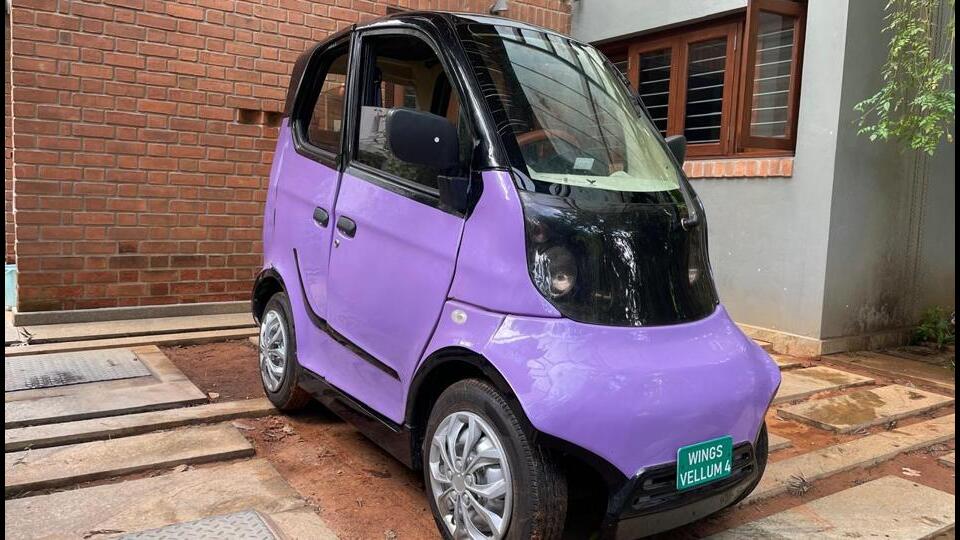
Excited to give wings to an idea that hit them in the middle of the cacophony of horns, whistles, and shouts, Prakash and Pranav Dandekar decided they would build a car that takes the space of a bike on the road but offers the comfort and safety of a car.
Giving shape to an idea
Decision made, they decided to build around their idea. They did some research and found that according to a study by the Pune Traffic Police and Bloomberg Philanthropies, 90% of accidents in the city involve two-wheelers and pedestrians. The duo was now convinced that the solution lay in a car requiring little space but offering greater safety. And they set about working on it.
Experience counted
Pranav Dandekar was not new to the automobile industry. His father, Prakash Dandekar, had spent four decades working in industrial and automotive electronics, including a stint with Tata Technologies where he was also on the team that worked on the Nano car.
Pranav had worked in the tech industry in the United States before returning to his hometown Indore.
Pranav, now 45, said: “We understood that two-wheelers played an important role in people’s lives and yet they were not exactly safe or even comfortable. At the same time, cars take up a lot of space on the road and in parking lots. My father and I discussed this and thought, why not build a vehicle that had the utility of a two-wheeler but also the safety and comfort of a car?”
Overriding Nano fears
But, did the Nano car experience deter them? Nano proved that small affordable cars did not necessarily meet with success. The Tatas built it as a small family car for people with two-wheelers, yet it failed to impress the market.
Pranav said, “Yes, we understood that only too well. But there was a catch. The Tatas built the Nano as a family car for people who wanted to upgrade to cars from bikes. We did not want to do that. Often you have families that have a car and a two-wheeler also. The car may be used to drop kids or for family outings but the two-wheeler is used for errands or short runs. Or, if both spouses work, one uses the car and the other the bike. We wanted to build our vehicle for such families.”
Market research
Like any other sensible entrepreneur who did not rely only on gut feelings, Pranav did in-depth studies of what people actually felt about their two-wheelers and what they expected. Did the vehicle meet their expectations?
Pranav said, “We spoke to more than 500 families to get a deeper understanding of the two-wheeler situation they were living with. Pune’s summers are very warm which can make even a short ride very uncomfortable, besides being unsafe.”
What he finally understood from that study was that people did want a car but it should have the ease of a two-wheeler, particularly when it came to parking.
And, that was the critical point. How could one make a car with four wheels and yet make it as easy as riding and parking a two-wheeler? How could a vehicle as small as a two-wheeler accommodate four people? It seemed impossible at first. But, with a closer look and deeper insight, both father and son realised that the ‘impossible’ was well within their reach.
Finalising the design
Pranav agreed that it was indeed a challenge but once they set their minds to it, they went full steam ahead. “First we decided on the name ‘Robin’ for our car. Then we decided that Robin would be a two-seater, and so it would have the dimensions of a two-wheeler.”
Finally, they agreed upon the length and breadth of a large motorbike, about 7 feet by 3 feet, for Robin. And now it was time for the real work to begin. They had to design the body.
Building the dream
Pranav said, “My father had a very good network of automotive veterans he had worked with in Pune, people who had retired from Tata Motors, Eicher, and so on. We hired about 12 of them. Some of them became our mentors and guides, and we began work on the vehicle design.”
They named their start-up ‘Wings EV’ and rented a design studio. Some of the team members helped source the material required to build their idea - ‘a two-wheeler that ran on four-wheels’. Simultaneously, they began work on building the powertrain for the car.
Pravav elaborated: “A powertrain in a vehicle is the part that makes the car go when you press the accelerator: the battery, motors, electronics, software, and so on. You can call it the heart of the body. Since ours was to be an affordable electric vehicle, we started with the battery.”
Brick by brick
In those days - 2019-2020 - the battery scene was not as advanced as it is now. They needed a lithium battery but could not find one suited to their requirements. Hence, they ended up designing it themselves.
The idea to make it comfortable meant Robin required an air-conditioner. “But, we could not use the air-conditioners used by other car manufacturers as those were for larger-sized vehicles. Finally, we got a leading automotive AC supplier to design a small air-conditioner for us,”
Testing times
The powertrain took time to design and build given their requirements. By 2021, they had their first prototype ready. Now it was time to test their efforts. They took their vehicle to NATRAX, near Indore, which has 18 different tracks to test a vehicle’s performance. But, the final hurdle the vehicle had to pass was the crash test at ARAI (Automative Research Association of India) in Pune.
“I had my heart in my mouth while they were doing it. After all, we had invested all our energies, passion and time to build this. They set the vehicle on rails that are built under the track and ran it at high speed to crash it against a wall. If it did not pass, we would have to start all over again,” Pranav said, recalling the thoughts that were racing through his mind at that time.
Robin passes muster
Their dream machine crashed against the wall, and the steering wheel did not push beyond the requirements. Robin passed the test! Pranav heaved a huge sigh of relief. The efforts were worth it, after all.
Several other tests were conducted by ARAI - crash from the sides, brakes, climbing up slopes, etc. - and Robin cleared all of them, but not without several prototypes. Nine of them in total. The last test was in 2024.
Pranav said, “My friends, who test drove our vehicle, told me to get it out now. Enough of iterations, they said. Passion often makes innovators keep on working even when the results are there for all to see in plain sight.”
The Dandekars were pleasantly surprised by the responses they got. “Everyone was extremely happy and said that this was just what they needed – safety plus mobility,” Pranav said.
Launch by year’s end
Buoyed by the responses, Pranav is all set to launch Robin by the year’s end. They will offer three variants – the top end costs ₹3 lakh, has an air-conditioner, and can run 90 km per charge. The middle variant has no AC but a fan and gives 90 km on a single charge. It costs ₹2.5 lakh. The base variant has no fan or AC and costs ₹2 lakh.
The plan is to launch it initially in Bangalore and then expand to Pune, Chennai, Hyderabad and Indore.
Sourcing funds
When the father-son duo started, they were bootstrapped. Later, they raised a seed fund from General Catalyst India, and have invested a total of around $2 million in the project. They are in the process of raising another round of funding of about ₹10 million to start production.
What lies ahead
Pranav said that since congestion on roads is more or less a problem in most places, some Asian and European countries are very keen on importing Robin.
“Japan, Switzerland and Italy have shown serious interest. We are looking at these opportunities, too,” Pranav said.
Looking at the present scenario, the Dandekars are very hopeful about Robin’s future. “Looks like this two-wheeler that runs on four wheels will go places,” Pranav summed it up.


