
 E-Paper



Echoes of Twelfth Night in colonial Poona
In 1880, the Bishop of Calcutta was to be at Poona on the Feast of the Epiphany. Preparations for his arrival began much before Christmas

 Prefer HTon Google


Diaspora communities often become preservers of cultural elements, including rituals that may have faded or become extinct in their original homelands due to modernisation, political change, or assimilation pressures. This is driven by a strong desire to maintain a distinct cultural identity and a sense of belonging to a new land.
In 1880, the Bishop of Calcutta was to be at Poona on the Feast of the Epiphany. Preparations for his arrival began much before Christmas. There was an excitement in the air and a large English crowd, as expected to attend the Holy Communion in the morning, which was to be followed by readings about the visit of the Magi. Epiphany hymns were being practised, and later, lunch was to be served.
Poona, as a large military and civil station, ranked second only to Bombay in its own presidency. It was therefore well furnished with all the machinery for vigorous Church life. There were three English Churches in Poona, then served by Chaplains: St Mary’s, with a congregation partly military, partly civil; St Paul’s, a pretty little stone church more or less on the model of Exeter College Chapel, with an entirely civil congregation; and the unconsecrated military temporary Church in Ghorpuri. At Kirkee, where the artillery barracks were, there was a fourth church and chaplain.
Unfortunately, the Bishop did not participate in the celebration because he was ill with a fever. But the celebrations were not subdued.
Twelfth Night and the Feast of Epiphany marked the gentle close of the Christmas season, each carrying its own charm and meaning. Twelfth Night, observed on the evening of January 5, had long been a time of merry-making, the last festive flicker of the Twelve Days of Christmas, when families gathered, homes were bright with laughter, and old customs of cake, songs, and playful misrule filled the winter night.
The following day, January 6, brought the Feast of Epiphany, a quieter and more reflective celebration in the Christian calendar. It commemorated the moment the Christ Child was revealed to the world, symbolised in the West by the visit of the Three Wise Men. Together, these two observances blended joy and reverence, marking both the end of holiday cheer and the beginning of a thoughtful new season.
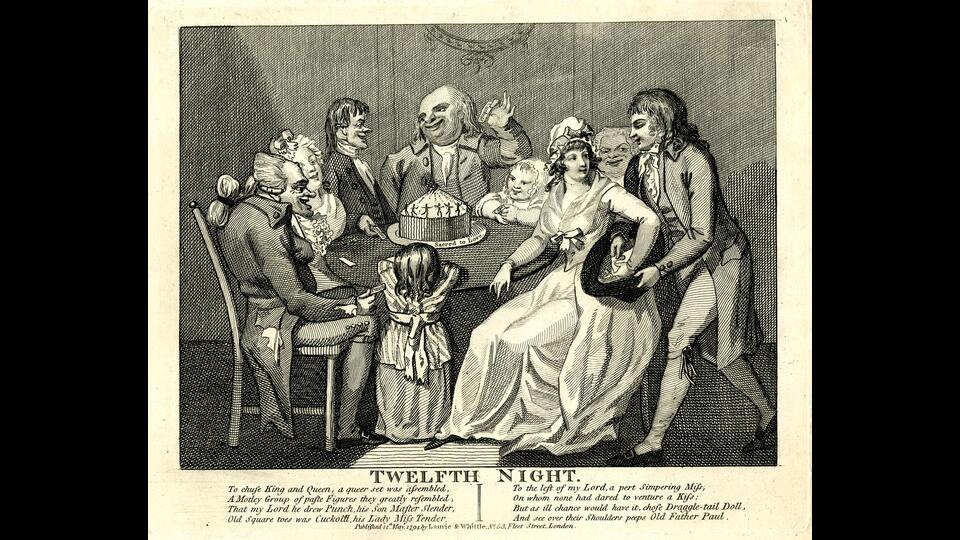
A King’s Cake was served on January 5, the traditional twelfth day of Christmas. Also known as the Twelfth Cake or Bean Cake, it contained within its fruity depths a bean and a pea, and whoever found these pulses was crowned “King” and “Queen” of the festivities of the evening. Before that, three jelly beans were hidden in the cake, and the three who found a jelly bean in their piece of cake were declared one of the kings and passed out any gifts that were given that day.
The custom of eating Twelfth Cake, and especially of the drawing for king and queen on this day, is ancient. In the calendar of the Roman Catholic Church, there is an observation of January 5th, the vigil of Epiphany, “Kings created or elected by beans”; and the 6th is called “the Festival of Kings”, with the additional remark that “the ceremony of electing kings was continued with feasting for many days”.
These ceremonies were probably the remains of those for choosing, amongst the Greeks and Romans, a sort of “King of the company”, whose business it was at feasts, to determine the laws of good fellowship, and to observe whether everyone drank his proportion, when he was also called “the eye”.
The custom of making merry with Twelfth Cake is also stated to be derived from the Saturnalia, and to have been a sacrifice to Janus, from whom January is named.
By Queen Victoria’s reign, these cakes were baked by commercial confectioners and sold to anyone who could afford them. Many houses boasted a cook who would turn her skills to making Twelfth Cake to her own recipe.
The most significant activity on Twelfth Night was the party. This often took the form of a masque or costume ball at which a large cake would be served to all the guests.
The famous Twelfth Night revels lost a great deal of their popularity after the change in the calendar in 1752, but continued to be held, on a decreasing scale, until about the middle of the nineteenth century in Britain. By the 1870s, the old tradition of finding a bean in the Twelfth Cake had become a great source of mischief for children who pranked customers waiting to buy cakes at the confectionery. Queen Victoria banned the keeping of Twelfth Night as a result of these pranks.
After that, it was but little regarded in England; the cakes in the London confectioners’ shops were few and far between, and in families where the night was noticed, the little carnival dwindled to a staid formal party.
The once popular custom of wassailing the apple trees, in the hope of obtaining a good crop the next season, survived until the early years of the twentieth century, but the custom of lighting Twelfth Night fires became a custom of the past.
Reports appearing in a Bombay newspaper between 1870 and 1900 suggest that it was customary for many families in Poona, on Twelfth Eve, to invite their relatives, friends, and neighbours to their houses to play at cards and have a supper at which mince pies were indispensable. After supper, the wassail bowl, fairly large, was brought in. The ingredients put into the bowl, ale, sugar, nutmeg, and roasted apples, were usually called Lamb’s Wool, and the night on which it was used was commonly called Wassail Eve. Spiced cake was given to everyone, and each, in turn, took a roasted apple from the bowl, by means of a spoon, and then drank to the health of the company.
Twelfth Night balls were also organised in honour of special occasions, like a wedding anniversary. A Bombay newspaper reported on 8 January 1891 that such a ball was hosted by Mrs and Mr JH Cartwright to honour their silver wedding anniversary. The guests, many of whom had arrived in Poona from Bombay and Belgaum, attended the Feast of Epiphany the following morning.
The Feast of Epiphany was usually quieter by comparison, a church day marked by prayer and a simple meal, often with a slice of the previous night’s cake lingering on the table.
Until the early decades of the twentieth century, the British living in Poona celebrated these two festivals with great enthusiasm. After that, newspapers and Church communications no longer carried reports about them. Perhaps the need to assert and preserve a distinct identity had faded by then. With better means of communication, their connection with their homeland had grown stronger. As a result, there was little desire to recreate festivals here that were no longer observed back home.
With this, the tradition of baking the Twelfth Cake also went into oblivion.


