Pune: During the campaign for Lok Sabha polls in 2024, Nationalist Congress Party (Sharadchandra Pawar) chief Sharad Pawar narrated a lesser-known story that has now gained renewed relevance. In the late 1990s, the state was exploring locations to set up a sugar factory in the Hinjewadi region, then a sleepy village on Pune’s outskirts. Pawar, who was the Union minister for defence and had a growing influence in Maharashtra politics, persuaded local farmers to give up their land not for sugarcane cultivation or a factory, but for something he believed was the future — information technology. The idea, he told them, was to build a new kind of economy. The locals agreed. And that land, stretching over hundreds of hectares, would go on to become the Rajiv Gandhi Infotech Park.
Today, nearly three decades later, the promise of progress that came with gleaming towers and global IT firms has collided with a grim civic reality. The very land that was once held up as a symbol of forward-thinking governance now represents a planning failure. Power outages, water shortages, traffic jams, encroachments, and a patchy drainage system plague Hinjewadi’s daily life — even as the software exports from this area fuel Maharashtra’s digital economy.
Spread across 700 hectares of Maharashtra Industrial Development Corporation (MIDC) land divided into three phases, Hinjewadi’s IT park houses more than 165 IT and allied companies across three developed phases. These phases now support a workforce of over four lakh people and continue to attract major real estate and infrastructure investment. Yet, residents and workers here struggle with problems usually associated with neglected urban peripheries. For all its economic output — estimated to be around ₹9,000 crore annually — Hinjewadi remains a civic work-in-progress. According to 2024 estimates, Hinjewadi accounts for roughly 60% of the Maharashtra’s total IT export.
Traffic woes
{{/usCountry}}Traffic woes
{{/usCountry}}Commuting to and within Hinjewadi is a daily ordeal. During peak hours, it can take over an hour to travel short stretches from Baner or Aundh. Roads connecting the three phases of the park are narrow, potholed, or under perpetual construction. Key expansion projects, like the link between Phase I and Phase III via Maan Road, or the Shivaji Chowk-to-Crematorium Road, are stuck in procedural delays and land acquisition hurdles. The area currently has less than 30 kilometres of internal roads, grossly inadequate for its population and vehicle density.
Residents blame fragmented governance and poor coordination among agencies. The industrial park comes under MIDC, but large parts of the adjoining residential settlements fall under the jurisdiction of Pune Metropolitan Region Development Authority (PMRDA). Water and drainage are managed by different bodies, and there is little synchronisation when it comes to roadworks, electricity supply, or even handling debris. Civic planning is split across many authorities — MIDC, PMRDA, PCMC, PMC — that each blames the other for the dysfunction.
The failure is visible most clearly in basic services. Earlier this month, an underground fault in a high-voltage cable caused a power outage that lasted more than 12 hours, affecting not just offices but homes, banks, and service providers. Though power utility Mahatransco has since repaired the 220kV Infosys-Pegasus line and increased substation capacity, many companies still rely heavily on diesel generators, which raise operating costs and carbon emissions.
Water is another constant worry. Though the official supply to Hinjewadi is pegged at 24 million litres per day, several residential societies depend on water tankers. A resident, Yogesh Kamant, said they purchase water jars for drinking and hire tankers for household use, despite living in a high-end housing complex. “When we ask officials why we face such problems, they say we should have checked before buying the flat. But we want to ask them — why did they give builders permissions without ensuring roads, water, and basic infrastructure? That’s the government’s job,” he said.
Merger talks
Adding to the governance tangle is a growing demand from Hinjewadi’s urban population to merge the area and its neighbouring villages with the Pimpri Chinchwad Municipal Corporation (PCMC). IT professionals and citizen groups believe that only a single, accountable civic body can bring the required coordination and efficiency. However, the idea has met stiff resistance from local villagers, who had given their land for the park’s development in the 1990s. Many of them fear that merging with PCMC would mean steep property taxes, losing traditional rights over land, and being pushed out of their own villages through rapid urbanisation.
“We were promised jobs and development when we gave our land,” said a landholder from Maan village. “But all we see now are outsiders taking over. If PCMC comes, they will impose tax on everything — homes, cattle sheds, small businesses. No one has asked what we want.”
The political establishment has now begun responding. On July 10, chief minister Devendra Fadnavis held a meeting with senior bureaucrats to discuss Hinjewadi’s deteriorating infrastructure and directed urgent coordination among state agencies. Days later, deputy chief minister Ajit Pawar made a surprise early-morning visit to the area. Officials were pulled up for the state of nullahs and debris, and were asked to clear footpaths and encroachments immediately. This was followed by a major anti-encroachment drive by PCMC on Wednesday. Over a dozen illegal sheds, hawker stalls, and roadside extensions were removed in Phase-I and along the approach roads.
Despite the urgency, the larger questions remain unresolved. Why was such a massive economic zone allowed to grow without a corresponding civic framework? Why were residential towers approved in adjoining villages without basic access roads, sewage lines, or water connections? Why did it take intervention from the top-most levels of the state government for basic footpath clearing to begin?
The answers are scattered across departments. But the impact is being felt every day by the people who live and work in what was once imagined as a smart, sustainable, world-class IT corridor.
Monsoon unpreparedness
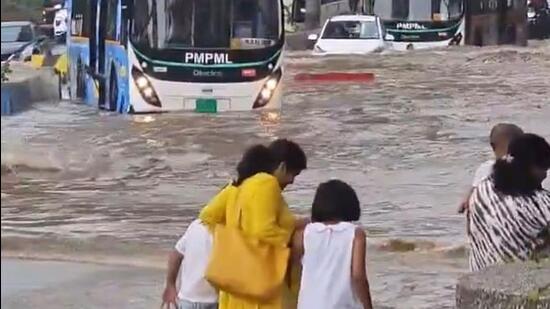
On a rainy June morning, the high-rises of Hinjewadi Phase II watched helplessly as water gushed into parking lots and climbed stairwells. The rain, though not unusual in intensity, brought an already overwhelmed stormwater system to its knees. Roads disappeared under water, clogged nullahs overflowed, and commuters abandoned vehicles mid-route. The very tech corridor that prides itself on powering India’s digital economy was reduced, yet again, to a flood zone.
This isn’t a one-off occurrence. Every monsoon, despite tall claims and pre-monsoon clean-up drives, waterlogging cripples Hinjewadi and its adjoining areas. According to engineers working with MIDC and PMRDA, the root cause lies in unregulated urbanisation, debris dumping, and rampant encroachments on natural water channels.
The construction of Metro Line 3—connecting Hinjewadi to Shivajinagar—has worsened matters in recent months. Piles of loose earth, construction waste, and concrete blocks have narrowed key stormwater paths. The few nullahs that remain functional are choked with plastic and silt. An official with the Hinjewadi IT Park confirmed that emergency clearing work has begun and repairs to footpaths are underway. However, the damage, he admitted, “has already been done over many years.”
The breakdown of Hinjewadi’s drainage network also exposes deeper flaws in how the area has been developed. The original masterplan, drawn up for an industrial zone, accounted for stormwater management based on sparse built-up density. But in the last decade, PMRDA has approved a slew of residential and commercial projects just outside MIDC limits—without integrating them into the existing infrastructure plan. “We created a ring of high-density development around a planned core,” a former MIDC official said. “That pushed all the stormwater back into the MIDC zone, where the system couldn’t cope.”
While PMRDA and MIDC officials now meet regularly to coordinate monsoon preparedness, their jurisdictions remain poorly aligned. A nullah that starts in a PMRDA-approved colony may pass through MIDC and eventually drain into a PCMC-managed stream. This overlap has led to delayed cleaning operations, confusion over responsibility, and, often, complete inaction.
What compounds the frustration is the lack of walkable roads and public transport infrastructure. Despite being home to over 165 IT companies and employing more than four lakh people, Hinjewadi lacks safe footpaths, streetlights, and even basic pedestrian crossings. At several points in Phase I and II, IT professionals and daily wage workers alike are seen walking along traffic-heavy stretches, often forced onto the road due to missing or broken pavements.
“It’s ironic,” said urban planner Rajesh Jagtap, “that we call this a ‘smart city’ zone. There are offices with biometric scanners and AI systems, but no footpath to walk safely to a bus stop.”
The long-awaited Pune Metro Line 3 is expected to ease commuting pressures. Connecting Shivajinagar to Hinjewadi, the line is in its final construction phase. But even here, the elephant in the room remains: last-mile connectivity. With no dedicated shuttle services or feeder networks planned so far, workers may still find themselves stranded unless supplementary systems are put in place.
Private developers have been quick to promote proximity to the Metro as a selling point, but residents say that basic connectivity within Hinjewadi itself remains dismal. Public bus services are irregular, and most depend on private vehicles, office cabs, or autorickshaws, which often overcharge.
Sharing responsibilities
As complaints multiply, so do calls for comprehensive reform. The state government has proposed creating a “single-window planning authority” for Hinjewadi and surrounding growth centres. The goal is to bring MIDC, PMRDA, PCMC, and PMC under one umbrella body that can coordinate land use, roadwork, utilities, and transport.
Yogesh Mhase, commissioner, PMRDA, said that his office has already begun efforts to streamline responsibilities. “We are coordinating with all agencies concerned to improve road infrastructure, ensure stable power supply, remove encroachments, and clean the nullahs,” he said. However, he acknowledged that administrative overlaps have created bottlenecks in execution.
An official involved in these coordination meetings admitted the problems were years in the making. “This is not the fault of one agency. It’s a collective failure,” he said. “Instead of blaming each other, we need to work together to rebuild public trust and Hinjewadi’s image.”
Residents, meanwhile, are not waiting quietly. Earlier this year, citizens and tech employees launched the #UnclogHinjewadi campaign. The online and on-ground initiative aimed to highlight chronic issues—clogged drains, traffic mismanagement, poor water supply—and demand immediate action. A petition submitted to the state government also requested that Hinjewadi be brought under PCMC to ensure better civic governance.
But that idea is facing resistance from villagers who originally gave their land for development. While the urban middle class wants access to a better-governed municipal corporation, local farmers fear that merging into PCMC will mean losing what little they have left—land, autonomy, and identity.
Rajendra Totala, executive engineer at Hinjewadi IT Park, said, “We’ve initiated clearing operations, removed encroachments, and repaired footpaths. PMRDA has also begun removing debris to allow smooth flow of rainwater. We are continuously improving our infrastructure.”
Yogesh Joshi, former president, Hinjewadi Industries Association, said that due to poor coordination between government agencies, employees and residents in Hinjewadi are facing serious issues like waterlogging and traffic congestion. “Last year, deputy chief minister Ajit Pawar held three meetings and created a single-point authority under divisional commissioner Chandrakant Pulkundwar. We submitted a list of 18 key issues and even visited the affected areas. But apart from removing overhead cables, no major work has been done. Road widening, land acquisition for new roads, proper drainage, stormwater systems, and pre-monsoon preparations are still only on paper,” he said.
Joshi said that before PMRDA was formed, taxes were collected by the Hinjewadi Gram Panchayat, but they did not invest in infrastructure. “Even companies did not take much interest in solving local problems. They expect the association to take the matter to the government. While company campuses are clean and well-maintained, the areas outside are in a poor state,” he said.
He suggested that the government should form a dedicated authority, similar to Bangalore’s Electronic City Industrial Township Authority (ELCITA), and allocate proper funds for infrastructure. “Alternatively, the state government should merge the seven villages around Hinjewadi into PCMC and provide funding for overall development,” Joshi said.
Ashutosh Pandey, an IT professional and resident of Hinjewadi, said, “Despite being a major IT hub, Hinjewadi still lacks basic infrastructure like reliable water supply and proper roads. Residents often have to depend on private water tankers for daily needs, which adds to our monthly expenses.”
Basu Patil, an IT professional and another resident, said, “We invested in homes here expecting better urban facilities, but the area continues to struggle with poor connectivity, inadequate public transport, and limited civic services. It feels like infrastructure development has not kept pace with the area’s rapid growth.”
The state now finds itself balancing two competing realities: an urbanised zone that needs urgent infrastructure upgrades, and rural communities wary of further marginalisation. Until that balance is found, Hinjewadi will remain what it is today — a showcase of economic ambition struggling to survive civic neglect.