
 E-Paper



Curtain Call: How songs saved “blackouts” of a play
The new songs were fun and very easy to sing! It just changed the fabric of the play titled “Dalan.” Because of these songs we were able to do away with the blackouts, says Nipun Dharmadhikari, storyteller


Last week, I wrote about my experience and approach towards adapting the short story “Cycle”, written by eminent Marathi writer Vyankatesh Madgulkar. The takeaway from that experience was that it was important to create the world in which the characters from the story would be set it. And while the original story definitely sets up a world for the reader, it does need more visual elements while making it into a play. I guess that is why this process is termed as “adapting”. This experience helped when I adapted another story into a play.
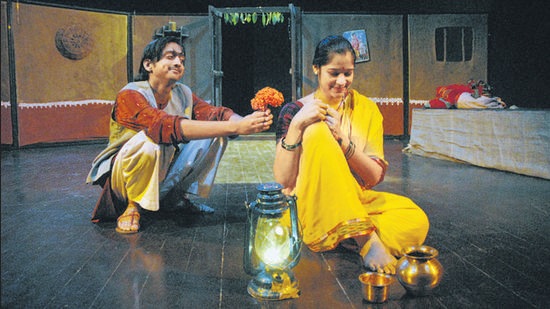
The next story that a friend and I adapted into a play was titled “Dalan” (The Grind) written by another well-known writer DM Mirasdar. Mirasdar is famous for creating characters with funny traits and throwing them in hilarious situations. “Dalan” is no exception!
The protagonist in the story – a schoolteacher – has this unique ability to guess correctly whether the mother of a student will be a looker or not. Based on this, he makes up some excuse regarding the academics of a particularly sweet-looking kid so that his mother will come and meet him. When she does and he realises that he is right (yet again!) he tries his best to get invited to her house when her husband is out of town. After many days of playing the waiting game, he gets an invitation, and his happiness knows no bounds! At night, when the village has gone to sleep, he visits her. After a few awkward moments when he is about to make a move, someone knocks on the door! Not knowing what to do and where to hide, the woman urges the schoolteacher to quickly drape a saree and to start grinding wheat in the hand mill stone. The visitor is an old woman staying next door and has come to have a chat to pass her time. The chat goes on till dawn and the teacher is successful in only one thing – grinding one whole gunny bag of wheat into fine flour!
Like “Cycle”, the structure of the play fell in place very quickly (or so I thought). We concentrated on dialogues more. There were some really funny lines in the original story and they helped set the tone to come up with more dialogues. The challenge was to make it seamless. Improvising with actors helped a lot too in this exercise.
We were cruising along smoothly and were ready with it nearly a week before our actual performance. It was the day of our first grand rehearsal and everybody was very excited. We had also invited a few of our friends over to receive some quality feedback. One thing that I noticed was that they were laughing during the scene and once the next scene started, it took some time for them to start laughing again. We had four scenes in the play of nearly eight to nine minutes each. Once the run-through was over, the friends gave the exact feedback that I had noticed. They were enjoying the individual scenes, but the overall play lacked pace.
After a “big” team meeting, in which we discussed various solutions to address this issue, I decided to go back to the drawing board – the script and the original story. I read the story and I enjoyed it yet again. Then I read the script and I found that I was enjoying reading that too. So, where was the problem? The next day at rehearsal, I watched the play again and then it dawned on me. There was a blackout between every two scenes, of nearly half a minute each. And I felt that after those thirty seconds of inactivity, getting back into the groove was taking time. We were playing some interesting recorded tracks during the blackout, but somehow those four blackouts were dragging the pace.
It was my good fortune that one of the team-members was a good poet and another a good musician. I asked them if they could come up with original songs for the situations. They were more than happy to take up the challenge. Our actors weren’t trained singers, but they were excited to sing too!
The new songs were fun and very easy to sing! It just changed the fabric of the play. Because of these songs we were able to do away with the blackouts! All our set changes took place in full stage light, in front of the audience. What’s more, our actors changed the set while singing so it didn’t even feel like a set change. It just fit in organically! There was just one costume change for the lead actor, when he finally visits the woman. But even that became a fun visual with him singing and changing on stage. It successfully showed his happiness and excitement without explicitly saying so!
The play opened and received a lot of love. It has been nearly 14 years to the first show, but we still perform it whenever we get a chance to get the dates of the 27 team members!
Nipun Dharmadhikari is a storyteller and looks forward to telling them on stage, in front of the camera or in person


