At the nondescript Science Activity Centre (SAC) of the Indian Institute of Science Education and Research (IISER), a quiet revolution is underway. With its hands-on workshops and low-cost science models, the SAC has reached over three lakh students since its launch in 2017; igniting curiosity, nurturing critical thinking, and making science both fun and accessible.
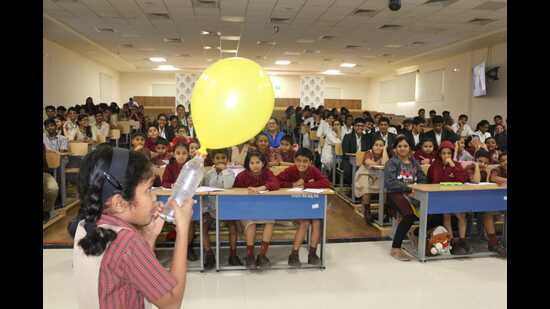
Every Wednesday, the centre welcomes a fresh batch of 70 to 80 students; some of them having travelled hundreds of kilometres from Odisha, Chhattisgarh and Sikkim among others to be part of the half-day workshop. For many, this is their first experience with laboratory equipment.
The format is simple but potent: a two-hour interactive demonstration introduces scientific concepts using real-life examples and activities; followed by students building models and toys (paper helicopters, hydraulic lifts etc.) using everyday materials such as straws, pen refills, syringes and plastic bottles. The kits are designed by the SAC team and given to the students to take home where they can tinker, rebuild and reflect.
Ashok Rupner, senior technical officer at SAC, said, “We align our activities with the Central Board of Secondary Education (CBSE) and state board syllabi for classes 5 to 12. More importantly, we focus on making science approachable. We want students, especially those from rural and underserved schools, to feel that they can do science using materials around them.”
From classroom to countryside
{{/usCountry}}From classroom to countryside
{{/usCountry}}One of the SAC’s standout projects is a mobile science van – a laboratory on wheels – which travels to far-flung schools in Maharashtra and other states, taking experiments to students who may never be able to step into a science lab otherwise. In areas like Palghar, Gadchiroli and Nandurbar where science classes often consist of blackboard diagrams and rote definitions, the van has introduced hands-on experiments for the first time.
Rupner said, “In rural schools, we often find that science is reduced to textbook jargon. When children actually see Bernoulli’s principle in action or build a periscope themselves, the subject stops being abstract.”
Teachers’ ally
While students are the face of the programme, teachers are equally crucial. The SAC regularly holds training sessions to introduce educators to activity-based teaching methods, helping them shift away from rote learning to experiential instruction. Teachers from Pune municipal and Zilla Parishad schools across Maharashtra have benefitted from these sessions.
“When we train a teacher, we reach hundreds of students through them. Many teachers return to their classrooms and begin weekly activity hours using our kits and guides,” Rupner said. According to IISER officials, more than 60 lakh students across India engaged with SAC’s digital content between 2020 and 2022 — a massive leap in its impact.
Long-term impact
The SAC doesn’t stop at workshops. It also hosts science exhibitions, STEM festivals, and innovation fairs on campus where school students present their own creations. Some of these events have drawn participation from over 200 schools in the past.
The long-term impact of the initiative is beginning to show. “We now have students who first came to SAC in class 9 and later joined IISER after class 12. That’s the most satisfying part — seeing their journey continue here,” Rupner said.
One such student is Shashank Dahiwale, a class 8 student who attended a recent workshop. “What we learned from textbooks, we actually tried out ourselves here. I used to find science boring, but now I want to become a scientist. When we make things ourselves, we remember them better,” he said.
Looking ahead
The SAC is now looking to deepen collaboration with schools and the state education department. Plans are underway to expand the mobile outreach units and partner with textbook bureaus to align activity-based modules with formal curricula.
A senior IISER faculty member involved with the programme said, “Science education in India often suffers from a lack of context and hands-on learning. What SAC is doing is not just outreach — it is a necessary correction to the way that science is taught.”
Schools can apply for SAC workshops through the official IISER Pune website. But with demand exceeding capacity, many are already on the waiting list — a testament to the centre’s growing importance in shaping how India’s next generation experiences science.