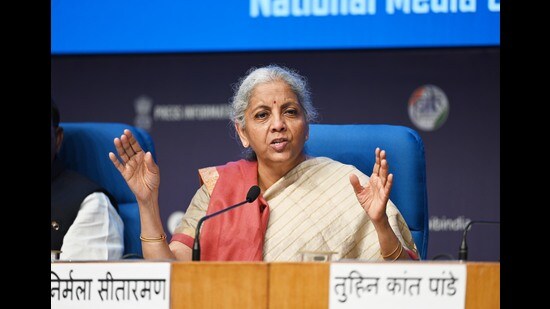
In a series of reactions to finance minister Nirmala Sitharaman’s Union Budget 2025 announcement on Saturday, industry leaders and business advocates hailed a raft of measures aimed at bolstering India’s economic engine.
The Maratha Chamber of Commerce Industries and Agriculture (MCCIA) sees the reforms as a significant boost to micro, small and medium enterprises (MSMEs) and startups—the very sectors that drive the country’s manufacturing, exports, and employment.
MCCIA praised the new provisions that have been designed to benefit over 23 crore people employed by MSMEs, which contribute 36% to manufacturing and 45% to exports.
“The budget has introduced a new classification for MSMEs and raised the investment and turnover limits by 2.5 and 2 times, respectively. It expands the eligibility for more businesses to come under the MSME umbrella and benefit from various schemes,” stated the release by MCCIA.
In addition, the budget’s decision to increase the loan limit and guarantees for micro and small enterprises—from ₹5 crore to ₹10 crore—was also applauded. Officials noted that this move is set to improve access to affordable credit, benefiting millions of MSMEs across the country.
Startups too found reasons to celebrate. The budget extends the incorporation period for startups by an additional five years, now valid until 2030. “The extension will provide startups with much-needed time to grow and establish themselves, fostering innovation and entrepreneurship,” said MCCIA spokesperson.
{{/usCountry}}Startups too found reasons to celebrate. The budget extends the incorporation period for startups by an additional five years, now valid until 2030. “The extension will provide startups with much-needed time to grow and establish themselves, fostering innovation and entrepreneurship,” said MCCIA spokesperson.
{{/usCountry}}A particularly notable highlight for the entrepreneurial ecosystem is the proposal for a new Fund of Funds Scheme (FFS) with a ₹10,000 crore corpus, aimed at spurring venture capital investments in early-stage ventures.
Ninad Karpe, founder and partner of 100X.VC, said, “The announcement of the ₹10,000 crore fund of funds is a significant and welcome step. It will catalyze early-stage investments by VCs, providing crucial risk capital to fuel innovation and growth. If India aspires to become the world’s second-largest startup ecosystem—and eventually the largest—such bold moves are essential.”
Anuya Nisal, co-founder of Serigen Biotech, said, “It is an excellent move by the government that has tremendously helped the startup ecosystem. Today, with over one lakh startups in the country, such initiatives will further boost venture capital investments and support our growth trajectory.”
Not all reactions were uniformly celebratory. Girish Lakhotiya, founder and CEO of Prachay Group, a Pune-based financial solutions provider, acknowledged the relief provided by the raised tax exemption limit of ₹12 lakh for middle-income earners but cautioned against unsustainable fiscal policies.
“While I appreciate the relief offered to the middle class, the government has forgone nearly ₹1 lakh crores—around 4% of total tax collections. There are no free lunches in the world. Is reducing capital expenditure worth these freebies?” he remarked.
Baba Kalyani, chairman & MD of Bharat Forge Ltd, summed up his reaction by emphasizing the budget’s focus on key economic drivers. “The budget presents a strong focus on the inherent strengths of the Indian economy and key drivers of Viksit Bharat 2047. The three M’s that bring me cheer are the middle class, MSMEs, and Make in India,” he said.
The budget also unveiled significant initiatives to drive technological and urban development. The government has earmarked ₹500 crore for a Centre of Excellence in AI for Education, aiming to enhance learning through AI-driven solutions amid fierce global competition from tech giants like NVIDIA, OpenAI, and DeepSeek.
Urban infrastructure received a major boost with the announcement of an Urban Challenge Fund worth ₹1 lakh crore. The fund is designed to transform cities into growth hubs by promoting creative redevelopment, enhancing water and sanitation, and modernizing urban spaces. Shashank Paranjape, managing director of Paranjape Schemes (Construction) Ltd, said, “The transformative step for real estate will attract investments and create more sustainable, future-ready urban spaces. It is a visionary move that will not only strengthen city infrastructure but also enhance real estate value.”
Ajay Agrawal, managing director of BramhaCorp Ltd, said, “The Budget introduces key measures to accelerate infrastructure development and revitalize the real estate sector. These initiatives reflect the government’s strong commitment to sustainable development and economic growth, creating long-term opportunities for progress.”
With the Budget unfolding a spectrum of reforms aimed at spurring growth across multiple sectors, industry stakeholders in Pune and across India are poised to ride the wave of these transformative measures, setting the stage for a new era of innovation and development.