An international team of astronomers led by researchers from the Inter-University Centre for Astronomy and Astrophysics (IUCAA) has discovered a rare star system in the Magellanic Bridge — a huge stream of stars and gas connecting the Milky Way’s neighbouring dwarf galaxies, the Large and Small Magellanic Clouds.
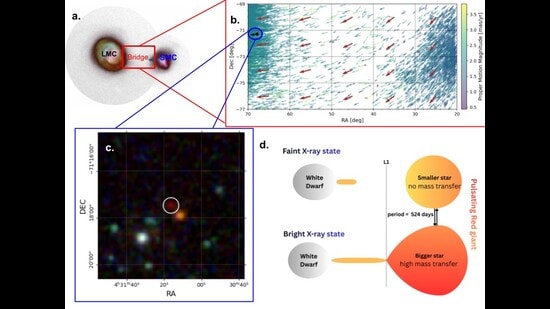
The discovery is the first confirmed symbiotic accreting system found in the Magellanic Bridge. The finding, made using data from the German eROSITA X-ray telescope, provides new clues about how compact stars evolve in galaxies that interact with each other.
The discovery is part of the second public data release (DR2) from the German eROSITA Consortium. The latest release nearly doubles the number of known X-ray sources in the sky, with a catalogue containing nearly two million sources, including more than 1.9 million point-like X-ray sources and about 64,000 larger objects such as galaxy clusters and supernova remnants.
The IUCAA-led team, headed by Tathagata Saha and professor Chandreyee Maitra, identified a rare stellar system named eRASSU J043115.8−711730 (J0431−71). The system consists of a white dwarf — the dense leftover core of a dead star — pulling gas from a nearby red giant star.
Researchers found that the red giant expands and contracts in a cycle of about 500 days. When the star expands, some of its gas is pulled towards the white dwarf. This process produces X-rays, which were detected by eROSITA.
{{/usCountry}}Researchers found that the red giant expands and contracts in a cycle of about 500 days. When the star expands, some of its gas is pulled towards the white dwarf. This process produces X-rays, which were detected by eROSITA.
{{/usCountry}}To confirm the location and nature of the system, scientists used data from the Gaia space mission, optical observations from the Southern African Large Telescope (SALT), and long-term observations from the Optical Gravitational Lensing Experiment (OGLE). These observations confirmed that the system belongs to the Magellanic Bridge and is not a star located closer to Earth.
The Magellanic Bridge was formed due to the gravitational pull between the Large and Small Magellanic Clouds. It contains young stars formed within the bridge as well as older stars pulled away from the Small Magellanic Cloud. While the region has been studied extensively using optical and infrared telescopes, its X-ray sources have remained largely unexplored.
Scientists said the discovery will help improve understanding of compact objects such as white dwarfs, neutron stars and black holes. These objects carry information about the age, chemical composition and evolution of galaxies.
Studying such systems in the Magellanic Bridge could also help researchers understand how interactions between galaxies influence the formation and evolution of binary star systems.
“This supersoft symbiotic binary system, powered by material transferred from a pulsating red giant star, is the first of its kind discovered in the Magellanic Bridge. The sensitivity and wide coverage of eROSITA have opened new possibilities for studying changing star systems in interacting galaxies,” said Saha, postdoctoral fellow at IUCAA and member of the eROSITA-DE Consortium.
Maitra, associate professor at IUCAA and chair of the Compact Objects Working Group of the eROSITA-DE Consortium, said the discovery highlights the importance of combining X-ray surveys with optical observations.
The research paper, titled “eRASSU J043115.8−711730: The first pulsating symbiotic super-soft X-ray source in the Magellanic Bridge”, was published in the Monthly Notices of the Royal Astronomical Society on July 30.
The discovery is part of a larger effort to create the first detailed X-ray map of compact objects across the Magellanic System and understand how stars evolve in different galactic environments.