E-Paper



Khadki stone labyrinth reveals ancient Mediterranean links
Archaeologists have discovered what is believed to be India’s largest known ancient stone labyrinth in Khadki shedding fresh light on Satavahana-era trade network linking Deccan to Roman world

 Prefer HTon Google


PUNE: Archaeologists have reported the discovery of what is believed to be India’s largest known ancient stone labyrinth – a rare 15-circuit, circular structure in Khadki on the Solapur-Dharashiv border – shedding fresh light on the Satavahana-era trade network that connected the Deccan to the Roman world. The findings have been published in the July 2026 edition of Caerdroia, an international journal dedicated to labyrinth studies. The research was carried out by Sachin Bhagwan Patil and P D Sabale of the department of ancient Indian history, culture and archaeology at the Deccan College Post-graduate and Research Institute, Pune.
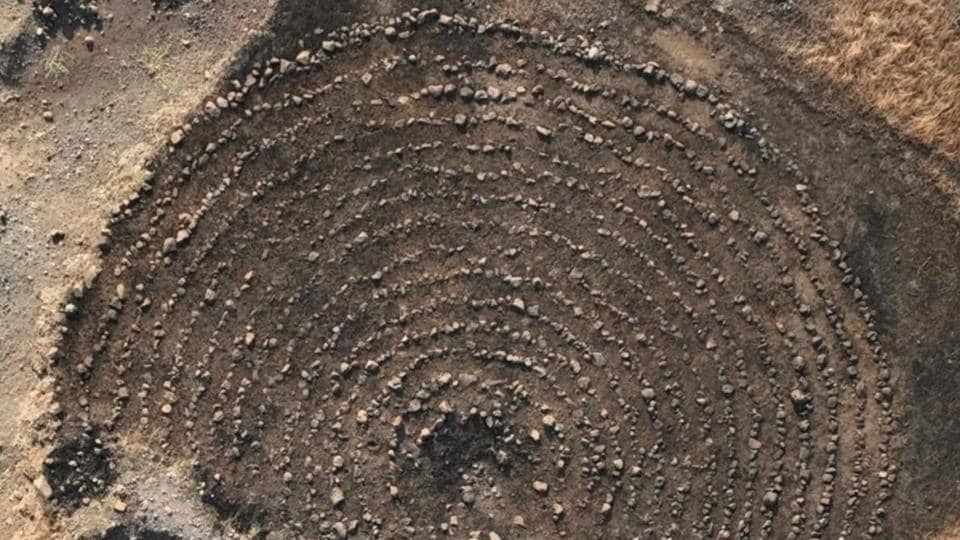
The labyrinth was first unearthed in late 2025 by members of the Nature Conservation Circle working near the Great Indian Bustard sanctuary at Boramani in Solapur. Hidden beneath dense grassland for years, the structure was later excavated, revealing a remarkably well-preserved circular stone formation measuring 50 feet (15.25 metres) in diameter.
According to Sabale, “The labyrinth features a 15-circuit classical design with a tightly-coiled spiral centre, making it the largest and most intricate example of its kind reported along the ancient trade routes linking western Indian ports with Kolhapur and Ter (Tagar) during the Satavahana period, which flourished between the late second century BCE and early third century CE”. Sabale said that the structure is unusual because of its perfectly circular layout; a feature rarely documented in India. It was constructed using naturally available basalt rubble and cobblestones embedded in black cotton soil formed from weathered Deccan trap basalt. Despite being built without a deep foundation, the labyrinth survived for nearly two millennia with minimal damage. The site lies on agricultural land near Khadki village, surrounded by reserved forest and semi-arid grasslands. The researchers noted that the location of the labyrinth inside a protected landscape has helped preserve the monument from modern disturbances.
Links to ancient trade network
As per the study, the location of the labyrinth is unlikely to be accidental. It sits along an ancient overland trade corridor that connected ports on India’s western coast with important inland commercial centres such as Ter and Paithan, both of which played a significant role in trade with the Roman Mediterranean.
The researchers pointed to archaeological discoveries from Brahmapuri, where Roman artefacts including a bronze mirror and a statue of a Greco-Roman sea god were previously unearthed. They also cited Satavahana coins depicting ships as evidence of flourishing maritime commerce during the period.
According to the study, merchants travelling across the Deccan plateau relied on carefully planned routes that avoided steep terrain while remaining close to water sources and forest resources. The Khadki labyrinth stands beside one such historic route, suggesting that it may have served travellers moving through the region.
More than a decorative structure
While the exact purpose of the labyrinth remains uncertain, the researchers suggested it may have served multiple purposes, blending local Chakravyuha traditions with classical labyrinth symbolism that may have reached India through long-distance trade. According to the study, such structures may have been used for religious rituals, or served as landmarks for merchant caravans, or symbolised protection and safe passage. Across several ancient maritime cultures, labyrinths were believed to ward off evil spirits and safeguard travellers, and the authors argued that similar beliefs may have travelled to India through commercial links with the Mediterranean.
Calls for conservation
The researchers described the discovery as significant not only for archaeology but also for understanding ancient trade, cultural exchange and the use of landscapes in the Deccan. With the site located near the proposed Solapur international cargo airport and within an ecologically sensitive grassland ecosystem, they have called for detailed archaeological investigation, scientific dating, and immediate conservation measures. They said that preserving the monument is essential, as it has the potential to become one of the most significant archaeological discoveries in recent years related to the Satavahana-era trade network and India’s early links with the Mediterranean world.