
 E-Paper



Marathi filmmakers open up about individual journeys to PIFF’s ‘international Marathi competition’ section
For Kale, who took over a decade to make her directorial debut, filmmaking is as much about collaboration as it is about personal expression

 Prefer HTon Google


The 24th Pune International Film Festival (PIFF) shone a light on the creative grit behind Marathi cinema today. At an interactive session titled, ‘Voices of tomorrow: Conversations with today’s Marathi competition,” both debutants and veteran filmmakers shared personal, financial, and artistic struggles that shaped their films selected for the prestigious ‘international Marathi competition’ section.
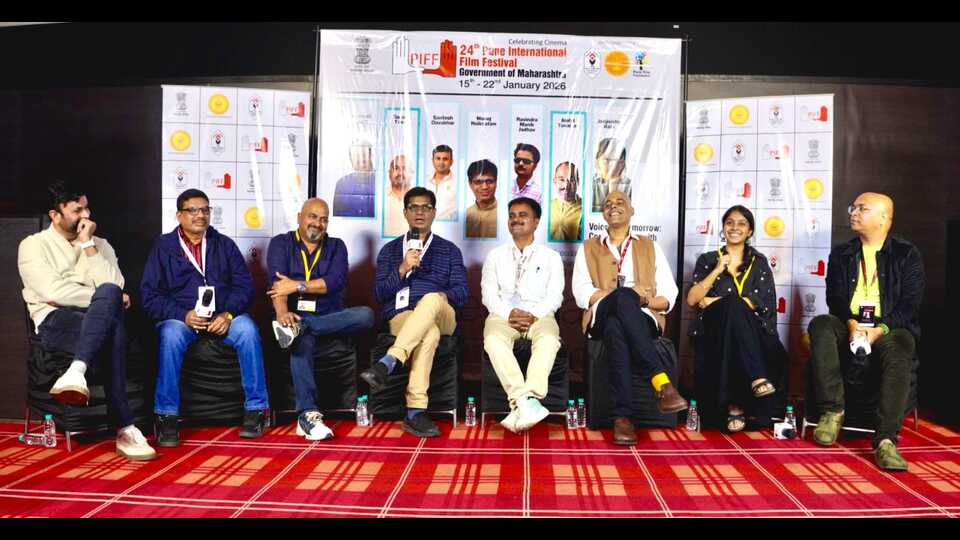
Moderated by PIFF deputy director Vishal Shinde; the panel included Ramesh More (Aadishesh), Mohit Takalkar (To, Ti ani Fuji), Jijivisha Kale (Tighee), Ravindra Manik Jadhav (Jeev), Santosh Davkhar (Gondhal), Manoj Naiksatam (Gaman), and Sameer Tiwari (Bapya).
For Kale, who took over a decade to make her directorial debut, filmmaking is as much about collaboration as it is about personal expression. “No matter how intense your passion is, your story cannot move forward without the right people,” she said. Kale, who often felt lonely as an only child, added, “The women I have observed throughout my life are the ones visible in my cinema.”
Takalkar who has made the transition from theatre to cinema said, “I grew up in the city, surrounded by chaos and stories. Relationships in urban life undergo changes, and that is what I have tried to portray,” explaining how his urban experiences shaped To, Ti ani Fuji.
Jadhav who is a Dhule-based school teacher, shared an inspirational story about self-taught filmmaking. “I had no knowledge of filmmaking, but I started with a handicam and learned by doing,” he said. He grew ambitious after winning a ₹2 lakh prize for his documentary, Thaal Bhanksar. “When a school memory about Nag Panchami inspired Jeev, my wife supported me financially and that is how the film was completed,” Jadhav said.
For Naiksatam, filmmaking is a high-stakes gamble. “I had no money. I had only two options: go mad or dive in deep. I decided on the latter,” he said. Drawing characters from the Konkan region, Naiksatam adapted a story he had originally published as a novel in 2015.
For Tiwari, a native of Uttar Pradesh (UP) making a Marathi film, crossing cultural boundaries brought their own challenges. “I spent four years searching for a producer. Finally, my wife raised the funds and actor Girish Kulkarni helped me. The social realities I have observed come to the fore in Bapya,” he said.
Veteran filmmaker More spoke about the struggle of producing artistic cinema. “I spent three-and-a-half years looking for producers. Many didn’t understand the difference between a ‘project’ and a ‘film’. Finally, a professor stepped in,” he recalled. About the theme of Aadishesh, he said, “The experiences of the Covid pandemic brought out the ‘shesh’ (residue) in us which shaped the characters.”
Davkhar shared his journey of self-education and determination. “I have no film background. I saw my first movie in class 10. When OTT platforms rejected Marathi films, I was determined to showcase my work,” he said. Davkhar immersed himself in the folk art of Gondhal, even taking a bank loan to fund the film.
Together, these stories highlighted a shared truth: independent Marathi cinema is powered by resilience, personal conviction, and the courage to bring social realities to the screen. At PIFF 2026, ‘Voices of tomorrow’ became more than a session; it was a testament to filmmakers turning struggle into storytelling.


