
 E-Paper



Monday Musings: Maha politics unable to shed its casteist lineage, dating back 2 decades
If the agitation for the formation of unified Maharashtra was led by Brahmin (leftist) leadership in the form of SM Joshi, Nanasaheb Gore, and SA Dange, post-1960s saw Maratha domination over the power struggle


Last week Raj Thackeray reiterated in Pune that caste politics in Maharashtra has escalated after the birth of the Nationalist Congress Party (NCP) in 1999. In Maharashtra, caste and politics have often been inseparable since the formation of the state in the 1960s, even as the nature of the two has changed in the past two decades.
If the agitation for the formation of unified Maharashtra was led by Brahmin (leftist) leadership in the form of SM Joshi, Nanasaheb Gore, and SA Dange, post-1960s saw Maratha domination over the power struggle.
The formation of Sanyukta Maharashtra also gave birth to the term “bahujans” (majority of people). State’s first chief minister Yashwantrao Chavan emphasised two things: That the state would be governed by Marathi people rather than Marathas (a reference to the Maratha community) and it would usher in an era of Bahujan Samaj.
By invoking Bahujans, Chavan wanted to imply non-elite, oppressed, non-Brahmin castes to send a message that the state will be ruled by the represented masses. This also helped him gain more acceptability among various non-Maratha communities.
So when Raj Thackeray insisted that he had read the writings of both Prabodhankar Thackeray (his grandfather) and Yashwantrao Chavan, he was reminding Sharad Pawar of how the NCP has come to be known as a party of Marathas.
For Maharashtra, its social-political fabric altered post the attack on the Bhandarkar Oriental Research Institute (Bori), when a bunch of people ransacked the manuscripts at internationally acclaimed institute in 2004. The attack was allegedly prompted by a controversial book from American author James Laine – “Shivaji: A Hindu King in Islamic India”.
This changed the equation between Brahmins and Marathas. The attack preceded Lok Sabha elections where parties like NCP made attempts to gain mileage by raking up the issue to whip up Maratha sentiments, to take on the BJP in order to polarise votes. The party reaped rich dividends during that, and subsequent elections, till the issue subsided.
Pawar and NCP meanwhile, have tried to project themselves as party of bahujans, though it has had limited success expanding roots among OBCs and Dalits. The party has given prominence to leaders like Chhagan Bhujbal (an OBC) and Madhukar Pichhad (leader of nomadic tribes) to woe the respective vote banks.
Pawar himself has on multiple occasions tried to project himself as a bahujan leader as part of his politics to target the BJP, which had a Brahmin face as chief minister of Maharashtra (Devendra Fadnavis between 2014 to 2019), to consolidate the bahujan vote bank in order to retain its stronghold of western Maharashtra.
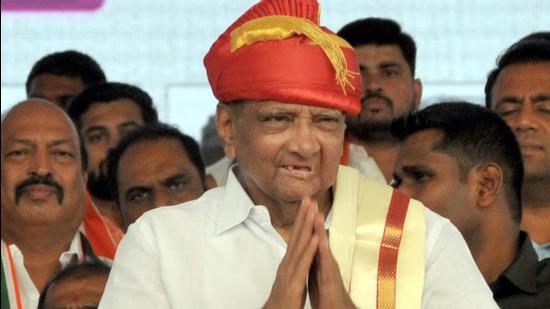
So asking partymen to shun the Puneri pagdi (turban) and instead use the Phule pagdi has suited Pawar in his politics. He chose to clarify his stand during the pagdi episode saying, he is a follower of Shahu Maharaj, Mahatma Phule and Dr Babasaheb Ambedkar’s philosophy of equality and wanted to convey that through this action (of shunning the Puneri Pagdi and instead wearing the Phule Pagdi).
While referring to Chavan, Raj Thackeray also spoke about his grandfather – Keshav Sitaram Thackeray, who started a periodical Prabodhan (Awakening) in 1921, and came to be known as Prabodhankar.
Prabodhankar was attracted to social reformer Jyotiba Phule’s writings and the core principle of Phule’s Satyashodhak Samaj organisation, to work for the social upliftment of members of the lowest castes. His biography – Majhi Jeevangatha (Story of My Life), also talked about influences in his early life.
Although belonging to the Chandraseniya Kayastha Prabhu caste, Prabodhankar wrote against the dominance of Brahminism and advocated eradicating caste hierarchies.


