The Union Ministry has directed municipal corporations across the country—including the Pune Municipal Corporation (PMC)—to strengthen surveillance and intensify measures for mosquito control to check dengue and chikungunya cases.
An inter-ministerial review meeting was held on July 1 and officials from 17 major municipal corporations across nine states participated in the meeting via video conferencing.
Dr Rajesh Dighe, assistant health officer, PMC, and head of vector-borne diseases control programme, who was present during the meeting, informed that vector-borne disease prevention and management activities have been initiated from May.
“As many as 71,368 mosquito breeding spots have been identified in the city, which includes 33,474 permanent and 37,874 temporary breeding spots,” he said.
“Awareness drives in vulnerable areas, especially slum settlements and construction zones and strengthening of sentinel surveillance have been suggested,” said Dr Dighe.
According to PMC health department data, in 2025, as many as 12 dengue and 10 chikungunya cases were reported. In 2024 as many as 382 dengue and 483 chikungunya cases were reported, in 2023, 272 dengue and 40 chikungunya cases were reported, while in 2022, as many as 686 dengue and 105 chikungunya cases were reported.
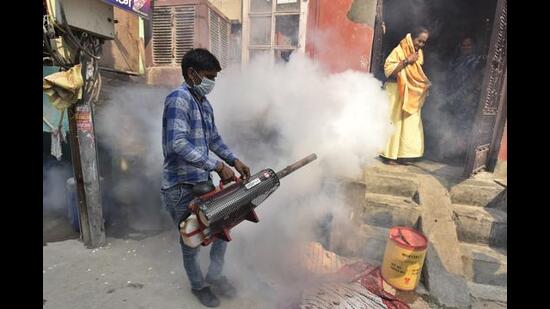
During the meeting, directions were issued to focus on the construction sites and urban poor slums. These locations have been identified as the two most critical breeding grounds for mosquitoes, particularly the Aedes aegypti species, which is known to bite during the daytime and spreads dengue and chikungunya. Besides, strict measures including fogging, spraying, elimination of stagnant water, and regular site inspections were recommended for these areas.
{{/usCountry}}During the meeting, directions were issued to focus on the construction sites and urban poor slums. These locations have been identified as the two most critical breeding grounds for mosquitoes, particularly the Aedes aegypti species, which is known to bite during the daytime and spreads dengue and chikungunya. Besides, strict measures including fogging, spraying, elimination of stagnant water, and regular site inspections were recommended for these areas.
{{/usCountry}}The municipal bodies have been instructed to ensure that cases of dengue and chikungunya are daily monitored using the Integrated Health Information Platform (IHIP) platform.
“The ward and zonal medical officers and malaria inspectors have recently undergone training for vector-borne diseases management,” said Dr Dighe.
He further informed that to biologically control mosquito larvae, guppy fish—known to feed on mosquito larvae—have been released at 2,518 locations.
“This year, PMC has issued notices to 1244 individuals and establishments found responsible for mosquito breeding. A total fine of ₹1,58,700 was collected, and the breeding spots were eliminated. Besides, to raise public awareness, rallies, poster campaigns, and pamphlet distribution have been done,” said Dr Dighe.