Pune: The doctors at B J Medical College (BJMC) and Sassoon General Hospital (SGH) on August 1 successfully performed a robotic total knee replacement surgery on a 62-year-old woman from Mohol village in Solapur.
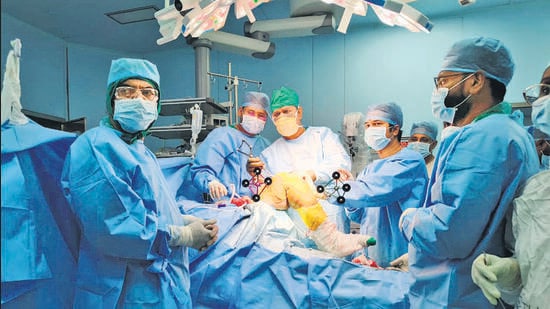
The surgery was carried out under the guidance of BJMC dean Dr Eknath Pawar and head of Orthopaedics, Dr Shrinivas Shintre. The surgery team included Dr Pravin Londhe, Dr Pradeep Jadhav, Dr Prafull Ingle and Dr Ritwik Shaw.
The osteoarthritis patient was suffering from intense pain in both her knees, making it difficult to walk and sleep. The condition of the left knee had worsened lately, which made her come to the hospital, seeking relief.
According to the doctors, after the patient was admitted for surgery, a CT scan of her leg was done, which was then converted into a 3D model using special computer software. This model helped the team plan the surgery with great accuracy.
During the operation, trackers were placed on her thigh and shin bones, and the robotic arm performed precise bone cuts based on pre-approved plans. Once the cuts were made, a trial fitting was done before the actual artificial joint was implanted.
“Unlike traditional surgeries, this procedure was supported by robotic technology, which offered enhanced precision and safety. In robotic-assisted surgery, bone cuts are guided by a robotic arm based on 3D mapping of the patient’s anatomy. This allows for extremely accurate implant placement, improving long-term outcomes and patient satisfaction,” said BJMC dean, Dr Pawar.
{{/usCountry}}“Unlike traditional surgeries, this procedure was supported by robotic technology, which offered enhanced precision and safety. In robotic-assisted surgery, bone cuts are guided by a robotic arm based on 3D mapping of the patient’s anatomy. This allows for extremely accurate implant placement, improving long-term outcomes and patient satisfaction,” said BJMC dean, Dr Pawar.
{{/usCountry}}Dr Surekha Shinde, head of the Anaesthesia department led the Anesthesia team of Dr Vijay Patil, Dr Tushar Sidgur and Dr Neha Jha.
According to hospital officials, robotic-assisted procedures cause minimal pain and discomfort post surgery. Also, the risk of complications is significantly less as the robotic system avoids deep drilling into bone cavities, and, hence, the chance of fat embolism (fat entering the bloodstream) is reduced.