In January 1947, two enterprising restaurateurs, Nanasaheb Sarpotdar and Kakasaheb Tambe, met in Pune to discuss the future of the restaurant industry in Maharashtra.
Sarpotdar owned a restaurant and a flourishing catering business in Pune, while Tambe ran a couple of eateries in Mumbai and was known all over India for manufacturing innovative “swadeshi” drinks, like Vitogen and Gandhi-peya.
The food industry in India was then at a nascent stage.
More people were moving to cities and living spaces were soon going to get smaller.
Sarpotdar and Tambe knew that soon restaurants would play an important role in the business, social, intellectual and artistic life in the thriving society. A healthy, thriving restaurant industry was not only critically important to the fabric of society through obvious stakeholders – the owners, employees and guests – but to an entire network of groups who might not have traditionally thought of themselves as stakeholders – the farmers, retailers and housewives. Eating out was looked down upon and restaurateurs were the new outcasts. The duo wanted this to change.
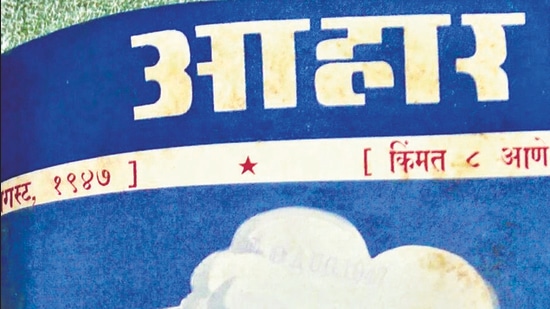
The outcome was “Aahaarmala”, the first mouthpiece of the food industry in Maharashtra and probably India, the first issue of which was published from Pune in April, 1947.
Sarpotdar wrote in the editorial – “This magazine would not limit itself to recipes and preach to its readers what, how and where to eat. We understand that beyond the basic purpose of restaurants to provide food and drink, in Western countries they have always fulfilled a human need for connections and shaped social relations. Our aim is to gain respect for restaurants and the workforce associated with it, and to make the common public aware of the challenges faced by the industry. We also want to talk about the food production in India, agriculture, retail and hospitality industry, household management and health. We want our readers to understand that the food industry will be an integral part of the development of this nation, and hence, initiatives like ‘Aahaarmala’ are in the interest of our beloved nation”.
{{/usCountry}}Sarpotdar wrote in the editorial – “This magazine would not limit itself to recipes and preach to its readers what, how and where to eat. We understand that beyond the basic purpose of restaurants to provide food and drink, in Western countries they have always fulfilled a human need for connections and shaped social relations. Our aim is to gain respect for restaurants and the workforce associated with it, and to make the common public aware of the challenges faced by the industry. We also want to talk about the food production in India, agriculture, retail and hospitality industry, household management and health. We want our readers to understand that the food industry will be an integral part of the development of this nation, and hence, initiatives like ‘Aahaarmala’ are in the interest of our beloved nation”.
{{/usCountry}}Unfortunately, Sarpotdar passed away a month later. Born in 1896, he had run away from his home as a child and joined a theatre company.
In 1927, he established Aryan Film Company and went on to produce and direct 24 silent, and six talkie, movies. Lalita Pawar, Hirabai Barodekar, Chandrakant, Shahu Modak, Ratnamala acted in movies he directed. He gave it all up to start the “Poona Refreshment House” and “Poona Guest House” on Lakshmi road in 1935.
Tambe took over the magazine and rechristened it “Aaahar” in June 1947.
Anand Antarkar was the editor. The absolute genius of Tambe and Antarkar lies in the fact that almost seven decades later, issues of “Aahaar” are still immensely enjoyable.
While the articles are informative, analytical, expressive and even persuasive, they often try to address human experiences directly. It must have been challenging for Tambe to find an inclusive way to cover all aspects of food production and sale in the magazine.
“Aahaar” regularly featured articles by stalwarts like Prabodhankar Thakarey, RD Karve, Durga Bhagwat, NS Phadke and VA Buva. It had interviews of eminent restaurateurs like Bandopant Joshi, Velankar, Veerkar and Pathare. These and several other restaurateurs wrote about their experiences in countries like Japan and the USA.
“Aahaar” taught its readers to use “modern” equipment like a pressure cooker, electric grinder and ovens. It told them how to arrange the kitchen and keep fruits and vegetables fresh. Several articles taught new restaurateurs how to cook, talk to guests, maintain cleanliness and make sense of the complex laws.
There were translations from “Royal Institute of International Affairs” and “Financial News” which dealt with agriculture, land reforms and market economy.
It did not stop at printing recipes for “new” dishes like samosa and masala dosa. All the while it existed, “Aahaar” regularly kept urging women to become a part of the food industry. There were several articles which provided blueprints to women for starting an eatery.
The most spectacular aspect of “Aahaar” was its empathy for the restaurant-staff and workers. Many of them were young children and men who would work long hours without food. They had absolutely no support in cities like Mumbai and Pune. “Aahaar” publicised their plight. It urged the owners to treat them with dignity and pay them well.
Mahatma Gandhi was a regular reader of “Aahaar”. Tambe would send him translated articles. They shared a warm bond and this reflected in the articles printed in “Aahaar”. Tambe was inspired to start a restaurant after reading a booklet written by Gandhi promoting “clean” eating. Gandhi later praised his efforts to popularise buttermilk as a drink in Maharashtra.
“Aahaar” ceased to exist in 1954. It is a testimony to the dazzling pragmatism of Sarpotdar and Tambe. That they desired that restaurants be woven into city planning, neighborhood development, and real estate in 1947, talks volumes about their foresight. They wished to see their country prosper and created “Aahaar” to further their cause.
It took only a few decades for restaurants, from being considered anti-religion and anti-national, to be an important part of the national economy.
Sarpotdar, Tambe and “Aahaar” definitely deserve credit for being an important part of this journey.