
 E-Paper



Taste of life: How the canned food industry took roots in India
The government saw a possibility that trade in canned mangoes might be developed. The Europeans loved mangoes and there was a ready market for the canned fruit in India too


The canned food industry is an important part of the world economy. Not only do canned foods provide year-round access to important nutrients, but manufacturers of canned food products provide jobs and generate sizable revenues for governments.
While societies have preserved foods through drying, smoking, sugaring, freezing, and salting for hundreds of years, safely storing food in metal and glass canisters dates only to the early 1800s.
In 1809, Nicolas Appert, a French confectioner and brewer, observed that food cooked inside a jar did not spoil unless the seals leaked, and developed a method of sealing food in glass jars. The process of canning rapidly made progress since then.
In nineteenth and twentieth-century India, canned food, being a novelty, became a status symbol among Europeans and rich Indians. Especially coveted were canned mangoes.
The mango was rightly called the king of fruits. It was unrivalled in colour, smell, and taste. The green mangoes were cooked as chutneys and the ripe ones were eaten fresh. The juice was dried and made into thin cakes. Various other kinds of preserves and pickles were made of mangoes.
Europeans generally preferred it as it was turning ripe, when the flesh was yet firm and cut easily. Indians however liked it at a later stage when the flesh was soft and squashy. One method common among Europeans was to take up a slice on each side leaving the stone and its surrounding pulp in the middle, scoop out the side slices and bite the flesh off the stone after removing a ring of skin on it. Indians often sliced the mango into sections and ate each separately after skinning.
Although mangoes are one of the oldest cultivated fruits of India, the knowledge about the life history of the plant and the physiology, ecology, and genetics of the flowers, the detailed methods of their pollination and fertilisation and the nature of the yield per year or every alternate year was very poor. Research on such problems for greater yield, production of improved disease-proof varieties by judicial cross-breeding and grafting and quicker rotation in the yield were imperative and carried out at the Ganeshkhind Botanical Garden since the early twentieth century. The agriculture department also entrusted the garden with conducting experiments to achieve successful canning of mangoes.
The mango crop was in season for about two months in the Bombay Presidency, during which period the fruits glutted the market considerably. The cultivators on several occasions did not get a proper price for their produce. In several districts along the coastline in the Bombay Presidency mangoes were left unsold every year on account of the stoppage of steamers during the rains
The government saw a possibility that trade in canned mangoes might be developed. The export of canned mangoes to the countries overseas was an exciting prospect. The Europeans loved mangoes and there was a ready market for the canned fruit in India too.
Canning, in the early nineteenth century, was recognised all over the world to be the most practical method of storing large quantities of fruits and vegetables for use in lean months. It involved preservation either in tin cans or in glass jars or bottles. It depended on the complete sterilisation of the product by heat and the exclusion of other organisms.
Regular use of fruits and vegetables meant better health, and canning could make them available all around the year. It was an economical way of preserving fruits and vegetables when they were plentiful.
The efforts to conduct experiments to achieve the canning of mangoes in Poona also gained momentum after canned fruits from Bengal flooded the markets in the Bombay Presidency.
The first cannery in India, the Bengal Preserving Company, was established in Muzaffarpur in 1906 by AB Sircar after his return from the USA. A few years later, Srikissen Dutt and Company, Calcutta, started their cannery section. The canning operations were done under the guidance of RK Dutt who had trained in the USA.
Fifteen varieties of canned fruits, twenty-five varieties of canned vegetables, four canned soups, nineteen varieties of canned fish, and twenty crystallized fruits were offered by this cannery. Canned pickles, chutneys, jams, and jellies were sold too. The chutneys included such well-established brands of the time as Col Skinner’s, Major Grey’s, Bengal Club, and Calcutta Club, each made to specific recipes and with distinct tastes.
The agricultural department of the Bombay Presidency decided in January 1913 to allot funds for the next ten years to carry out canning experiments at the Botanical Garden in Poona.
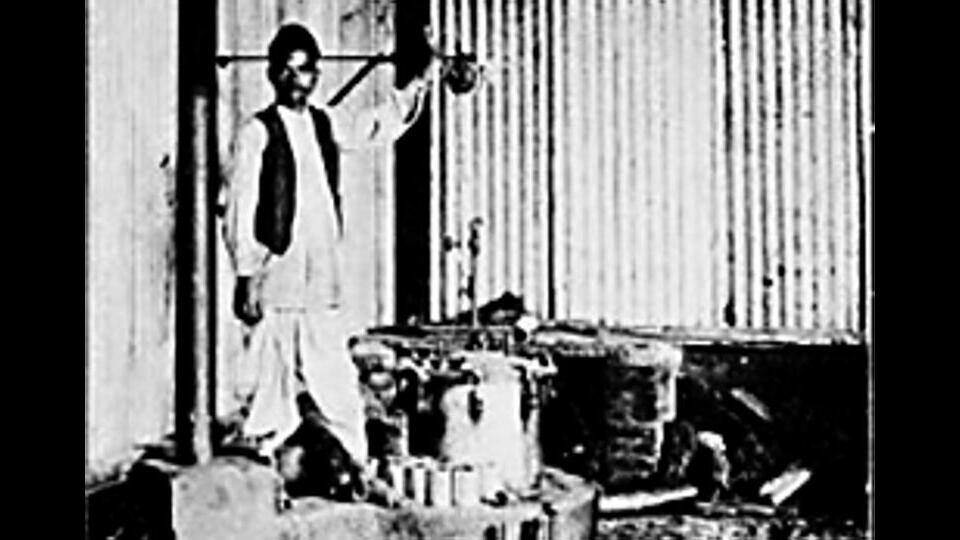
A steam pressure canning apparatus (Hotel Outfit No 1) was ordered from the North Western Steel and Iran Works, Eau Claire, USA, and received in time to can some of the mangoes of the season in 1913. The net price of the apparatus was ₹150. This particular type of apparatus was chosen because it could develop a steam pressure of 30 lb per sq inch. As a rule, only 10 lb per sq inch was used in canning. A fire could be built under this model. Such a type suited Indian conditions better than one with a firebox.
The process employed at the Ganeshkhind Botanical Garden started with the mangoes being skinned, stones removed, pulp sliced, and filled into the tins. In some cases, the juice was only put into the tins. The lid was soldered on each tin, leaving a small central hole (the vent hole) open. The tins were put into the apparatus and kept at varying pressures for different periods. This process was called “exhaustion”.
The tins were then removed and the vent holes were sealed. The tins were put back in the apparatus and subjected to a further period of treatment, at varying pressure. This was called “sterilisation”.
The results of the 1913 canning experiments were somewhat vitiated by either faulty cans or faulty solder and about forty per cent went bad. The others varied considerably in flavour and consistency.
These experiments were carried out with “Pairi”, “Alphonse”, “Khoont”, “Shendrya”, “Shahbuddin”, “Cowasjee Patel”, and “country” varieties of the mango. The best results were obtained with the tins filled with the juice of “country” mangoes, exhausted for 3 minutes at 2 lb pressure and sterilized for 15 minutes at 10 lb. In some cans the consistency was watery and the taste sweet, in others, bitter.
The next year, experiments were repeated using the same varieties of the mango. Many cans were swollen due to the formation of gas inside, the bacteria not being sufficiently killed.
The results in the next few years were a long way from success in the case of pulp, but the tins filled with juice from “country” mangoes showed good promise of success in those cases where the pressure was small and the time of the process was rather prolonged.
These experiments went on for almost a decade. While it was concluded that the “country” variety was the most suited for canning, the notions of prestige and luxury associated with the “Alphonse” variety made the agriculture department abandon the “country” mango.
By the 1940s, a handful of entrepreneurs had undertaken canning of fruits in the Bombay Presidency. The agriculture department had provided a few of them with the required knowledge. Their success could be attributed to the experiments that started in 1913 in Poona.
Chinmay Damle is a research scientist and food enthusiast. He writes here on Pune’s food culture. He can be contacted at chinmay.damle@gmail.com


