
 E-Paper



Jharkhand assembly passes 1932 Khatiyan bill again
The Hemant Soren government, during a special session on November 11, 2022, had passed the ‘Jharkhand definition of local persons and for extending the consequential, social, cultural, and other benefits to such local persons Bill, 2022’, also known as the 1932 Khatiyan Bill.

 Prefer HTon Google


The Jharkhand assembly, on Wednesday, once again passed the 1932-based domicile Bill, which specifies that only individuals or their ancestors listed in the Khatiyan (land records) of 1932 or earlier would be recognised as local inhabitants of Jharkhand, entitling them to Class III and Class IV jobs in the state.
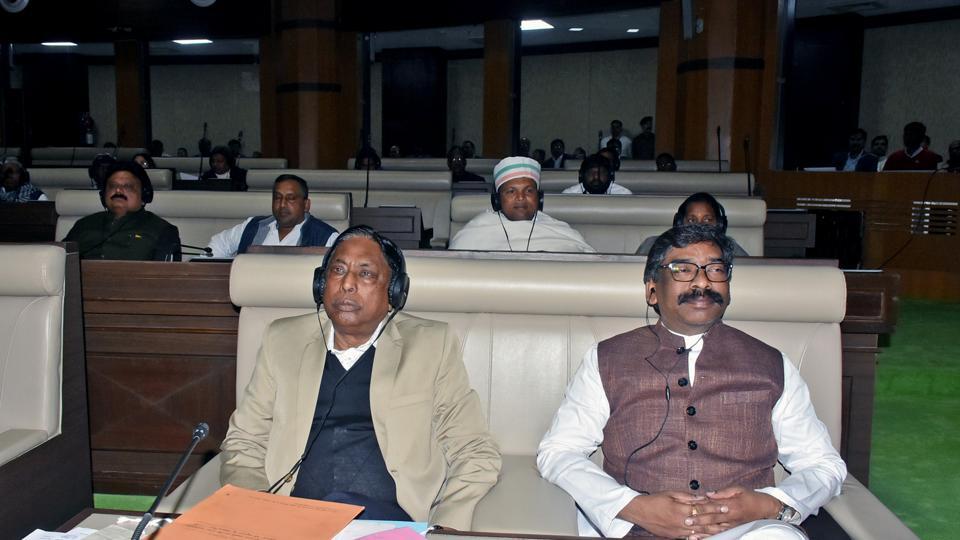
The Hemant Soren government, during a special session on November 11, 2022, had passed the ‘Jharkhand definition of local persons and for extending the consequential, social, cultural, and other benefits to such local persons Bill, 2022’, also known as the 1932 Khatiyan Bill.
However, the Bill was returned twice by the Raj Bhawan since then for reconsideration.
Despite this, the Hemant Soren government brought the Bill back into the assembly on Wednesday without making any changes, rejecting the governor’s opinion to make changes based on suggestions from the Attorney General of India (AGI).
“We don’t believe there is any need to amend the bill. I request the house to pass this unanimously,” said chief minister Hemant Soren while proposing the passage of the Bill.
He added that the Bill represents “the ethos and the ‘Asmita’ (identity)” of Jharkhand.
Soren argued that the bill addresses all references to Supreme Court orders cited by the AGI, hence, there was no need for any amendment in the original bill.
According to this Bill, passed on November 11, 2022, only individuals or their ancestors listed in the Khatiyan (land records) of 1932 or earlier would be considered local inhabitants of Jharkhand, entitling them to Class III and Class IV jobs in the state.
The new law, per the Bill’s provisions, would come into effect after being included in the Ninth Schedule of the Constitution, thereby shielding it from judicial review.
The state government forwarded the Bill to Raj Bhawan for assent and subsequent submission to the Centre for inclusion in the ninth schedule in December 2022. However, then-governor Ramesh Bais returned the Bill to the government for reconsideration in January this year, emphasizing the need to review its legality and alignment with constitutional norms and court rulings. Despite this, the state government sent the Bill back to Raj Bhawan, requesting detailed objections alongside the legislation.
On December 2, Raj Bhawan returned the Bill to the assembly with a message containing the attorney general’s opinion. Speaker Mahto read the governor’s message on Friday during the first day of the winter session.
The governor’s message highlighted that section 6(a) of the bill might breach Article 14 and Article 16(2) of the constitution. He suggested an amendment in line with the attorney general’s opinion to ensure constitutional validity, as the people said.
The governor’s message quoted the attorney general, expressing concerns about the absolute exclusion of non-local persons from applying for Class III and Class IV posts under the state government. “The attorney general proposed a constitutionally safer approach of providing preference to local persons when all other aspects are equal. Additionally, for Class IV posts, the attorney general recommended that only local persons be considered, with a review of this scheme after five years, creating a database for government understanding and ensuring justice for deserving local candidates,” the governor’s message reads.
However, the chief minister argued that the state government had sought the opinion of the advocate general and deemed it fit for passage by the house.
“Through you, I would like to submit that the state government sought the opinion from the learned advocate general. He has clarified that the bill can be passed and included in the ninth schedule of the constitution. Additionally, it could also be included in Part-III of the constitution as per Article 31(B) of the constitution and insulate it from any judicial review,” the chief minister said.
While the opposition Bharatiya Janata Party (BJP) did not oppose the Bill, Leader of the Opposition (LoP) Amar Bauri said the bill was intended to create a legal tangle and alleged that the government was not serious about providing jobs to the youth.
“The government has brought this Bill, but your intent is not clear. You promised to provide five lakh jobs, but four years have passed. Accept your failure that you have failed the state’s youth. Your intent is doubtful because you can ensure that Class III and IV jobs for locals by an executive order. We don’t need a bill or inclusion in the ninth schedule to do so and throw the ball into the court of the Centre or any other court. Our previous government defined the domicile and provided jobs to lakhs of people, out of which 95 per cent were locals. If you really intend to do this, bring an executive order and give jobs to youth,” said Bauri.
The treasury bench members argued that getting the bill included in the ninth schedule was necessary to insulate it from judicial review.


