
 E-Paper



Jharkhand govt tables ₹1.58L cr budget for 2026-27
Jharkhand's ₹1.58 lakh crore budget for 2026-27 focuses on social sectors, education, and rural development, with new initiatives for health and empowerment.

 Prefer HTon Google


The Jharkhand government on Tuesday tabled ₹1.58 lakh crore budget for the upcoming financial year 2026-27 in the Assembly, an increase of around nine per cent in the total annual outlay as compared to the current fiscal, with major focus on social sector, school education and rural development.
Some of the key new announcements include setting up a state university in Chatra district named after Babasaheb Ambedkar, opening 100 new CM Schools of Excellence, setting up test facilities at five medical colleges and 24 sadar hospitals for early cancer detection, opening of 750 Abua medical shops to provide medicines at affordable rates and providing AI training at six selected ITIs in the state.
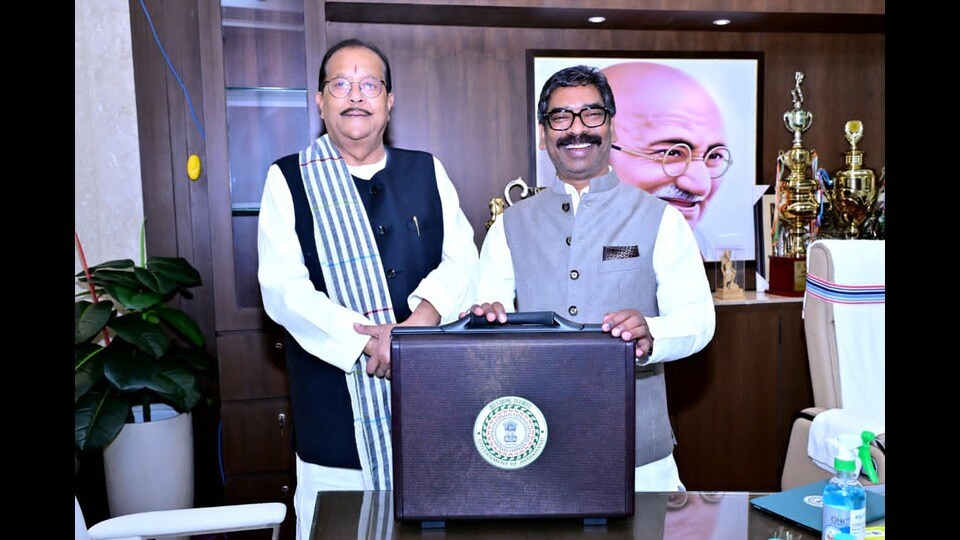
Tabling his second consecutive budget in the Jharkhand Assembly, finance minister Radha Krishna Kishore paid tributes to former CM Shibu Soren, who passed away last year, calling the 2026-27 budget the ‘Abua Dishom Budget’.
“The budget will meet the aspirations of every section of society, including the poor, farmers, tribals and women. The ‘Abua Dishom’ (our own) budget will help wipe the tears of the poor, and it will also bring smile to the faces of Jharkhand citizens,” said the minister.
In terms of sectoral allocations, the budgetary proposals seem to have a sense of continuity from the current fiscal with women and child welfare, education and rural development getting the lion’s share. Women, child development and social security department is the biggest gainer with ₹22,995.69 crore, followed by ₹16,251.43 crore for school education & literacy and ₹12,346.90 crore to rural development department.
Of the ₹22,995.69 crore allocated to the women, child development & social security department, ₹14,065.57 crore has been allocated for the flagship Mukhyamantri Maiyan Samman Yojna (MMSY) under which women in age group 18-50 get ₹2,500 every month.
“People often criticise this government for this scheme. But the revolutionary impact of this scheme would be visible in the next couple of years. The amount is small, but more women are able to send their kids to school, they have money at hand for priority spending. This government is committed to empowering women at the grassroots,” the minister later told reporters.
On the new major announcements, the minister said opening of the Babasaheb Ambedkar University and special allocation for cancer identification had been done after due deliberations. “The university is dedicated to the framers of the Constitution. Chatra has been chosen for the project as it is along the bordering areas of Bihar,” he said.
“Due to an increase in the number of cancer incidences, the government has decided to provide PET and CT scan machines at all five medical colleges, besides installing memography machines at all 24 sadar hospitals for detection of breast cancer. Of the total allocation to the health department, ₹200 crore has been set aside for this purpose,” the minister said.
The budget also laid emphasis on the tourism sector as Jharkhand is bestowed with rich mineral resources, religious places like Baba Baidyanath temple in Deoghar and the Rajrappa temple, besides popular tourist spots like Netarhat.


