A soon-to-be-launched news channel has declared public enemy #1. Not poverty, disease or illiteracy, it’s Pakistan.
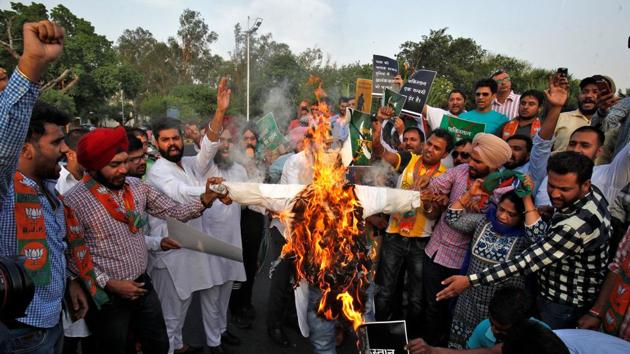
The channel isn’t on air, but if you watched the news on other channels this past week, you’d imagine that war had been declared as retribution for Pakistan killing and decapitating two of our soldiers – not for the first time.
News channels went into overdrive, and a senior officer had to clarify. No, he told Hindustan Times, India had not destroyed Pakistani bunkers and killed several soldiers. “They [TV channels] go ballistic without asking us anything,” said the unnamed officer.
It wasn’t just hyperventilating channels. Political parties too were piggybacking on public outrage. Ironically, the BJP, which not so long ago was accusing the then ruling UPA of weakness with regard to Enemy State Pakistan, was now fending off the same theatrical accusations (including the predictable wearing of bangles, presumably a sign of weakness since they are worn by women).
This noisy media-public-politician caucus is placing our army at the edge of dangerous hyper-nationalism. Even otherwise restrained anchors swore not to invite Pakistani enemies on their shows, because, after all, who wants to be seen as anti-national? Never mind that journalism means listening to all sides.
The pitch is so high that any questioning of army action, no matter how legitimate, invites abuse. When Lt Gen H.S. Panag questioned the army’s decision to tie an alleged Kashmiri stone-pelter (he wasn’t) to the front of an army jeep, he was trolled on social media. The tenor of chatter on Whatsapp and email groups of retired officers was triumphant. “Ironically, many had been hard task masters and upholders of human rights while in service. It’s as if, in keeping with changed times, they had given in to baser instincts,” says General HS Panag.
{{/usCountry}}The pitch is so high that any questioning of army action, no matter how legitimate, invites abuse. When Lt Gen H.S. Panag questioned the army’s decision to tie an alleged Kashmiri stone-pelter (he wasn’t) to the front of an army jeep, he was trolled on social media. The tenor of chatter on Whatsapp and email groups of retired officers was triumphant. “Ironically, many had been hard task masters and upholders of human rights while in service. It’s as if, in keeping with changed times, they had given in to baser instincts,” says General HS Panag.
{{/usCountry}}Elsewhere, anchors saw the action as a masterstroke that helped avert a bloodbath instead of asking the obvious question: why parade him for four hours?
“Media should be asking about lapses with regard to Sukma and the decapitation of soldiers,” says General Panag. Instead, it’s joined the ‘10 heads for one’ chorus.
We do the army no favours by placing it on a pedestal from where it cannot be asked legitimate questions. We do it no favours when we seek to draw it into an emotional public debate.
Military action cannot be based on populist sentiment; wars are not fought and won in TV studios. A solution, when found, will not happen by placing hot emotion over cool strategy.
Those who feel strongly about supporting the army, including our loquacious anchors, need not feel disheartened. There is a place for citizen action. It is here, Happy donating.
Namita Bhandare writes on social issues and gender. The views expressed are personal
@namitabhandare