The call by the leaders of the farmers’ agitation to gherao Delhi was only partially effective. The stir is still somewhat restricted and so was the effect of the Bharat bandh. So, what is the next step for the farmers? It appears that the leaders will go on a hunger strike at Delhi’s Singhu border on December 14.
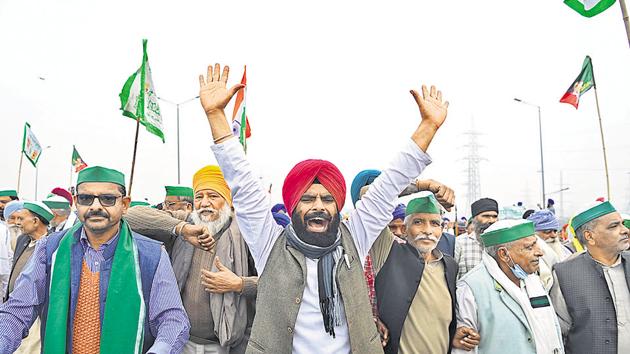
The central as well as state governments concerned know that they must act in a spirit of generosity rather than adopt an iron fist approach. This is why Union agriculture minister, Narendra Singh Tomar, and commerce minister, Piyush Goyal, have repeatedly emphasised that the central government has no ego in this matter. However, the movement shows signs of spreading in its intensity. Why is this the case?
There have been very few instances in which the Capital has been brought under siege in such a way. The dharna was organised by farmers from Punjab, Haryana and western Uttar Pradesh. A limited number of farmers from other parts of the country joined it.
But the degree of preparation undertaken by the agitating farmers is nothing short of astounding. They have ensured daily essentials including medicine and food to sustain a long-term protest. They have also won the sympathy of the public and several gurudwaras and charitable organisations have come to their aid. But if farmers from other states do not join this agitation, how long can this protest last?
Similar questions were raised when Chaudhary Mahendra Singh Tikait led thousands of farmers in protest at the Boat Club in Delhi 32 years ago. Let us not forget that unlike several other kinds of protestors, farmers have a near-spiritual relationship with their land, produce and ecosystem. They are not easily deterred by the elements or other adverse conditions.
{{/usCountry}}Similar questions were raised when Chaudhary Mahendra Singh Tikait led thousands of farmers in protest at the Boat Club in Delhi 32 years ago. Let us not forget that unlike several other kinds of protestors, farmers have a near-spiritual relationship with their land, produce and ecosystem. They are not easily deterred by the elements or other adverse conditions.
{{/usCountry}}So far, leaders have ensured that the protests have been peaceful. There are, of course, hotheads in any agitation but they have been controlled quite effectively. The vast majority of those protesting are in favour of registering their grievances without any resort to violence.
There have been outsiders who have been systematically attempting to provoke them. Some have labelled the agitators as Khalistan supporters. There are still others who are casting aspersion on the farmers saying that the whole protest is part of a conspiracy by China or Pakistan. Some even went to absurd lengths to allege that these were not farmers at all judging from the way they were dressed. Though the farmers did not rise to any of these baits, all this has led to a widening of the trust deficit between them and the government.
So far, the efforts by senior central ministers have failed to make any headway. The government must rein in disruptive elements who are trying to provoke the farmers and stress on the fact that there is a fundamental difference between this movement and the resistance seen in Shaheen Bagh.
The initial success of the movement and the support it got seem to have made the farmers more ambitious than warranted at the moment. The call for a Bharat Bandh was not well thought-out. This gave the Opposition an opportunity to join the cause and with this, the politicisation of the movement began. Last Tuesday’s Bharat Bandh made it clear that even though the farmers had called for a nationwide protest, they did not have the reach or strength to affect the whole country. The bandh left an impact in Opposition-ruled states and in those where the Opposition is on a strong wicket. In Maharashtra, where there is a non-Bharatiya Janata Party (BJP) government, the shutdown did not create as strong an impact as expected though farmers in the state have been agitating for quite a long time.
This gave the National Democratic Alliance (NDA) constituents the opportunity to allege that the movement was the handiwork of the Opposition. In order to thwart the bandh, the government not only tightened its administrative machinery but also fielded all its prominent leaders. This is why the farm leaders later reworked their strategy. They sought to maintain a distance from those who tried to link their agitation with Shaheen Bagh.
This movement will end sooner or later. We have to think beyond an agreement on both sides. Farmers must be taught new techniques to increase their yield and income. Indian farmers are focused almost solely on wheat and paddy. As a result, India grows more wheat and rice than it needs.
On the one hand, there are people who do not get enough food and, on the other, the government does not have enough warehouse capacity to store foodgrains. The farmers must be provided with the expertise to grow different kinds of produce appropriate to the climate and soil in their regions. This will increase agricultural yield and boost farm incomes. It is clear that India desperately needs a complete revolution in agriculture. But, are both the farmers and the government ready to acknowledge this and take suitable steps?