Economics can soar into the stratosphere of advanced mathematics. It can present grand visions, paint big pictures, real in theory but not apparently rooted in reality. The Nobel Prize to three economists, Abhijit Banerjee, Esther Duflo, and Michael Kremer brings economics down to earth. In their citation, The Royal Swedish Academy of Science said the three had addressed “smaller more manageable questions” about the persistence of poverty in spite of the growth of the global economy.
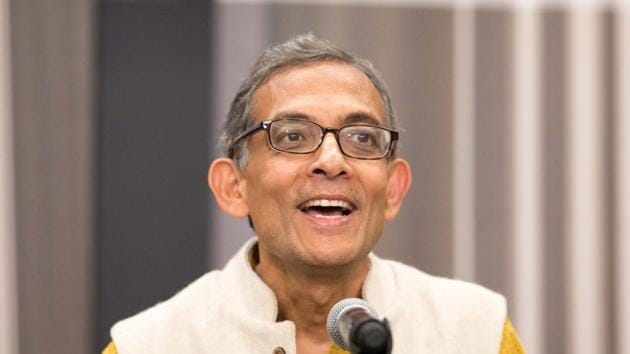
The Swedish Academy’s recognition of the value of this basic, or grassroots, economics, is of course good news for India. But it should also be taken as advice to be acted on. It’s good news because for the second time an Indian has been awarded a Nobel Prize for economics. This also demonstrates that the best of Indian education is world-class. Professor Banerjee studied first at Calcutta University, and then Jawaharlal Nehru University (JNU), before going on to Harvard for his PhD. The award should also create awareness of the loss India is suffering by allowing an educational asset as valuable as JNU to be embroiled in controversy.
The three prize winners’ method of research is popularly known as the Randomised Control Trial (RCT) approach. It is similar to the method used to test drugs. Two similar groups are chosen. One group is given a possible improvement in the delivery of health or education — in one case that was more textbooks, in another remedial classes. The other group is not given the possible improvement, and the results of the two are compared.
In an interview after the award was announced, Professor Duflo said, “Without spending some time understanding the intricacy of the lives of the poor and why they make the choice that they make, and why something that might seem at first surprising makes a lot of sense in a particular logic it is impossible to design the right approach.” So here is one lesson for India surely: The right approach can never be some centrally-planned scheme dumped on the poor without consulting them. It’s the poor who should be allowed to choose the help they need, not bureaucrats or indeed politicians. To give the government its due, RCT was apparently used in designing the Aadhaar card and implementing reforms in the public distribution system.
{{/usCountry}}In an interview after the award was announced, Professor Duflo said, “Without spending some time understanding the intricacy of the lives of the poor and why they make the choice that they make, and why something that might seem at first surprising makes a lot of sense in a particular logic it is impossible to design the right approach.” So here is one lesson for India surely: The right approach can never be some centrally-planned scheme dumped on the poor without consulting them. It’s the poor who should be allowed to choose the help they need, not bureaucrats or indeed politicians. To give the government its due, RCT was apparently used in designing the Aadhaar card and implementing reforms in the public distribution system.
{{/usCountry}}The RCT approach yields scientific data. To analyse that data, Banerjee and Duflo have a laboratory at their university, Massachusetts Institute of Technology, or MIT. It’s called the Abdul Latif Jameel Poverty Action Lab. JNU economist, Himanshu, says he hopes the award “will spur our own government to take data and evidence more seriously”.
Another lesson for India is the role of NGOs in the RCT approach. All three prize winners worked with local NGOs. After receiving the award, Professor Banerjee said he had learnt huge amount from the Indian educational NGO Pratham and the South Rajasthan NGO Seva Mandir. But NGOs are organisations the government treats with suspicion instead of encouraging them to contribute to its understanding of overcoming poverty.
Inevitably, there has been criticism of the awards in academia. In an article in the Wall Street Journal, macro- economist, David R Henderson, has criticised the concentration on the micro-level in research and claimed “immigration and economic growth are far the most reliable ways to improve the quality of life among the world’s poor.” The rise of extreme right leaders in the West seems to me to be in part at least, due to poorer people feeling growth has enriched the rich and bypassed them. As for immigration, nation-states are tightening their borders rather than relaxing them, and so, immigrants are unlikely to be welcome anywhere. Whether I am right or wrong, surely the answer is that macro and micro-economics should flourish side by side, each enriching the other.
The views expressed are personal