


 Live Score
 Cricket Teams
 Cricket Players
From Ranji to Surya: Batters who revolutionised shotmaking in cricket
The textbook is for beginners and the real stars of the game are always the players who have their own rule book


New Delhi: As a rule, captains have hated batters who take the field out of the equation. These are batters who play the field — constantly seeking out gaps or hitting shots to areas where there are no fielders. In such cases, the captaincy can often be only reactive.

Twenty20, as a format, is becoming bolder and wilder by the year. A ringside view of a practice session of batters will tell you that they spend a great amount of time range-hitting but it is also the time when they experiment with shots that aim to access more parts of the ground and scoring zones.
It is no surprise then that ridiculous shots are becoming more frequent. Over the years, batting has undergone a tactical shift with players going beyond traditional shot-making, innovating some new ones and rediscovering more scoring areas and capitalising on the area behind the square.
According to CricViz, a breakdown of run percentages by scoring zones in the T20 World Cup over the last five editions reveals that whilst the 2016 and 2021 edition still saw scoring largely dependent on the dominant onside areas, the trends have changed massively in the last two editions. The runs scored on the onside between the midwicket and long leg – dropped in 2022 and significantly in 2024. Instead, it started leaning heavily into the Straight V%-- between extra cover and midwicket – and Behind the V% – between third man and fine leg.
Today, multiple modern day T20 cricketers are known for their all-round-the-ground batting – be it Suryakumar Yadav, Glenn Maxwell, Abhishek Sharma or Heinrich Klaasen and it explains why that redistribution has peaked.
However, before innovation became so mainstream, there were pioneers that forced revaluation of conventional run-scoring and cricket rules.
It perhaps started with K. S. Ranjitsinhji, who at the turn of the 20th century, innovated the ‘leg glance.’ His coach at one time, Dan Wayward, suggested a modification in order to correct his tendency to move out of the line and towards point against fast bowling. Yet his left foot continued to make its way across and as a result, he ended up twirling his wrists to deflect the ball fine.
In that era, batters would apologise to bowlers for hitting the ball in an unexpected direction, and captains would not put fielders there - “he expected you to drive on the off side like a gentleman.” Ranji changed that.
Batters such as Hardik Pandya, Chris Gayle and Marcus Stoinis now commonly bat with a high back-lift to generate more momentum and bat speed. But Viv Richards and Brian Lara did it before it was cool. Richards’ batting was defined by an aggressive, high-backlift swing, a dominant bottom-hand grip, allowing him to pull or hook fast bowlers from outside off-stump with ease. Lara’s high bat-swing with crouched stance, a top-hand dominant grip allowed him to execute drives and cuts with a full follow-through.
During his time with the Sunrisers Hyderabad, Brian Lara made Abhishek Sharma play golf to improve his bat-swing.
Unconventional shots and Kevin Pietersen’s switch-hits go hand-in-hand. One of cricket’s most controversial shots, the switch-hit pretty much urged a re-evaluation of cricket rules as it allowed batters to neutralise field placements set for a right-hander.
True to his rebellious self, Pietersen insisted that he would not abandon his switch hit after receiving a formal warning by the umpires for misusing the stroke during the second Test at the P Sara Oval in 2012. Pietersen walked so modern cricketers could run. It is becoming increasingly common for batters to unleash shots that destabilise a bowler’s existing plan. KP’s switch hit forced bowlers to abandon traditional line-and-length logic. The switch-hit destabilised matchups and made fields temporarily irrelevant.
Zimbabwe’s Doug Marillier invented the scoop shot. The Marillier involved flicking the ball over the shoulder towards the fine leg region. And necessity is the mother of invention, they say. So Sri Lanka’s Tillakaratne Dilshan perfected it and it was then called the ‘Dilscoop’. It became an effective way to exploit field restrictions in limited overs cricket. High risk, high reward, the shot involved the batter kneeling to scoop a good-length or short ball directly over the wicket-keeper’s head. This shot did play a massive role in accelerating the rise of ‘behind V percentages’ in scoring.
One of the most iconic 360° players – AB de Villiers’ – had multiple innovative shots in his repertoire. But the iconic sweep against seam came off even against the likes of fast bowlers Lasith Malinga and Dale Steyn meant he could hit sixes off full deliveries behind square even off slower balls.
The sweep comes out far too often now, especially in the subcontinent, in order to counter spin. But Glenn Maxwell’s reverse sweeps took the largely spin-only shot and also executed it against pace. As a result, expanded scoring zones square of the wicket.
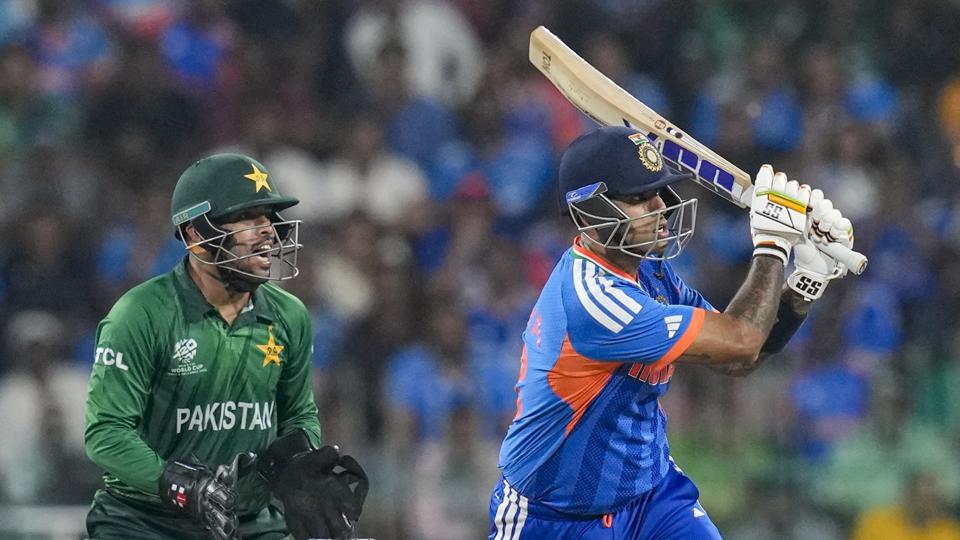
Amongst the current-gen spatial thinking maestros, Suryakumar is one of the modern masters of behind-the-square scoring. He glides off good length deliveries and has perfected the ramp shot, now a signature, that sends the ball over deep fine leg for six.
This generation may be rewriting the way T20 cricket grows but they learnt from the past and added new layers to it. And in the process, it has changed how the runs are redistributed on the cricket field.


