


 Live Score
 Cricket Teams
 Cricket Players
GT's INR 10.27 crore bill on the field: Shubman Gill's costly mistake becomes the gateway to KKR's 247-run Eden assault
Gujarat Titans lost to Kolkata Knight Riders primarily due to poor fielding, resulting in a total loss of INR 10.27 crore from four dropped catches.

 Prefer HTon Google


Gujarat Titans did not lose to Kolkata Knight Riders only because KKR batted big. They lost because their fielding gave KKR’s biggest batting assets extra overs, extra balls and extra monetary value.
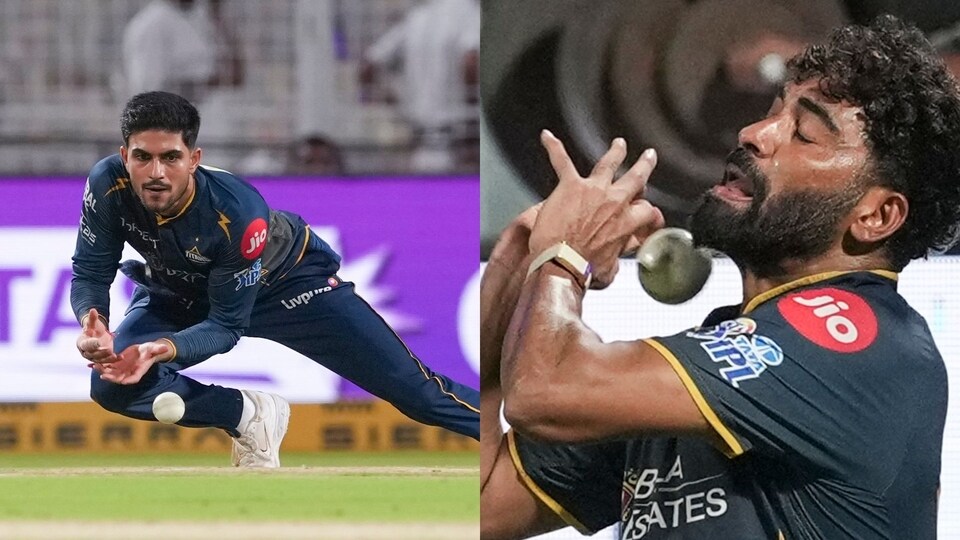
The four dropped catches in KKR’s innings carried a direct fielding penalty of INR 54.10 lakh. Once the escaped runs and post-drop batting impact are added, GT’s total non-duplicated loss rises to INR 10.27 crore in Match 60.
GT’s INR 10.27 crore fielding leak against KKR
KKR finished on 247/2 at Eden Gardens, their highest total against the Gujarat Titans, and eventually won by 29 runs. Finn Allen led the damage with 93 off 35 balls, while Cameron Green and Angkrish Raghuvanshi also converted their lives into damaging half-centuries. There were four dropped chances by GT, and Finn Allen’s reprieve was a major moment in the game.
The raw catch-drop penalty alone showed a fielding collapse. Shubman Gill’s drop of Allen at 2.6 cost INR 19.45 lakh. Mohammed Siraj’s drop of Allen at 6.5 cost INR 10.43 lakh. Arshad Khan’s drop of Cameron Green at 15.2 cost INR 10.69 lakh. Washington Sundar’s drop of Raghuvanshi at 17.4 cost INR 13.53 lakh.
That gives the base fielding damage: INR 54.10 lakh. The real damage begins after that.
Gill dropped Allen in the third over. From that point onward, Allen scored 79 runs off 27 balls and generated 119.07 batting impact points. In our monetary model layer, that escaped batting spell was worth INR 5.95 crore. Add Gill’s direct drop penalty of INR 19.45 lakh, and that one chance becomes an INR 6.15 crore standalone damage event.
Siraj then gave Allen another life at 6.5. From that point onward, Allen added 60 runs off 18 balls and generated 93.14 batting impact points. That was worth INR 4.66 crore in escaped value. Add Siraj’s direct fielding penalty, and the second Allen drop becomes an INR 4.76 crore standalone event.
Those two Allen chances cannot simply be added together in the final total. Gill’s drop already includes everything Allen did later, including the damage after Siraj’s drop. Counting both full values together would inflate the loss. The cleaner non-duplicated calculation keeps Allen’s post-first-drop damage as the full escaped Allen liability, then adds the direct penalties for both drops.
That still leaves GT with a brutal Allen-only leak: INR 5.95 crore in escaped batting value, plus INR 29.88 lakh in combined direct penalties from Gill and Siraj. Total Allen drop damage: INR 6.25 crore.
Cameron Green’s chance added another layer. Arshad Khan dropped him at 15.2 off Rashid Khan. Green scored 29 runs off 16 balls from that point and produced 35.64 batting impact points. At INR 5 lakh per impact point, his escaped value stood at INR 1.78 crore. With Arshad’s direct penalty added, the Green drop cost GT INR 1.89 crore.
Raghuvanshi’s drop came later, but the timing made it sharp. Washington Sundar put him down at 17.4 off Kagiso Rabada. Raghuvanshi scored 30 runs off nine balls from that point, adding 49.88 batting impact points. At his INR 4 lakh per impact point value, that was worth INR 2.00 crore. Add the direct penalty, and the damage becomes INR 2.13 crore.
The complete non-duplicated bill reads like this: Allen’s escaped batting value from the first drop, INR 5.95 crore; Green’s escaped value, INR 1.78 crore; Raghuvanshi’s escaped value, INR 2.00 crore; and all four direct catch-drop penalties, INR 54.10 lakh. Total: INR 10.27 crore.
GT lost by 29 runs. Allen alone scored 79 runs after the first reprieve. Raghuvanshi and Green added another 59 runs combined after their chances. The match did not drift away in one death-over burst. GT kept opening exits for KKR batters, and KKR kept walking through them with sixes in their pockets.
Gill’s drop remains the biggest standalone event because it gave Allen the longest runway. Mohammed Siraj’s drop becomes the heaviest marginal wound because Allen’s post-second-life burst was worth INR 4.76 crore on its own. Arshad and Washington’s misses then turned an already expensive innings into a 247-run wall.
For GT, the most damaging drop was Gill putting down Allen at 2.6. It created an INR 6.15 crore standalone swing and allowed Allen to build the innings that set KKR’s win in motion.
The sharper dressing-room question, though, sits with the collective damage. Four dropped catches produced an INR 10.27 crore non-duplicated fielding loss. In a 29-run defeat, that is no longer a fielding footnote. That is the match ledger bleeding in full view.
Method note
This calculation uses the Match 60 impact and monetary files from a model designed exclusively by the author. Each dropped catch was valued in two layers: the direct fielding penalty charged to the fielder, and the batting impact generated by the dropped batter from that delivery onward.
For the escaped batting value, post-drop batting impact points were multiplied by the batter’s manual point value in the monetary layer.
The final total uses a non-duplicated method. This is an impact-model estimate, not an official IPL financial figure.


