


 Live Score
 Cricket Teams
 Cricket Players
In case of cricket grounds, politicians a necessary evil
While the Lodha panel recommendations talk about doing away with politicians, most associations depend on them for ground leases.


In 2010 the Indian cricket board urged state associations wanting to stage international games to develop own venues and avoid confrontation with state governments and municipal bodies as had become the norm in many places.
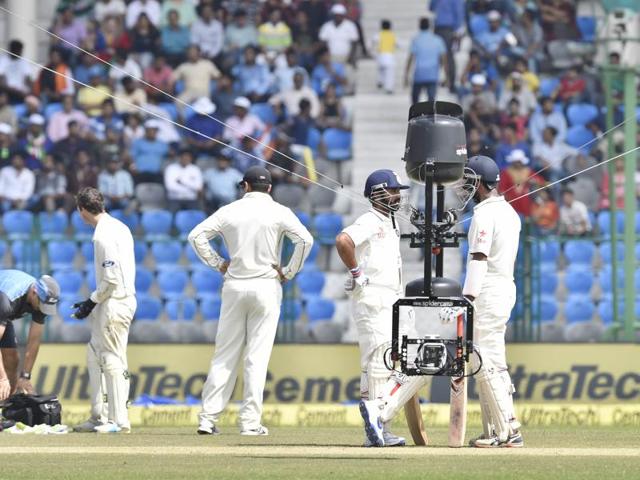
Over the years, many state units have seen local authorities holding games to ransom, sometimes due to a lackadaisical approach of state bodies that leads to non-payment of dues or muscle flexing by government or municipal bodies.
Kanpur’s Green Park, venue of the first Test against New Zealand, is a government property. The association had issues with the administration and the match was the first after a seven-year hiatus. This happened with the Uttar Pradesh government signing a Memorandum of Understanding (MoU) with the state association.
LAST-MINUTE DEALS
The Delhi and District Cricket Association (DDCA) has made it a habit of getting late permissions and obliging various sanctioning authorities. “We have to get NOCs from various agencies before every game. While the DDCA is to blame for a lot of irregularities, these agencies too exploit,” says a top Delhi cricket official.
While the country celebrates the birth of new Test venues, Indore being the latest addition, another venue in Madhya Pradesh, captain Roop Singh Stadium at Gwalior where Sachin Tendulkar scored the first-ever ODI double century is struggling to get international games. The Tendulkar tie against South Africa in 2010 was the last international game there. Local officials blame a tussle between the state government and the municipality.
A senior BCCI official explains, “In most cases, it depends on state governments. They can make things easy or can make things tough. Look at Himachal Pradesh. The state body and the government are at loggerheads. In Punjab too, similar issues have cropped up and the government always created problems for the home association.”
KAPIL’S FAREWELL VENUE
Faridabad’s Nahar Singh Stadium, once an international venue where Kapil Dev played his last international match, too has become a relic. The previous Haryana government and the cricket association were rarely on the same page, which meant the ground has hosted no match since March 2006.
Things are on an upswing in Chhattisgarh. The state government built a stadium at Naya Raipur, providing decent facilities. And with Chhattisgarh now a full member, steps to transfer the ground on long-term lease to the association have been initiated.
Rajesh Dave, the association secretary, says, “Earlier, it was the responsibility of the state government. Now as a full member, we’ll get more funds which will ensure we can maintain it.”
TOO FAR AWAY
Logistics though make it tough for state units to own a ground.
New stadiums need large swathes of land, but they can be acquired only on the city outskirts, making accessibility an issue. Almost 90% of the associations prefer exercising the other option given by BCCI --- get a long-term lease for at least 30 years.
The Baroda Cricket Association is a case in point. It had purchased 25-30 acres on the periphery of Vadodara city, but decided to retain the Reliance Stadium.
Snehal Parikh, secretary of the Baroda body, says, “If we shift our base to the outskirts, our junior cricket will suffer as it’ll be tough for the youngsters to travel that far. On top of it, the project will cost us Rs.300-400 crore. Having this facility in the heart of the city (along with the Moti Bagh ground gifted by Baroda’s erstwhile rulers), is great for us.”
Neighbours Saurashtra Cricket Association (SCA) have been luckier. Longtime SCA president Niranjan Shah, a former board secretary, helped get the land to build a new stadium. Besides Baroda and Saurashtra, Gujarat is the third association of the state, and it is one of the few bodies that have a good deal. The Motera stadium near Ahmedabad was built by the state authorities and the cricket body doesn’t have to pay any lease amount.
The Goa association too pays a nominal amount for the stadium at Porvorim, just two km from the secretariat, and authorities allow the Gwalior stadium to be used during the off-season for a payment of just Rs.1 lakh.
“It all depends on the government of the day. Building new stadia isn’t always feasible. The cost will be huge and it’ll be far from the city. The better option is to get a long-term government lease. But that can happen if the political brass is kept in good humour, or if it is supportive on its own,” says Gwalior association secretary, Ravi Pathankar.


