Live Score
 Teams
Teams Players
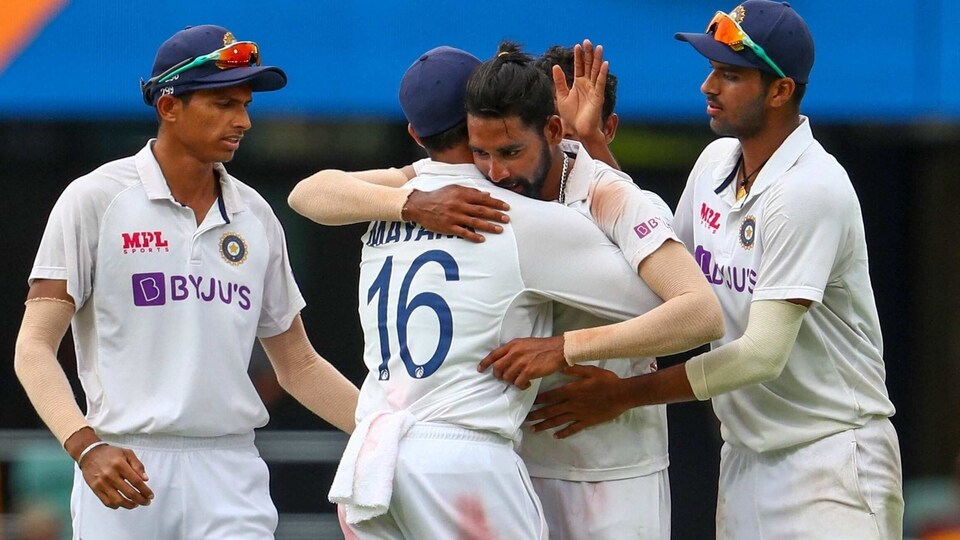
India bowlers shackle Australia batsmen in iconic Test series
Australia template has been to score heavily and then bring visiting teams under pressure with their fast bowlers. This time India's revolving bowling unit has checked that

 Prefer HTon Google


“In the past, what Australia liked to do is bat first and get 500 and bowl the opposition out. All throughout we have stayed in the game, and just about in all the Test matches we competed really hard. To come here and not allow them to score 400 is an achievement in itself. It is just about another hurdle we need to cross here in Brisbane.”
Rohit Sharma spelt out the story of the series so far and set it up perfectly for what promises to be a thrilling final day of play at the Gabba. There was an important observation too—about Australia’s batting prowess. Sharma knows from experience; he was a part of the team when India got routed by Australia in the 2011-12 tour (though he did not play a match) and again during the 2014-15 tour. The latter series is remembered as Steve Smith’s tournament. In each of the four Tests, the hosts amassed 500 plus scores, with Smith hammering four hundreds.
“Once the batsman is in, the pitch settles down and the sun is beating down, it can be tough,” Sharma recalled.
ALSO READ | Brisbane Test: After Siraj touch, series decider on final day
Then the towering Aussie fast bowlers and a spinner apply the stranglehold; opposition batsmen wilt.
Now, in two consecutive tours of Australia, India has messed up this template. When they clinched the 2018-19 series 2-1, Australia’s highest total was only 326, the only innings in six where the hosts managed to even cross 300. That failure was attributed to the absence of Steve Smith and David Warner, both serving suspensions for their role in the ball-tampering incident in South Africa.
There is merit to that argument: Since Warner and Smith have returned, Australia has again routed visiting teams with massive scores. In 2019-20, they beat Pakistan and New Zealand, winning all the five Tests they played against the two teams. Against Pakistan, Australia’s first innings totals were 580, and 589 for three, declared. Against New Zealand, their lowest first innings total was 417.
In this series though, Australia’s highest first innings total is 369, which came in the fourth Test.
At Adelaide they made 191; at the Melbourne Cricket Ground their totals were 195 and 200—Warner was injured and India managed to keep Smith quiet. At the Sydney Cricket Ground, Smith got a hundred but India still managed to restrict the hosts to 338. In the second innings, Australia declared at 312 for six to try and force a result, but India held out heroically for a draw.
All this, against an Indian bowling attack severely weakened by injury-absences; so much so that India fielded its most inexperienced bowling line-up in more than eighty years in the final Test.
Australia’s desperation to shore up their batting was evident when they added Warner to their line-up after the second Test, even though he had not fully recovered from his groin injury. It didn’t help as the opening batsman scored 5, 13, 1 and 48.
But India has found the most critical success in not allowing Smith to impose himself on the series. It’s rare that Smith and Warner get a start but fail to build on it.
That’s exactly what happened at Brisbane—Smith falling for 36 and 55 and Warner for 48 in the second innings.
ALSO READ | 'Your all-round performance has kept the Test series alive'
An important caveat is that in the second innings, Australia were trying to score rapidly so as to give their bowlers a chance to get India out on the final day.
Australia’s issues started with their opening pair. The selectors’ decision to back the out-of-form Joe Burns didn’t pay off. He was dropped after the second Test, averaging 21. According to a tweet put out by a CricViz analyst, "Australia's opening batsmen will end this series with an average of 23.73. That's the lowest figure for any home Test series since the West Indies toured in 1988-89.”
Mathew Wade’s series ended with a duck on Monday. He has scored 173 runs in eight innings at an average of 21.62; his lowest series average since his return to the team during the 2019 Ashes. Skipper Tim Paine’s 73 not out in the first Test remained his only innings of any impact. Paine was expected to shepherd the Australian tail along with debutant Cameron Green, but neither lasted long enough for the responsibility.
On a Gabba pitch that is breaking, Australia is in a strong position to win the series; but however it plays out, they have been nowhere near their dominant, big-scoring selves.