


 Live Score
 Cricket Teams
 Cricket Players
More than a statue: Sachin taking guard could be the start of many more
Immortality odes to India's cricket heroes are an idea whose time has come.

 Prefer HTon Google


Not far from where he played his first and final Tests and won the World Cup, a short walk from where he spoke of his life between 22 yards for 24 years... uniting stadium, sub-continent and beyond in tears of gratitude, will Sachin Tendulkar be immortalised.
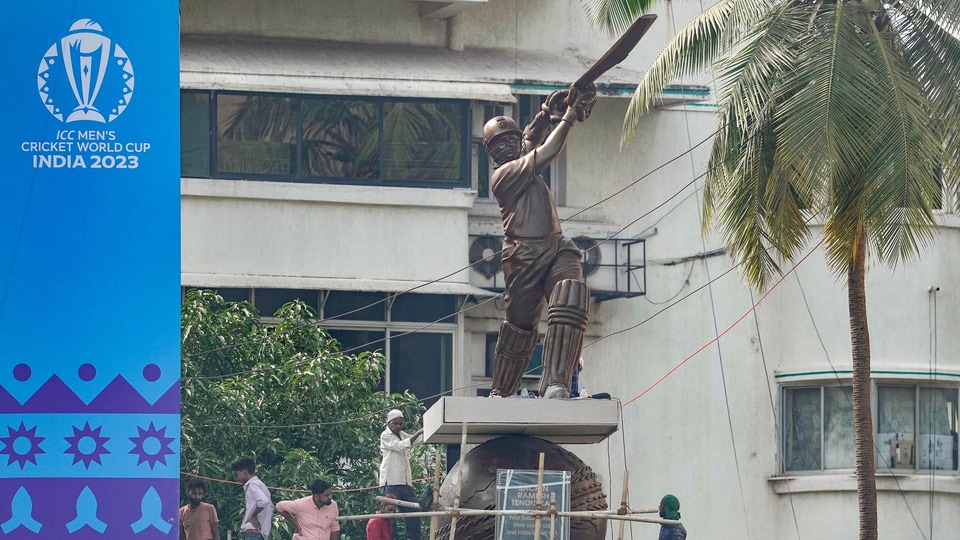
Right foot forward, left back in the crease, a slight pivot of the hips to raise the bat following through what looks like a lofted cover drive – “for six,” the sculptor Pramod Kamble tells ANI in a video interview – the statue will be unveiled at Wankhede Stadium on Wednesday, one day before it hosts the India and Sri Lanka.
"The sort of people who would have been statue subjects, such as politicians and people of the church and royalty are less popular now,” said Dr Chris Stride, a statistician at Sheffield University which created a database of statues of sportspersons in 2011, in a BBC report. For the tennis writer Steve Tignor, statues create an aura around a legend. “Just like good sportswriting, they turn the mundane into something religious,” he has written.
Shane Warne frozen in delivery stride, excitement in his eyes which lock on the batter who is about to look silly, near Melbourne Cricket Ground is a good example of that. It explains why after Warne’s sudden death, a glass of beer and a packet of cigarettes was left for a man who described himself as, “I smoked. I drank, and bowled a bit of leg-spin.”
It was the same at Old Trafford where Bobby Charlton, ball in hand, stands next to Dennis Law and George Best. Not just Mancunians, tributes to Charlton flowed from all over the world. Of the bald man who blended balletic grace with power Manchester United has said, without a hint of exaggeration, that for a long time Bobby Charlton were the two most spoken English words in the world.
Arthur Ashe’s statue in Richmond, USA, where he was born and brought up, has a book held higher than a tennis racket. It was the 1975 Wimbledon champion’s way of telling children, who form part of the pedestal, the importance of education.
Thierry Henry in full flight at Emirates; Sergio Aguero, Vincent Kompany and David Silva at Etihad; Bobby Moore at Wembley; Alex Ferguson, Matt Busby at Old Trafford; Bobby Moore in London and Zico at Maracana are some of football’s immortality odes. Basketball has Shaquille O’Neal defying gravity in Los Angeles and Michael Jordan soaring at Chicago’s United Center. There’s Rod Laver at Melbourne Park, a vein on his left hand standing out as he plays a volley and Rafael Nadal at Roland Garros.
WG Grace greets visitors at Lord’s, Vivian Richards provides a photo opportunity at a stadium named after him in Antigua and Brian Lara holds the pull shot at Port of Spain’s Brian Lara Promenade. The walkways to MCG and in Yarra Park ensure that Bill Ponsford, Don Bradman, Keith Miller and Betty Cuthbert, who won the 100m, 200m and 4x100m gold at Melbourne Olympics, live on stories of their other-worldly feats relived.
India has the world’s richest cricket board whose treasure chest needs to keep giving for the sport to survive. But when it comes freezing its sporting heroes in time, the country has some catching up to do. CK Nayudu has a place of permanence in Indore, DB Deodhar in Pune, Gostho Pal faces Eden Gardens the ball stuck to his feet, Dhyan Chand enhances the National Stadium experience and there is a bust of Leslie Claudius but it is not near the Maidan where he once had Kolkata rejoicing.
World Cups have ensured that India’s cricket amphitheatres are no longer concrete terraces that leave fans with sore bums. Statues of sporting heroes worldwide are a late 1990s and 2000s phenomenon, according to the BBC report in 2012, and have a lot to do with the rise in celebrity culture. But though there has been a surge in the latter, it has not run with the former in India.
In fact, given that cricket is a national obsession in India, and not a passion restricted by parochial or regional boundaries, why not have statues of players not based on their birthplaces or home grounds, but at venues where they have shone brightest?
So, imagine an Eden where Rohit Sharma is cast in stone, or bronze, a hat-tip to his world record 264 in 2014, his only IPL century and where he got a Test ton on debut. Sharma could be alongside VVS ‘281’ Laxman and Rahul ‘180’ Dravid with Bishan Singh Bedi in recognition of his 7/98, the spin Sardar’s best effort in a Test innings coming in Kolkata. How about Anil Kumble and BS Chandrasekhar in a leg-spinners reunion across eras, one for emulating Jim Laker the other because he took 8/79 in the 1972-73 series, at Kotla? Kapil Dev at Ahmedabad for his 9/83 against the West Indies in November 1983.
You could have Kapil and Sunil Gavaskar's statue anywhere cricket is played in India but Bengaluru too could be an option. Because Kapil became the world's highest wicket-taker there. He could illuminate the Chinnaswamy with Virat Kohli who has a record four IPL centuries there, Sourav Ganguly, who got a double-century there, and Harbhajan Singh for his match haul of 11/224 in 2004.
Gavaskar’s statue could be in Chennai for his unbeaten 236 or at Wankhede where he has four centuries. Of course, no conversation about sporting permanence in Chennai can be complete without its 'thala' so a statue of MS Dhoni is a must but he can have the company of Narendra Hirwani for his 16/136 on debut, a world record.
Now that Tendulkar has taken guard and will not be dismissed, why not?


