


 Live Score
 Cricket Teams
 Cricket Players
PSL team auction looks mundane next to IPL, and the numbers paint brutal picture: Gulf of 100x explained in detail
PSL's new franchises cost INR 56-59 crores each, vastly overshadowed by IPL's expansion teams priced at INR 5,625 crore and INR 7,090 crore.

 Prefer HTon Google


Pakistan Super League’s (PSL) expansion took a major step on January 8, 2026, when the PCB sold two new franchises at its teams auction: Hyderabad went for PKR 1.75 billion and Sialkot for PKR 1.85 billion, as the league moves from six to eight teams.
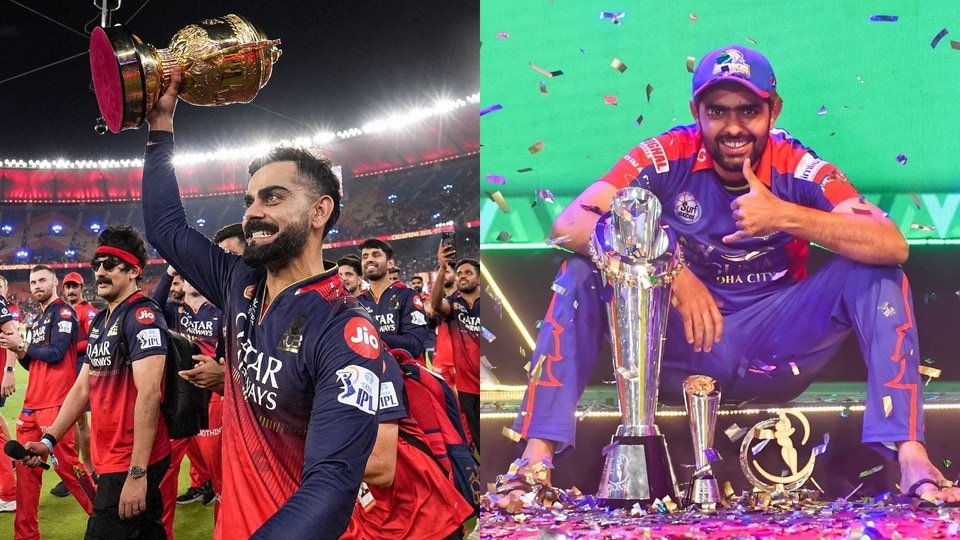
Notably, IPL too had two key “team ownership” moments: the inaugural IPL franchise auction in 2008 and the most recent IPL expansion sale (2021). Here we look at a valuation comparison of the franchises in the two leagues. To keep it fair, we used a simple normalisation method: convert all prices into common currency (USD) using Jan 8, 2026 spot exchange rates, and for IPL 2008 (which is in older USD), inflate 2008 dollars into 2026-ish dollars using US CPI (Consumer Price Index) before comparing.
PSL 2026 expansion
Using USD/PKR spot for Jan 8, 2026 (1 USD = 280.05 PKR), the new PSL franchise fees translate to roughly:
- Hyderabad (PKR 1.75 bn) = $6.25 million
- Sialkot (PKR 1.85 bn) = $6.61 million
And if we convert these same numbers in INR at the same as-of point (1 USD = INR 89.90), those are roughly INR 56-59 crore.
So, the PSL expansion buy-in is essentially a single-digit million-dollar cheque.
Scenario 1: If IPL’s first franchise auction happened in 2026
The 2008 IPL franchise auction produced eight team sales, headlined by Mumbai and Bangalore at roughly $111-112 million each, with Rajasthan at $67 million as the lowest.
But comparing 2008 USD directly to 2026 USD is misleading, so we inflation adjusted 2008 dollars to 2026-ish dollars using CPI. US CPI shows 2008 annual average - 215.303, while the latest pre-Jan 2026 CPI print (NOV 2025) is 324.122, an inflation factor of roughly 1.50x.
That means, in 2026-equivalent terms:
- Mumbai Indians/RCB - roughly $168 million in 2026-ish dollars
- Rajasthan Royals - roughly $ 101 million in 2026-ish dollars
Now compare those to PSL’s entry price:
- A 2026-equivalent Rajasthan is about 16 times a PSL franchise.
- A 2026-equivalent Mumbai/RCB is about 27 times a PSL franchise.
Even after doing the fairest possible adjustment, the IPL’s Day-1 ownership pricing sits in nine-figure USD, while PSL’s 2026 expansion pricing sits in single-digit millions.
Also Read: Tilak Varma ruled out of first three New Zealand T20Is; BCCI to assess progress before final two matches
Scenario 2: IPL’s most recent team auction vs PSL
The IPL’s latest ownership sale is an even sharper contrast because it was priced in modern, mega-rights IPL economics:
- Lucknow sold for INR 7,090 crore
- Ahmedabad sold for INR 5,625 crore
Converted into USD using the same Jan 8, 2026 USD/INR spot rate, that is roughly:
- Lucknow = $789 million
- Ahmedabad = $626 million
Put against PSL’s team values:
- Lucknow is 126 times PSL’s Hyderabad franchise
- Ahmedabad is 100 times PSL’s Hyderabad franchise
So, IPL’s latest expansion entree fee is roughly 100-125 times PSL’s latest expansion entry fee, once everything is expressed in common 2026 currency.
Why the gap is this extreme
A two to five times difference can be explained by audience size/ A 100 times difference is structural.
- Central broadcast + digital economics: IPL franchise valuations are underwritten by a massive media-rights ecosystem and strong central revenue distributions; the market prices that predictability into team ownership.
- Commercial depth: IPL teams monetize at multiple players - sponsorship inventory, premium hospitality, merchandising, year-round brand value - at scale.
- Global premium product positioning: IPL is valued as a global sports entertainment property. PSL is a strong league with momentum, but its ownership pricing reflects the actual difference between the two.
Using the same January 8, 2026 exchange-rate snapshot, the contrast looks even starker in local currencies: PSL’s new franchises work out roughly INR 56-59 crores each, while IPL 2021’s expansion teams were sold for INR 7,090 crore and INR 5,625 crore - about 100-125 times higher on a like-for-like basis. Even the IPL’s 2008 founding fees, once converted into 2026-equivalent value land in the INR 900-1500 crore band per team, still multiple times PSL’s new-team pricing. In short, PSL’s expansion fee behaves like an entry ticket into a growing league; the IPL’s franchise sales are priced like global sports assets.


