This is perhaps the only time Kraigg Brathwaite and Brian Lara will be mentioned in the same breath but here goes the comparison nevertheless: Brathwaite batted 673 balls against England in Barbados, eclipsing Lara’s record (582 balls) of the longest any West Indies batter has spent at the crease in a Test. How they went about their batting is incomparable though. Lara’s was an epic 400 against England in Antigua that stays Test cricket’s highest ever individual score. Brathwaite’s encapsulated
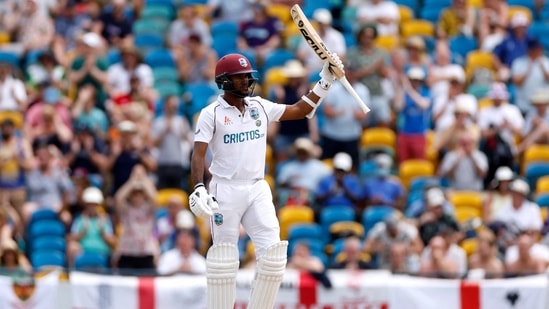
This is perhaps the only time Kraigg Brathwaite and Brian Lara will be mentioned in the same breath but here goes the comparison nevertheless: Brathwaite batted 673 balls against England in Barbados, eclipsing Lara’s record (582 balls) of the longest any West Indies batter has spent at the crease in a Test. How they went about their batting is incomparable though. Lara’s was an epic 400 against England in Antigua that stays Test cricket’s highest ever individual score. Brathwaite’s encapsulated two innings of different character—a defiant 489-ball 160 followed by an unbeaten 56 in the rapidly waning light over Kensington Oval.
Both Tests ended in draws after England were ground to dust but the eras they came in couldn’t have been more different. Just before Twenty20’s foray, the late 90s and 2000s was possibly Test cricket’s highest point over the past three decades, a phase that witnessed some of the most memorable rubbers—think 1999 West Indies-Australia, 1999 and 2004 India-Pakistan, 2001 India-Australia and 2005 Ashes. It was a time of riveting wins and equally fascinating draws. With time though Test cricket has taken on a more black-and-white hue where draws aren’t desirable anymore. Brathwaite turned back the clock with those two innings in Barbados.
That only seven players since the end of timeless Tests in 1939 have ever faced more deliveries in a Test gives you a measure of what Brathwaite has achieved. But when you also consider the time—this being the age of T20-inspired quick results—and the team he plays for—West Indies being predominantly a white-ball force known for their T20 mercenaries—Brathwaite is an outlier.
Even as a boy, he was different. At the turn of the century, when every student at St Michael’s Combermere School wanted to bat like Lara, Brathwaite was heavily influenced by Shivnarine Chanderpaul. With Frank Worrell and Wes Hall among its alumni, Combermere was coming up with a batch that had Carlos Brathwaite (no relation), Roston Chase, Shane Dowrich, Chris Jordan and Jomel Warrican. Always deemed the slower, more cautious batter, Brathwaite proved to be more dependable from his early days. Be it the 122 on debut for the U-15 team, 73 on first-class debut for Barbados when he was still a high school student or even a 95-ball 48 on List A debut, Brathwaite offered an assured alternative to the narrative of freakishly talented West Indian batters not caring for defence and taking the white-ball career route.
Red ball devotion
It isn’t easy to stay steadfastly devoted to cricket’s purest form at a time one IPL contract can set your life straight. And in the Caribbean, the choice is pretty straightforward. Brathwaite’s introduction to the game coincided with a turbulent time in Caribbean cricket that witnessed a steady flow of talent to baseball and athletics, cricketers striking work and top players refusing to be bound by central contracts. A T20 contract, under such circumstances, was the best meal ticket. Not for Kraigg Brathwaite though. Even Cheteshwar Pujara has always maintained he wants to play T20 cricket but here’s a man who has accepted his limitations and willingly shunned its spoils, not even trying it at the domestic level. In a side that breeds a high attrition rate in Tests, Brathwaite has thus been a constant who has grafted centuries not only at home but also England, South Africa and the UAE.
Sure, Brathwaite risked being labelled a Test specialist quite early in his career. But so driven is the West Indies captain to embark on a different culture that it almost justifies having a character far removed from T20 to create and shape a team’s Test journey. We got a hint of that pursuit of excellence in Sri Lanka last year when the West Indies captain revealed what goes in his mind as a batting leader, and what he expects from his mates. “The plan is to be clear in what you want to do. Believe that you can do it, and do it for long periods,” Brathwaite had said before the second Test in Galle. “We’ve got to have the discipline and the fight to do it for 50 overs—more than two sessions, or three sessions.” Brathwaite was in his element in that series, scoring a dogged 41in the first Test and 71 in the second, but his team wasn’t. West Indies lost 0-2.
Having not won a Test since February, 2021, Brathwaite can’t be blamed for trying to save one when the opportunity arose. “It was annoying how good he was,” England captain Joe Root said after the Barbados Test. “He played brilliantly in both innings and didn't give us many opportunities. He ground us down. He's an ideal player for a pitch like that. He takes it deep time and time again. He had a clear game-plan and stuck to it very well. It's frustrating but there's a lot of respect for the way he went about it.”
Not draws, near-victories
To Brathwaite, these Tests are rehearsals for the next big stride. And he believes in taking small measured steps, not blind leaps of faith, towards that. “It was good that, after England put up 500, we as a team could fight and put 400 back,” he said. “That's the attitude we want, and the fans want to see. Once you continuously have the right attitude, our Test (results) will go up. In periods we could (be more attacking), but spending time at the crease and batting through three new balls is a great start for us. We need to just learn as quickly as possible on the job, and improve at different periods of the game.”
Because West Indies’ disappointing year rounded off by an equally disheartening T20 World Cup campaign, these draws are basically near-victories. This argument may not pass muster when Test cricket is fighting to stay relevant but West Indies alone can’t be singled out for the back-to-back draws against England. Barbados could have easily gone down a different path had Root been braver about his declaration and not set West Indies 282 in 65 overs, an impossible target given their run rate throughout the series. You see similar shades of trepidation in Australia as well when they had the hosts on the mat in Karachi this month but didn’t enforce the follow-on to prevent burnout of their fast bowlers. Endurance levels are most tested in sub-continental extremes but at a time where non-Asian teams can camp at the ICC academy in the UAE well ahead of tours for acclimatisation, it’s difficult to accept a team not willing to stretch limits in pursuit of a win in a country they are visiting after 24 years.
West Indies, in comparison, are staring at a more existential crisis of faith. In a format that brings in very little revenue unless India, England or Australia are involved, and in front of largely empty stadiums, Brathwaite’s job is to maintain the lure of Tests. Losses certainly won’t help. A draw thus becomes the most practical middle path here, a possible precursor to better, greater heights. Remember Gabba? India wouldn’t have got there without the draw in Sydney. When New Zealand asked India to follow on after they had folded for 305 in response to 619/9 at Napier in 2009, Gautam Gambhir (137), VVS Laxman (124), Sachin Tendulkar (64), Rahul Dravid (62) and Yuvraj Singh (54) came together to bat almost five sessions to preserve their series lead. And who can forget that gritty second-innings 110 by Faf du Plessis on debut in Adelaide in 2012, when South Africa seemed down and out at 45/4. Survive they did, courtesy du Plessis, before South Africa defeated Australia in the final Test at their fortress in Perth to claim a sensational series win.
As captain, you live in hope of such miracles and take whatever comes your way after giving your best. Brathwaite probably is in a similar frame of mind. He’s not pretty to watch, the strokes are not exactly silken, but Brathwaite is happy as long as he is the anchor needed to avoid defeat or charge for victory. And he is willing to give it as much time as possible—955 minutes at Barbados, 813 minutes against Sri Lanka in Antigua last year, both the highest for any West Indies batter—till his team steps up in coordinated fashion. So far, this approach has fetched a few wins and fewer draws but Brathwaite isn’t done playing the waiting game. To him, it’s not over till it’s over.
One Subscription.
Get 360° coverage—from daily headlines
to 100 year archives.
Archives
HT App & Website