A straightforward analysis of India’s semi-final defeat to Australia is that they lost to a better team. Five-time champions, seven-time finalists, Australia are in a zone no women’s team has ever been in and hence, even their percentage cricket can be substantially better than the best show other teams are capable of. But a more critical analysis will throw up a few finer points that India need to work upon.
Uninspiring fielding
Apart from several misfields, two catches were dropped
A straightforward analysis of India’s semi-final defeat to Australia is that they lost to a better team. Five-time champions, seven-time finalists, Australia are in a zone no women’s team has ever been in and hence, even their percentage cricket can be substantially better than the best show other teams are capable of. But a more critical analysis will throw up a few finer points that India need to work upon.
Uninspiring fielding
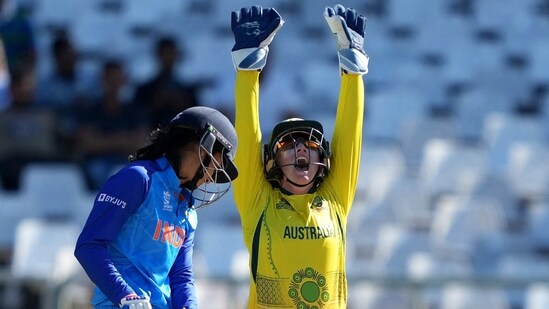
Apart from several misfields, two catches were dropped too. And the one Shafali Verma fluffed was as easy as it can come–Beth Mooney spearing the ball that was dropping on her at waist level and well inside the boundary. Verma not only spilled the catch but also conceded a boundary. How you move in the field is the first indicator of a team’s head space. It was evident India hadn’t turned up on the field. Australia, on the other hand, were electric–especially on the boundary–despite dropping Harmanpreet Kaur in the 13th over.
"The Australian side, they always field very well; and from our side, we made some mistakes," Kaur said later. "But again, we have to just learn (from) whatever mistakes we have made. But obviously, the Australian side is better than us. Today also, after I got out, their body language completely changed. The way they stopped two-three boundaries, that also made a huge difference."
Death bowling the difference
From 113/2 in 15 overs, Australia added 59 runs. India, needing 39 from 30, ultimately lost by five runs. In a situation that should have made Australia sweat, India nearly conceded a wicket-maiden, lost three wickets and hit just three boundaries in the last 30 balls. Australia didn’t waver from their strengths, hitting hard lengths or absolutely full so that India couldn’t get any elevation under their shot. It was also a lesson for India’s bowlers who had tried too many variations and even conceded a few easy full tosses.
Ultimately it again boiled down to temperament. India cracked up under pressure. But Australia, as Ashleigh Gardner later said, toughened up. "What we speak about is when our backs are up against the wall, we always try and find a way, and today we probably had no right to win at one point there. They were cruising and then we found a way to get some wickets and ultimately came out on top."
Temperament under scanner
The indications were there for everyone to see. Allowing Pakistan to recover from 68/4 in the 13th over to post 149 wasn’t an ideal start to the tournament even though India did win with six balls to spare. But it was nowhere close to a comprehensive win. Against more quality bowling, India were found out. Like in the match against England, where they snailed to 62/2 in 10 overs and 93/3 in the 15th while chasing 151. Too much was left for the last five overs, and India expectedly capitulated.
It’s in this background that India went into the semi-final, where they were set an even higher target after the bowlers conceded 103 runs in the last 10 overs. India were sliding fast till Kaur took over the reins of the chase with Jemimah Rodrigues, both of them striking at over 150. No other India batter, however, could match that tempo.
Stage fright?
Even if the ‘C’ word is carefully bypassed here, India may need to seriously introspect their performance in the knockout stages. Losing the 2017 World Cup final at Lord’s, the 2018 T20 World Cup semi-final to England, the 2020 T20 World Cup final to Australia and now, another semi-final to Australia–there is a worrying pattern to these results, especially because the core group hasn’t changed much.
India are still a big name. But England and Australia continue to hold an edge when it comes to ICC tournaments. Australia, especially, have been ruthless in highlighting the gap with India, winning nine and losing just one out of 11 matches played against them since the 2020 T20 World Cup final at the MCG. If India aim to be a superpower, they need to figure out a way to beat Australia and England in the tournaments that matter.
No long-term planning
In May 2022, Matthew Mott was announced as coach of England’s white-ball cricket team and within six months they were World T20 champions. But before that, Mott was with the Australia women’s team for seven years, turning them into a more professional and an even more athletic unit. Former player Shelley Nitschke–the ICC Women’s Cricketer of the Year in 2010 and part of that year’s T20 World Cup winning team–inherited this post after being assistant coach since 2018. She got a four-year contract. Australia’s women’s cricket is a tightly run ship where everyone knows their role and are given enough time to prove themselves.
Pit this against India who went to the T20 World Cup with an interim coach in Hrishikesh Kanitkar after Romesh Power had been sacked for the second time in four years. The coach can only do so much, and that too off the field. But this reeks of bad planning and worse management.
One Subscription.
Get 360° coverage—from daily headlines
to 100 year archives.
Archives
HT App & Website