For Sunil Singh, Naveen Bhandari, Vikram Singh and Vinod of Baragaon village, May and June are months when they can make some big money. Reason: Availability of Keerajari (Yarsagumba).
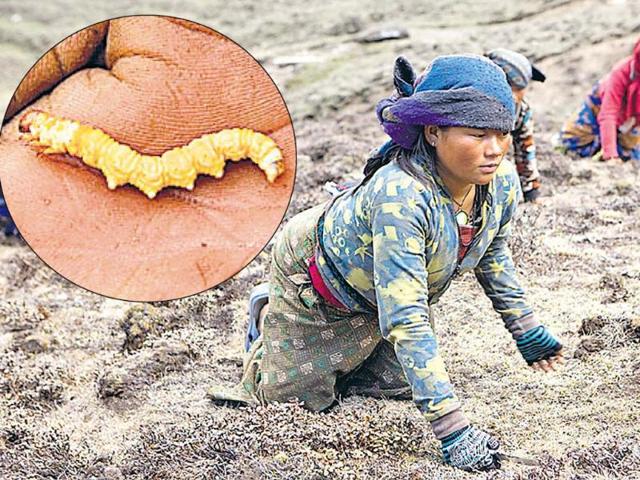
Keerajari is a parasitic combination of fungus (Cordyceps Sinensis) and insect (Hepialus Armoricanus) and is found at a height of about 3,500 metres and above.
Keerajari, the caterpillar fungus is an exotic species and known as Himalayan Viagra of Indian Viagra for its libido boosting power. The important chemicals found in the herb are calcium and selenium, the latter being well known for its ability to enhance immunity against cancer.
Keerajari is priced very high internationally but is available for `2 to 3 lakh per kilogram locally and plays a vital role in boosting the economy of the area. The price of the Yarsagumba depends upon the quality of the herb and there have been reports that it fetched a price of around `15 lakh/kg at Pithoragarh last year.
Keerajari is available when the snow melts in the higher ranges of Himalayas. It is during this time that people from far-flung villages of Chamoli district gear up to collect the Keerajari.
Residents of Dasholi, Ghat, Urgam valley, Niti valley and Joshimath blocks of Chamoli district have already started shifting their belongings and ration to these place where they would stay put for at least two months, searching and digging for the precious herb. The villages of Sutol, Kanol, Dhuni, Ramni, Jhinji, Pana, Irani, Baragaon, Merag, Parsari, Aera, Paika, Karchon, Tugasi, Regri, Ringi, Bhalgaon, Lata, Subhai, Bardinga, Devgram, Bansa Dhumak and many more are left with only children and the elderly as majority of the young men and women go out to collect Keerajari. The importance of collecting Keerajari can be gauged from the fact no wedding bell rings during this period and even those who are work outside state come back home on leave to join engage in this process.
{{/usCountry}}Residents of Dasholi, Ghat, Urgam valley, Niti valley and Joshimath blocks of Chamoli district have already started shifting their belongings and ration to these place where they would stay put for at least two months, searching and digging for the precious herb. The villages of Sutol, Kanol, Dhuni, Ramni, Jhinji, Pana, Irani, Baragaon, Merag, Parsari, Aera, Paika, Karchon, Tugasi, Regri, Ringi, Bhalgaon, Lata, Subhai, Bardinga, Devgram, Bansa Dhumak and many more are left with only children and the elderly as majority of the young men and women go out to collect Keerajari. The importance of collecting Keerajari can be gauged from the fact no wedding bell rings during this period and even those who are work outside state come back home on leave to join engage in this process.
{{/usCountry}}Keerajari has brought prosperity in their homes and arrested the wave of urbanization too.
Though the forest department issues permit to every individual through Van Panchayat for the collection of Keerajari to avoid over-exploitation, yet many engage in this illegally. Though the villagers are suppose to deposit the collection with Van Panchayat and through it to the forest department for `50,000 per kg, yet most of it slips through undetected as people prefer to deal with the dealer directly for quick and meaty grub instead of long and less profitable transaction through the forest department.
However, Rajiv Dhiman, the divisional forest officer (DFO) of Nanda Devi National Park, Joshimath clarified that people have the wrong impression that the government buys back Keerajari for only ` 50,000 per kg as this amount is only an initial payment while they would get the lion share of 90% of the auction at their depot at Rishikesh while 5% of the money goes to Van Panchayat and the forest department each. He also added that he has asked the government to open a depot at Joshimath for the convenience of the people and encourage legal transaction of Keerajari.
Though the over-exploitation and premature collection of Keerajari declines the harvest in the bugyals of Devangan, Bedni, Aali, Bhaguavasa Dyalisera, Kanwari, Kagbhusandi, dikchatri, Barmal and Raunthi peaks etc yet it cannot be denied that Keerajari has brought prosperity in the villages like Bhangule and Molta of Joshimath block where nothing tangible has been done in the name of development since Independence.