If the Ghazipur Landfill collapsing and killing two persons by sweeping them into a drain was a nightmare for the Capital two years back, the scare is only getting bigger!
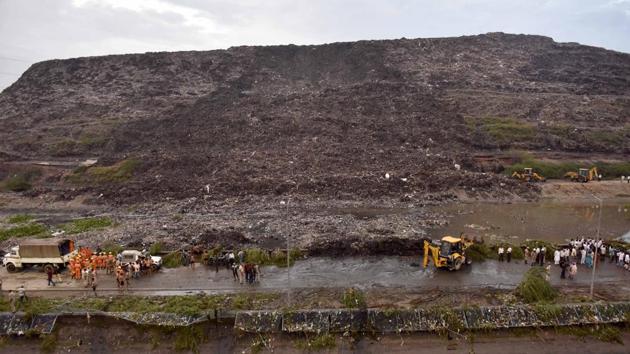
As per the East Delhi Municipal Corporation (EDMC), which maintains the landfill site, at least 1 million (or 10 lakh) metric tonnes of fresh garbage has been piled on the “sides” of the trash mountain between 1 September, 2017 (the date of the collapse) and now (August 2019).
The addition has taken the total mass of garbage standing at Ghazipur Landfill today from 13 million metric tonnes to 14 million metric tonnes, inspite of orders from the Lieutenant Governor, Anil Baijal, to immediately close the site after the incident.
To put the numbers into perspective, 10 lakh metric tonnes -- the amount of fresh garbage heaped on the landfill in the last two years -- is almost seven times the weight of the Signature Bridge (1.48 lakh metric tonnes of steel and concrete), enough to fill up 15 Hauz Khas Lakes (which has a water volume of 1.3 lakh cubic meter) and could create another 28-storey ‘Shyama Prasad Mukherjee Civic Center’ (the tallest building of Delhi which stands on a built-up area of roughly 6 acres).
“We have taken utmost care not to heap more waste on the peak of the landfill, which stands at 65 meters of height presently. We are also doing slope stabilization work (compressing the garbage using earth-moving machines) to prevent another collapse, but we are heavily constrained for land and cannot close Ghazipur at the moment,” said Dilraj Kaur, commissioner, East Delhi Municipal Corporation.
{{/usCountry}}“We have taken utmost care not to heap more waste on the peak of the landfill, which stands at 65 meters of height presently. We are also doing slope stabilization work (compressing the garbage using earth-moving machines) to prevent another collapse, but we are heavily constrained for land and cannot close Ghazipur at the moment,” said Dilraj Kaur, commissioner, East Delhi Municipal Corporation.
{{/usCountry}}“Since we receive about 2,100 Metric Tonnes of mixed and un-remediable waste daily, it has to be deposited somewhere. We had a 6-7 acre parcel of land at the Ghazipur Landfill complex, meant for expansion of the Waste-to-Energy (WTE) plant, and we are utilizing it to deposit the fresh waste for now. But this patch is also not infinite and we need to look for solutions,” she said.
The corporation has faced local resistance to build even an ‘Integrated Waste Management Facility’ at Ghonda Gujran recently due to the plot’s proximity to Yamuna River. “With a lot of difficulty, we were able to get the Singhola site, 30 km away, and have diverted at least 50,400 metric tonnes of drain silt away from the Ghazipur landfill. Our Construction and Demolition (C&D) debris is going to the Shastri Park recycling facility,” an officer, who did not wish to be named, said.
However, land and resource constraints notwithstanding, environmental experts pointed out the dangers of continued garbage dumping on a landfill that was started in year 1984, sits on 70 acres of land and expired its shelf life in 2002.
“The government and judiciary should have taken a tough stand and closed this landfill long back. The leachate emanating from it, often seen as streams of black water running down its slopes, is a toxic concoction of heavy metals like arsenic and mercury. It is ruining the groundwater and poisoning the lives of locals,” said Shashank Shekhar, Assistant Professor, Department of Geology in Delhi University.
Other experts pointed out how landfill fires produce carcinogenic gases like dioxins and furans from burning of plastic, & their smell vitiates the atmosphere, especially if slaughter waste is also dumped on them.
Swati Singh Sambyal, programme manager with NGO, Centre for Science and Environment, said, “Landfills are a major hazard for the population living around them, besides for informal waste pickers who work on the site. A whole lot of non-recylable material is put on fire here including plastics, rubber, etc.”
“The MCDs should work on the minimisation approach for waste management in Delhi. Two years since the Ghazipur collapse, still almost 40-50 per cent of Delhi’s waste is disposed in landfills, this has to change,” she said.
East MCD to float tender for bioremediation of Ghazipur landfill soon
Following the National Green Tribunal’s (NGT) order against capping of landfills and asking municipalities to go for bioremediation instead, the East Delhi Municipal Corporation (EDMC) has begun taking steps in this direction with regards to the Ghazipur dumpyard.
“We are following the NGT instructions and abandoned plans to dry cap Ghazipur Landfill. We have deposited Rs. 40 lakh in an escrow account, as asked by the court for this purpose, and will soon float a tender inviting companies to undertake bioremediation of the full 70 acres of the trash mountain,” Sandeep Kapoor, Standing Committee Chairperson, East MCD, said.
Concerned officials and political leaders have already started examining trawmills or ballistic separators which are used to ‘sift’ or manually separate garbage components of various sizes. The sand, plastic, metal, paper and wood pieces derived thus are then sent for processing accordingly.
Capping, on the other hand, involves layering the garbage mountain to give it a safe 45 degree slope, laying a geo-membrane and soil over it before greening. Sometimes, pipes are inserted into the landfill to extract gas and liquid formed due to microbial activity and heat inside the rotting trash mountain.
“We are trying to stick to the October 1 deadline fixed by the NGT,” Kapoor said.
The NGT principal bench headed by chairperson Adarsh Kumar Goel had expressed its displeasure over municipal corporations being “indecisive and indulging in blamegames” over remediation of the three landfills in Delhi -- Bhalswa, Ghazipur and Okhla -- in July this year. Set up in the 1980s, they completed their saturation periods around year 2000.
The bench had advised the three municipal corporations to look at Ahmedabad and Indore municipal corporations which have gotten rid of landfills in their jurisdictions through biomining and bioremediation at minimum cost with just departmental equipment and staff.
It also asked the three municipal corporations, the New Delhi Municipal Council (NDMC), the Delhi Cantonment Board and the Delhi Government to deposit Rs. 250 crore in an escrow account to biomine and bioremediate the three landfills.
A senior EDMC corporation official said on the condition of anonymity, “We had sought about Rs. 94 crore under the Urban Development Fund (UDF) from the Union ministry of housing and urban affairs (MoHUA) for ‘capping’ the south side of the Ghazipur landfill, which had collapsed. But the MoHUA refused us the amount saying they are willing to give it for bioremediation but not capping.”
The east corporation’s ambitious plan to get the National Highway Authority of India (NHAI) to use up the entire 14 million metric tonne of waste lying at Ghazipur landfill also got stuck as NHAI went for a financial re-evaluation of the project.
On the other hand, EDMC’s plans to engage a Singapore-based company, AG Dauters, to use a unique technology to turn the garbage into water and energy also hit a roadblock after the union Ministry of Environment and Forests (MoEF) gave a long list of conditions to grant the project its approval recently.
Stay updated with all top Cities including, Bengaluru, Delhi, Mumbai and more across India. Stay informed on the latest happenings in World News along with Delhi Election 2025 and Delhi Election Result 2025 Live, New Delhi Election Result Live, Kalkaji Election Result Live at Hindustan Times.
Stay updated with all top Cities including, Bengaluru, Delhi, Mumbai and more across India. Stay informed on the latest happenings in World News along with Delhi Election 2025 and Delhi Election Result 2025 Live, New Delhi Election Result Live, Kalkaji Election Result Live at Hindustan Times.