With cases of the coronavirus disease (Covid-19) rising, the Delhi government is seeking to increase the number of beds available for patients by setting up makeshift hospitals in 40 hotels and 77 banquet halls. The idea is to add 15,800 beds for sick patients. Five hundred converted railway coaches will add another 8,000 beds for the city’s Covid-19 patients.
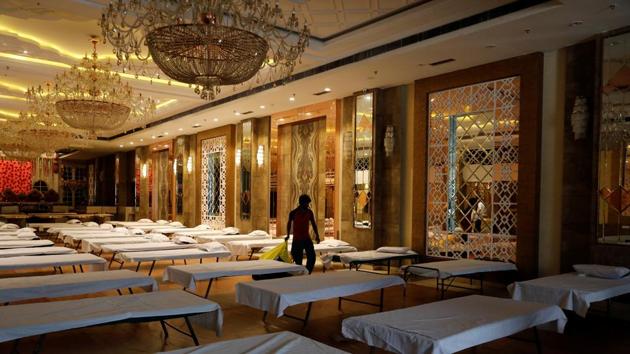
To meet the need for around 150,000 beds by the end of July, the government plans to use stadiums to create makeshift hospitals.
The challenge, however, lies in finding a sufficient number of doctors, nurses, and sanitation workers to staff these makeshift hospitals.
For Covid-19 patients with mild to moderate symptoms – those who are likely to be admitted to the makeshift hospitals – the government would need at least one doctor for every 10 to 12 beds and one nurse for every five to eight beds, in line with the staffing norms followed in several of the city’s Covid-19 hospitals.
This means, for the 23,800 beds that the government is likely to add within this month, there will be a need for over 1,983 doctors and 2,975 nurses assuming the lower staffing estimates. Additionally, the government will also have to hire housekeeping and sanitation staff.
The state government is in talks with the Delhi Medical Association to provide staff for the makeshift hospitals.
{{/usCountry}}The state government is in talks with the Delhi Medical Association to provide staff for the makeshift hospitals.
{{/usCountry}}“We have requested the Delhi Medical Association to not only arrange for doctors but also other staff as per need for the upcoming makeshift hospitals,” said a senior official from Delhi’s health department, requesting anonymity.
Additionally, the government has set up a helpline number – 08047192219 – where doctors wishing to volunteer for the government’s Covid-19 telemedicine helpline have been asked to give a missed call.
“The helpline will recruit doctors for physically treating patients in the makeshift hospitals as well. So far, we have received very few responses,” said the official.
The Delhi Medical Association’s plan is also a work in progress, with only four to five people having registered since June 8 when the doctors’ body first met the health minister to discuss the plan.
“We have asked our members to provide not only their services but also that of nurses and housekeeping staff they might employ in their clinics and nursing homes. The plan is to ask doctors to adopt a certain number of beds – say 50 or 100 – and use their own staff to man it,” said Dr Girish Tyagi, president of the Delhi Medical Association.
The requirement
“The government will likely have to hire doctors and nurses. That is the plan but there hasn’t been any decision taken on this,” said another Delhi government official, on condition of anonymity.
Of the total beds, those in the hotels will be paid facilities with private hospitals pitching in staff and consumables. As per the government’s May 29 order, five-star hotels will be allowed to charge Rs 5,000 and three or four-star hospitals Rs 4,000 per patient per day, with the linked hospitals allowed to charge up to R 5,000 for medical services and consumables per day.
“This does not eat into our manpower too much because we need very few nurses and doctors to monitor the patients with mild symptoms,” said a doctor/executive one of the big private hospitals in the city on condition of anonymity. Another private hospital, however, said it was already facing staff shortages. “Most of our nurses put down their papers when we were asked to earmark beds for Covid-19. Several other demanded higher salaries, it is not possible to do so in this economy,” said a doctor at the private hospital.
“The shortage was created in the last three months due to two reasons – one the fear of the infection in the minds of the healthcare workers and two salary cuts that several hospitals had to implement is April and May with their routine surgeries and out-patient clinics remaining closed. Hospitals are likely to make up for the shortfall in revenue with many treating Covid-19 patients. But the government also needs to incentivise workers,” said Girdhar Gyani, director-general of Association of Healthcare Providers (India).
He cited the example of the Odisha government that is paying a private medical college hospital to reserve around 500 beds. “In addition, the government is also paying the healthcare worker 50% more in addition to their salaries, who wouldn’t want to work then?,” he said.
“In case of banquet halls being turned into hospitals, the logistics are being worked out. We are requisitioning some doctors from all our government hospitals that are not being utilised for Covid. As for the support teams, each hotel and each banquet hall while being requisitioned has also signed for making their staff available to us. So, that in addition to the civil defence volunteers will suffice,” said the government spokesperson.
Former AIIMS director, Dr MC Misra, said, “There is no doctor patient ratio that we can follow here as this is not an ideal scenario. But we have to make sure that our healthcare workers are comfortable. One person should be on duty with the PPE {personal protective equipment} only for maybe for hours, but in mild cases – those that are likely to be admitted to the makeshift hospitals – one doctor or trained nurse per ward should be enough.”
To augment staff, he said, “Interns and medical students who have done their MBBS from other countries but have not cleared the MCI test can be utilised. Ayurvedic practitioners can be roped in. Delhi can request other states with lower disease burden to send their doctors and nurses. However, the government has to ensure their safety and provide proper incentive,” said Dr Misra. He also suggested leveraging technology for monitoring the mild patients remotely or providing specialist consultations to those outside the hospitals.
Existing shortages
A senior government official said the city administration is reorganising the staff in all their hospitals to ensure resources are optimally used. This official said it is here that the role of the medical staff under the municipal corporations will also come into play.
“Part of the staff shortage is being addressed by reorganising the existing manpower in all the government hospitals. The process will take 2-3 days more to be finalised. We will also be using the medical staff of the MCD-run hospitals,” said the official.
This, however, might not work with doctors and nurses in the existing hospitals already stretched thin.
“The government has already taken over the services of almost all the big teaching hospitals in Delhi, which have the maximum number of residents who can work in the Covid-19 wards. And, the total number of beds so far is just 10,000. What about the other 70,000 or so beds that the government plans to create?” said Dr Parv Mittal, vice president of the Federation of Resident Doctors’ Association.
The government hospitals have a shortage of staff and in March the Covid-19 hospitals of Delhi government were allowed to hire staff up to 25% of sanctioned strength till June 30 to meet any shortfall.
“Most of the bigger private hospitals in Delhi are accredited and hence need to hire 125 nurses for every 100 beds. This ratio in government hospitals across the country comes to about 30 nurses for 100 beds; Delhi being a little better it would be about 45 nurses per 100 beds,” said Gyani.
The shortage is also acutely felt when it comes to housekeeping staff. “The hospital has always been short staffed when it comes to housekeeping. Earlier, the family members of the patients could help in cleaning up a little, changing sheets, taking the patients to the washroom. Now, there is a big gap in these services,” said a doctor from Lok Nayak hospital.
To add to the shortfall, several healthcare workers testing positive are going into quarantine on coming in direct contact with Covid-19 patients. The government will also find it difficult to draw doctors, nurses and staff from its smaller non-Covid-19 hospitals.
“We are a non-Covid hospital, but we keep getting patients who later test positive. Some doctors and staff inevitably get exposed and have to go on quarantine. Several of our staff have also tested positive for the infection. We are finding it hard to run our own hospital with the limited manpower, we do not have anyone to spare,” said the administrator of one Delhi-government run hospital on condition of anonymity. The hospital just runs its clinics and emergency services, all routine surgeries and procedures have been put on hold.
Stay updated with all top Cities including, Bengaluru, Delhi, Mumbai and more across India. Stay informed on the latest happenings in World News along with Delhi Election 2025 and Delhi Election Result 2025 Live, New Delhi Election Result Live, Kalkaji Election Result Live at Hindustan Times.
Stay updated with all top Cities including, Bengaluru, Delhi, Mumbai and more across India. Stay informed on the latest happenings in World News along with Delhi Election 2025 and Delhi Election Result 2025 Live, New Delhi Election Result Live, Kalkaji Election Result Live at Hindustan Times.