Lunch break is the time of the day that a 37-year-old employee of Rail Bhawan, located in the posh Raisina Road in Lutyens’ Delhi, looks forward to the most. During the break, he steps out to take a quick stroll around the wide and encroachment-free footpaths along Rajpath and Rafi Marg, soaking in the view of the perfectly pruned trees and the beautifully manicured gardens.
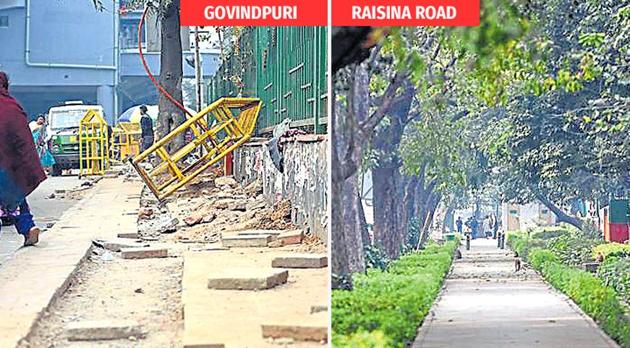
Approximately 13-odd kilometres away, around 3pm, 54-year-old Rai Chand leaves his house — in a slum in south Delhi’s Govindpuri — to arrive at a nearby street, where he sets up a stall to sell sunglasses. During this kilometre-long journey, Chand walks on the main carriageway, twisting and turning his way through the ubiquitous food stalls, e-rickshaws and gramin sewas, while the discontinuous footpath on the side bears a desolate look, with heaps of garbage and construction material dumped on it. In less than 15 steps, the footpath ultimately hits the boundary wall of a residential colony.
These two examples, according to experts, aptly depict the vast disparity that exists in pedestrian infrastructure across the national Capital. Sanjay Gupta, head (transport and planning), School of Planning and Architecture (SPA) says, “On one hand, central Delhi, the hub of the VIPs maintained by one of the richest municipal corporations in the country, has pathways even along roundabouts and a few dividers, despite having the lowest population density in the city.”
On the other hand, Gupta adds, “There is the rest of the city, especially those areas inhabited by the lower middle class and the economically weaker sections, where locals are always looking out to quickly hop on to some mode of transport or the other, lest their lives be threatened by zooming cars.”
{{/usCountry}}On the other hand, Gupta adds, “There is the rest of the city, especially those areas inhabited by the lower middle class and the economically weaker sections, where locals are always looking out to quickly hop on to some mode of transport or the other, lest their lives be threatened by zooming cars.”
{{/usCountry}}For 22-year-old Mohammad Azhar, a resident of Sangam Vihar, dealing with the disparity is a regular affair. “I always plan my trips in such a way that most part of my journey is covered in the Metro. I can easily walk to the Metro station from my home. But I gave up after trying a couple of times. Walking is so uncomfortable, with so many obstructions on the way. I prefer to pay Rs10 to reach the Metro station in an e-rickshaw,” he says.
According to data provided by the transport department, of the nearly two crore people who live in the city, 72 lakh own two-wheelers and nearly 33 lakh own cars.
However, film-maker Sohail Hashmi, who regularly organises heritage walks in Delhi, says that an analysis of data available with the Delhi government shows that the city still has over 60 lakh people who walk in the city. “A majority of them are the ones who either walk to work or to a point from where they can access public transport. Although those who walk constitute a big chunk of the population, the need for safe and convenient infrastructure for pedestrians continues to be ignored. But we still see pedestrians on the roads despite hostile infrastructure designs, which is indication enough that the ongoing practice of framing policies around motorists alone needs to be reversed immediately,” Hashmi says.
Places such as Laxmi Nagar, Shahdara, Seelampur, Burari and Lajpat Nagar, where Hindustan Times conducted spot checks, have almost no functional footpaths. Most of them have either been encroached upon or broken while others have been designed poorly.
Geetam Tiwari, professor, department of civil engineering, IIT-Delhi, says it is alarming to note that the current government policies seem to promote motor vehicle manufacturing industries in order to stimulate economic development and cater to the transportation demands of more affluent and middle-class residents. “The improvement of pedestrian infrastructure continues to be a low priority for most city governments. Often, pedestrian paths are removed or reduced to make more space for motorised traffic. Current policies encourage people to use cars. Most state governments are reluctant to call investors to help buy new buses that can improve the public transport system. However, investment in road expansion, elevated roads and grade separated intersections continues,” Tiwari says.
Experts, however, maintain it would not be enough to just release a set of guidelines on walkability in Delhi. Agencies would have to collaborate, re-plan and simply execute the rules laid down, they say.
Stay updated with all top Cities including, Bengaluru, Delhi, Mumbai and more across India. Stay informed on the latest happenings in World News along with Delhi Election 2025 and Delhi Election Result 2025 Live, New Delhi Election Result Live, Kalkaji Election Result Live at Hindustan Times.
Stay updated with all top Cities including, Bengaluru, Delhi, Mumbai and more across India. Stay informed on the latest happenings in World News along with Delhi Election 2025 and Delhi Election Result 2025 Live, New Delhi Election Result Live, Kalkaji Election Result Live at Hindustan Times.