Standing on the banks of the Yamuna, the water from the swollen river touching her feet, Manju Devi, 39, looks at her farmland. She watches as her belongings and her family are being shifted to a tent at a temporary camp set up by the government opposite East Delhi’s Gandhi Nagar market.
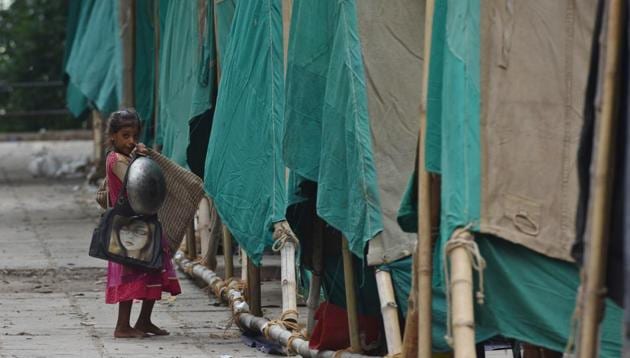
She takes a last look at her shanty—a mud and thatch hut barely 50 metres away, on the floodplains near East Delhi’s Geeta Colony—and moves up with them.
“It is difficult to move out with the belongings every year when the river swells. In 2013, our shanty was destroyed by the water and we had to build the house all over again. I just heard locals saying the water could go up even further this time. I hope my house is not washed away again,” said Devi, who moved to the camp with her husband, four children and cattle on Monday.
A separate area was demarcated near the campsite for cattle and other domestic animals. She is worried about feeding her cattle, including a cow, a calf and four goats. “We can go hungry for a day but the cattle can’t. Every day I go down to the forest to get fresh grass. I could not arrange for their fodder this morning because of shifting. I hope to arrange some food for them,” said Devi, who has been living here for the past 18 years.
The area falls under thokar number 17 (a local term used to identify dirt roads leading to the floodplains) where around 30 such families live. Most families living on the floodplains are farmers, cattle grazers and daily labourers.
{{/usCountry}}The area falls under thokar number 17 (a local term used to identify dirt roads leading to the floodplains) where around 30 such families live. Most families living on the floodplains are farmers, cattle grazers and daily labourers.
{{/usCountry}}Jeetu, 32, a daily-wager, said he had to skip the day’s work because of the shifting. “I have to feed eight people in my family. Skipping a day’s work means a loss of around ₹300-500.”
A team of 30 civil defence volunteers, working in three shifts, has been deployed at the floodplains to ensure security, food, drinking water, medicines and civic amenities. Mobile toilets have been set up.
“We alerted people about the rising water levels the previous night itself. We have set up 25 tents here, which can house around 150-200 people. Eight people could be housed in one tent. If the family is bigger, we try to keep the women and children together. Food packets are provided three to four times a day. There is electricity connection,” said a senior government officer looking after the evacuation process from Shahdara district.
Initially, the officer said, people are reluctant to move to camps and wait till the water inundates their dwellings.
Sanjay Kumar, a pradhan of the area, said every year he helps officials in convincing people to move out for their own safety. He had not slept through the night, as he and four others kept up in shifts to monitor the water levels.
“From Sunday night, we have been monitoring the water levels to alert people in case it reaches the danger mark. It has become a routine practice for us. Though we get food and other amenities, people lose out on the earnings from vegetable produce,” said Kumar.
Stay updated with all top Cities including, Bengaluru, Delhi, Mumbai and more across India. Stay informed on the latest happenings in World News along with Delhi Election 2025 and Delhi Election Result 2025 Live, New Delhi Election Result Live, Kalkaji Election Result Live at Hindustan Times.
Stay updated with all top Cities including, Bengaluru, Delhi, Mumbai and more across India. Stay informed on the latest happenings in World News along with Delhi Election 2025 and Delhi Election Result 2025 Live, New Delhi Election Result Live, Kalkaji Election Result Live at Hindustan Times.