As Delhi’s temperature plummets to a bone-chilling 4 degrees Celsius, for 15-year-old Nand Lal, who had undergone a major surgery of the spine and can barely get up or speak, his only hope for comfort is a night-cum-recovery shelter for the sick at Sarai Kale Khan.
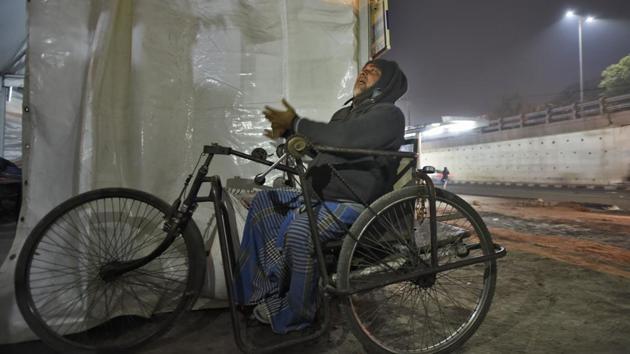
The boy and his father, a rickshaw-puller from Bihar, came to Delhi three months ago to treat a neurology disorder.
After the surgery, they had to stay for follow-up but had no money or place to go to. They spent a few nights on the pavement along GB Pant Hospital till one day when they were taken by a team of volunteers to this shelter for the homeless.
The boy, who still has a board-like equipment wrapped on him to support his neck and spine, now has attendants at to help him move around. He will take another two months to recover, said an attendant at the shelter.
“Doctors told us this is a major surgery and that his spine could not be exposed to any pressure or too much cold or heat. I had spent all my money in his treatment. We slept outside the hospital where people donated food and blankets, but it started getting colder and my son had difficulty breathing. I saw some people coming and asking those on streets to shift to a shelter. They are now arranging for medicines and food,” said the boy’s father.
The double-storey structure at Sarai Kale Khan is one of the 248 night shelters in Delhi. Of them, 83 are permanent buildings, 115 porta cabins while 45 are makeshift tents set up every winter.
{{/usCountry}}The double-storey structure at Sarai Kale Khan is one of the 248 night shelters in Delhi. Of them, 83 are permanent buildings, 115 porta cabins while 45 are makeshift tents set up every winter.
{{/usCountry}}The Delhi government’s Delhi Urban Shelter Improvement Board (DUSIB) is tasked with providing a safe and comfortable stay to Delhi’s over 17,000 homeless people. All shelters are run by NGOs on a contract basis, which also rescue people from the streets. According to NGOs, the number of homeless could go up to over a lakh.
DUSIB had last year promised warm water, television and breakfast at all its permanent shelters and porta cabins. At most places HT visited, geysers, though one each to cater to around 150-200 people, were functional. But breakfast was provided only at a few shelters.
DUSIB officials said they would start providing tea and toast at all places from January 1.
Winter stay at all shelters is free, which was extended till March last year. In summers, one has to pay ₹10 per night.
This winter is different for occupants of the white makeshift tents, some of which have attached toilets. The tents are ‘German-European’ style, which the government says are rainproof and fire retardant. There are folding beds, linen, pillows and mattresses.
Until this year, makeshift tents used to have only jute mats on the ground. Thefire-retardanttents were selected after a fire killed a person at a shelter at Yamuna Pushta in March, 2017.
These are spacious and can accommodate around 50-60 people. The tents are spread across Kashmere Gate ISBT, Nizamuddin, Yamuna Pushta, AIIMS and other places. While most shelters are not full to capacity yet, those at AIIMS are filled with a large number sleeping on the streets.
With no space, people were sleeping in the AIIMS subway.
The government’s weather forecasting agency has issued a warning of cold wave conditions over the next few days.
Most of the homeless are migrants who come to the city for a livelihood or are outstation patients at the premier hospitals.
Lakshmi Devi’s her family of six has been sleeping at the AIIMS bus stop with just two blankets, a sheet and a mat. Her eight-year-old grandson is being treated at the hospital for an infection and has a pipe attached to his body. The boy slept next to her. “It has been around six months since we came from Bihar. It takes too long to get even one test done here. All tents are full and even the subway. We can’t go to far-off shelters. It is getting colder every day,” the 70-year-old said.
Two tents have been set up outside the AIIMS metro station. But there are no attached toilets here.
Reena Devi from Bihar, whose seven-year-old suffers from a chronic disease, said government-run toilets were locked at night. “It has been eight days that I have come to Delhi. I was lucky to find a place at the tent, which is warm and cosy. But where does one go to relieve themselves at night when toilet complexes are locked?,” she said.
Nitesh Kumar, project coordinator, SPYM, which runs 60 shelters in Delhi, including at Sarai Kale Khan and AIIMS, said it was difficult to get permission to set up even two tents at the hospital gate. And there’s no space for toilets. Kumar, said, their rescue team goes out every night to urge people to shift to shelters.
“Our team moves 10-15 people every day from the streets to the shelters. But there are many who prefer the roadside as they don’t want to give up on public donations. Also, because as they are not allowed to indulge in substance abuse in the shelter. We request people to donate blankets and other stuff,” Kumar said.
DUSIB officials said they were pitching more tents around AIIMS. “We are pitching two to three more tents with a capacity of 50 each. This year the tents are bigger, fireproof and waterproof,” said Bipin Rai, member, DUSIB. The total 248 shelters can house over 17,000 people.
Stay updated with all top Cities including, Bengaluru, Delhi, Mumbai and more across India. Stay informed on the latest happenings in World News along with Delhi Election 2025 and Delhi Election Result 2025 Live, New Delhi Election Result Live, Kalkaji Election Result Live at Hindustan Times.
Stay updated with all top Cities including, Bengaluru, Delhi, Mumbai and more across India. Stay informed on the latest happenings in World News along with Delhi Election 2025 and Delhi Election Result 2025 Live, New Delhi Election Result Live, Kalkaji Election Result Live at Hindustan Times.