Indoors or outdoors, pollution doesn’t discriminate. It kills equally.
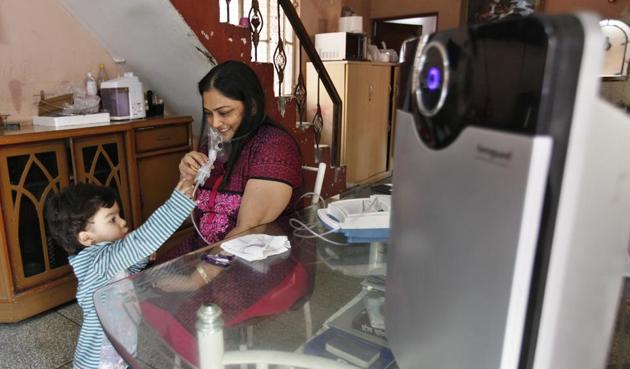
Though a majority of our anti-pollution strategy has remained focused on what is beyond the boundaries of our houses – vehicles, power plants, construction projects — there are several sources of pollution that pose danger to our health indoors too.
Experts suggest the composition of indoor air is different from outside. Unlike air quality outside that is measured on the basis of particulate matter, carbon monoxide, ozone and sulphur dioxide levels; air quality inside the house is determined by volatile organic compounds (from paints), bio-aerosols, nitrous oxides (from cooking gas) and so on.
Dr Raj Kumar, head of pulmonology department at Vallabhai Patel Chest Institute, however, has a slightly different view. “Pollutants that are present outdoors are also there inside our houses. Just that their density is lesser indoors. But, the good thing about indoor pollution is that curbing it is in our own hands, unlike the outdoor one for which we need to depend on the government and other agencies for cleanup,” he said.
Read More: Let’s fight pollution: Choked in dusty Delhi
{{/usCountry}}Read More: Let’s fight pollution: Choked in dusty Delhi
{{/usCountry}}According to the World Health Organisation (WHO), 4.3 million people a year die from exposure to household air pollution.
In poorly ventilated dwellings, smoke in and around the home can exceed acceptable levels for fine particles 100-fold. Exposure is particularly high among women and young children, who spend the most time near the domestic hearth. (www.who.int)
Most people have now moved on to using lesser-polluting cooking fuels in cities. However, chemical compounds used in buildings such as paints and varnishes are known to have adverse impact on health. Indoor air pollution from biological agents in indoor air related to damp and mould increases the risk of respiratory disease in children and adults by 50%, says WHO.
Researchers at the Patel Chest Institute have found that burning of incense sticks, a common practice in Indian homes for both aesthetic and religious reasons, increases the concentration of particulate matter (PM) to up to 15 times more than the permitted levels inside homes. The smoke emitted by incense sticks releases harmful pollutants and PM 1.0, PM2.5 and PM10, the study says.
Read More: Survey predicts 3000% rise in vehicles from 2015 to 2050
The daily permissible limit for PM10 is 100 micrograms per cubic metre and PM2.5 it is 60 micrograms per cubic metre. The study found that mean concentration of PM10, PM2.5 and PM1.0 levels increased by 1879.7g/m3, 1775.4g/m3 and 1,300.1g/m3 during burning of incense sticks indoors.
To fight pollution indoors, residents are buying air purifiers. The market for air purifiers in India was estimated at 40,000 units in 2015-16. It is expected to grow at least three times by the end of this year. All air purifier manufacturers have reported a steep spike in the sales, especially after the choking haze that enveloped Delhi-NCR after Diwali on October 30.
For those living around major hubs of pollution like Rajneesh Mathur the risks are even higher. Mathur lives in a fourth-floor flat in East Delhi’s Gharoli. The Mathur family’s immediate neighbours – Ghazipur landfill and Anand Vihar Bus Terminal – are one of the major pollution hubs in Delhi.
“My father and I bought this house about two decades ago. We are repenting now. Reeta, my wife, complains of gastric problems all the time. The doctor says it is also because of the location we live in. We try keeping our doors and windows shut for most part of the day to keep away dust and the stench of the rotting garbage as there is a lot of dust in the air. The stench gets worse during monsoons,” said Mathur.
Gases like methane, carbon dioxide, nitrogen, ammonia, sulphides, carbon monoxide and non-methane organic compounds such as benzene and vinyl chloride are in abundant supply for the Mathur family due to their proximity to the 70-acre Ghazipur landfill.
“We are worse off than others. Despite staying inside, our eyes burn due to the toxic smoke that emanates from the numerous fires that keep erupting at the landfill,” said Adarsh Joshi, a resident of Kaushambi in Ghaziabad.
Doctors say persistent exposure to gases that are released by landfills can cause gastrointestinal infections, cancer, birth defects and asthma.
Read More: Greenpeace says 1.6 million died due to pollution in India, China in 2015
“Pollution is so bad in our houses that the pipes of our air conditioners often get corroded leading to gas leakages. It’s anybody’s guess what this air does to the human body. Even the clothes we dry outside have a thin grey layer of dust and they lose colour,” said Manju Devi, a resident of IP Extension.
Others like Aanchal Kothari Oswal who lives in Noida Sector 104, are now ramping up defence against indoor pollution by adopting simple measures.
At least 36 indoor plants have been neatly placed at different corners of Aanchal’s home. “We had first installed an air-purifier, but found that it does not cover our entire house. So, we researched and decided to take the natural way for purifying air,” she said.
Her drawing room and kitchen are adorned with Areca palm plants that can filter indoor air pollutants such as xylene and toluene. At 1.8 m (5 ft 11 in) in height, the arecan plant can transpire 1-litre water in a day, making it an effective humidifier.
The bathrooms in her house have snake plants that are known to remove at least 107 known air pollutants, including carbon monoxide and nitrogen monoxide, formaldehyde, chloroform, benzene, xylene, and trichloroethylene among others.
“I also have a lot of English Ivy plants that provide a natural way of removing toxic agents from the air, helping neutralize the effects of sick building syndrome. Besides, we also have aloe vera, spider and other species of plants that help cleanse the air in our home,” she said.
Stay updated with all top Cities including, Bengaluru, Delhi, Mumbai and more across India. Stay informed on the latest happenings in World News along with Delhi Election 2025 and Delhi Election Result 2025 Live, New Delhi Election Result Live, Kalkaji Election Result Live at Hindustan Times.
Stay updated with all top Cities including, Bengaluru, Delhi, Mumbai and more across India. Stay informed on the latest happenings in World News along with Delhi Election 2025 and Delhi Election Result 2025 Live, New Delhi Election Result Live, Kalkaji Election Result Live at Hindustan Times.