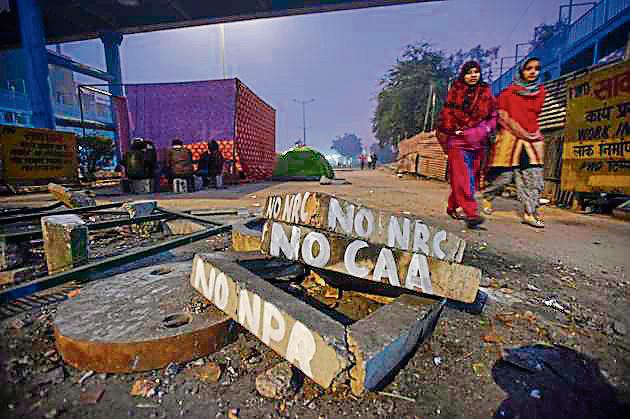
The decision of the Centre to press ahead with the Citizenship (Amendment) Act and the decision of a range of Opposition-ruled states to not implement the CAA, and in the case of West Bengal and Kerala, even the National Population of Register, brings to fore a new trend in India’s federal compact.
Indian federalism has evolved over the decades, and this can be broadly structured in four phases. The first lasted for four decades after Independence. The Constitution, in fact, does not use the term federal, but calls India a “union of states”. The backdrop of Partition and the recognition among founders that the country needed a strong Centre to consolidate the Republic gave India a quasi-federal structure — where the Centre was more powerful than the states. The fact that the Congress was in power both at the Centre and in most states meant that politically too, Delhi remained more powerful than state capitals. The second phase saw the rise of the regional parties and the decay of the Congress, particularly since the late 1980s, changing the distribution of power. The emergence of the coalition era, where regional parties had extraordinary power to decide who would govern in Delhi, reinforced the trend. Suddenly, states were equally — if not more — powerful than the Centre. The third phase began in 2014 and subsequent state polls. India had a single-party majority government after three decades. The Bharatiya Janata Party (BJP) also swept polls in a majority of Indian states. This meant that Delhi was once again more powerful than the states, which largely abided by the Centre’s political directives and implemented schemes and policies.
But the past year has seen a new equilibrium emerge. The Centre is strong, but states have strongly begun asserting their independent identity. As more states slip out of the control of the BJP, and as politics becomes more polarised, India is headed towards a fourth phase where both the Centre and the states are strong, and there is an underlying tension within the federal compact. To ensure that this does not slide into a dysfunctional polity, there is a need for accommodation on both sides. The BJP must recognise that while it has a brute majority in the Lok Sabha, running a diverse country like India requires sensitivity to regional aspirations and a working relationship with parties opposed to it nationally, but which exercise power in specific geographical domains. The states too must recognise that the division of powers in the Constitution is sacred — and abide by the spirit of the Union, State and Concurrent lists that specify which unit has the authority over which subjects. A collision between the Centre and states will undermine Indian unity.
{{/usCountry}}But the past year has seen a new equilibrium emerge. The Centre is strong, but states have strongly begun asserting their independent identity. As more states slip out of the control of the BJP, and as politics becomes more polarised, India is headed towards a fourth phase where both the Centre and the states are strong, and there is an underlying tension within the federal compact. To ensure that this does not slide into a dysfunctional polity, there is a need for accommodation on both sides. The BJP must recognise that while it has a brute majority in the Lok Sabha, running a diverse country like India requires sensitivity to regional aspirations and a working relationship with parties opposed to it nationally, but which exercise power in specific geographical domains. The states too must recognise that the division of powers in the Constitution is sacred — and abide by the spirit of the Union, State and Concurrent lists that specify which unit has the authority over which subjects. A collision between the Centre and states will undermine Indian unity.
{{/usCountry}}