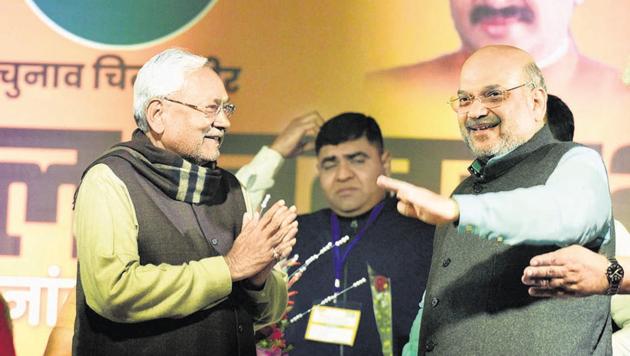
The campaign for the Bihar election, scheduled for the end of the year, has begun. In a display of what campaigning may look like in the coronavirus disease (Covid-19)-hit era, Union home minister and top Bharatiya Janata Party (BJP) leader Amit Shah addressed workers in a digital rally. His message was simple: The BJP-Janata Dal (United) alliance had delivered on governance; it will win a two-thirds majority under chief minister Nitish Kumar; and the Centre and the state government have worked to address the distress of the poor, particularly migrant workers.
Mr Shah’s claims are questionable. There is a sense in Bihar that in his third term, Mr Kumar’s record in office has been patchy, especially when compared to his own previous track record where he improved Bihar’s infrastructure and law and order. The last five years have been marked by political instability. He won the election in alliance with the Rashtriya Janata Dal (RJD), but changed partners mid-way. The next generation of reforms, needed to bring in investment to industrialise the state, has not happened. But most critically, Mr Kumar’s record in dealing with the health and the economic crisis in the last two months has had several gaps. Bihar’s testing was low in the initial period; it was not proactive in bringing back migrant workers — who are central to the remittance economy of the state; when migrants returned, there has been a surge in cases beyond the anticipation of the state government; and it has been unable to rigorously follow health protocols and come up with an adequate economic response.
Yet, the BJP-JD(U) alliance has an advantage in the race, primarily due to caste arithmetic and the state of the opposition. In Bihar’s triangular polity, whenever two actors come together, they have an advantage over the third. The ruling combine has the substantial backing of upper castes, backward communities, and a large segment of Dalits. But its biggest strength is the RJD. With Lalu Prasad still in jail, the leadership mantle of the party is with Tejaswi Yadav, who does not have his father’s mass connect and charisma. The RJD has the solid backing of Muslims, and the majority of Yadavs (though segments of Yadav’s moved away in the Lok Sabha elections to the National Democratic Alliance). This social coalition is enough to make the RJD a strong opposition, but not enough to win. It is also unclear if the RJD has the political heft to capitalise on the palpable discontent against the state government. But irrespective of the outcome, the real significance of the poll is in how parties mobilise during times of a pandemic and the shifting nature of issues that will now be central in the choices of voters.
{{/usCountry}}Yet, the BJP-JD(U) alliance has an advantage in the race, primarily due to caste arithmetic and the state of the opposition. In Bihar’s triangular polity, whenever two actors come together, they have an advantage over the third. The ruling combine has the substantial backing of upper castes, backward communities, and a large segment of Dalits. But its biggest strength is the RJD. With Lalu Prasad still in jail, the leadership mantle of the party is with Tejaswi Yadav, who does not have his father’s mass connect and charisma. The RJD has the solid backing of Muslims, and the majority of Yadavs (though segments of Yadav’s moved away in the Lok Sabha elections to the National Democratic Alliance). This social coalition is enough to make the RJD a strong opposition, but not enough to win. It is also unclear if the RJD has the political heft to capitalise on the palpable discontent against the state government. But irrespective of the outcome, the real significance of the poll is in how parties mobilise during times of a pandemic and the shifting nature of issues that will now be central in the choices of voters.
{{/usCountry}}