What does “development” mean? What does it mean for a civilisation thriving in the heart of Africa, untouched by the industrial revolution of the Western (and consequently white) world to develop into a technologically advanced state? These are some of the questions that Black Panther, the much acclaimed latest instalment of the Marvel Cinematic Universe (MCU) fails to answer. The film is many things – a black American wish fulfilment fantasy, a rare mainstream American film with an almost entirely black cast, an important moment in American film history – but what it certainly is not is the imagination of a successful alternative to the white colonial idea of development that it could have been.
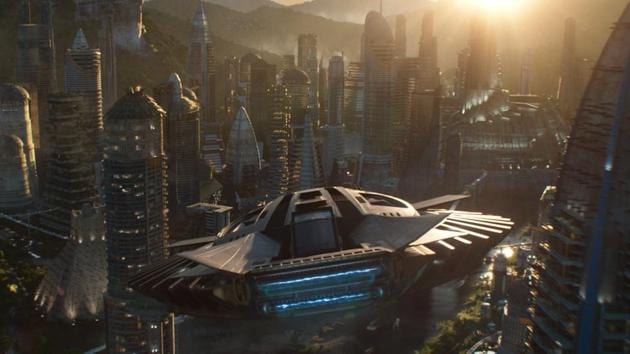
As we see the secret, powerful, self-contained and technologically advanced nation of Wakanda for the first time, we are treated to the typical visual of flat-topped acacia trees in the stark African savanna that shimmer and vanish to reveal what should have been an indigenous African kingdom. Instead what we see is a well-lit Gotham City located in a green valley. It is almost as if the western idea of development and technological advancement – slick, white labs with minimalist furniture, tall glass and metal buildings, and an inexplicable aversion to sandals in formal spaces – is the inevitable telos of all civilisation; as though any culture, with any philosophy would necessarily have eventually found its way to what 21st century America is. There is no departure from a contemporary American/western trajectory of technological progress in this untouched African nation (except for one excellent divergence from typical American action films: the absence of guns in fight sequences). In the final turn, as Wakanda decides to emerge from secrecy to share technological know-how with the rest of the world, it is only in service of a very American problem. Even then, it feels unconvincing that a mighty African nation would have idly stood by during the heyday of the slave trade and apartheid, only to help resolve racism in 21st century United States.
Limited as it is by the demands of the MCU franchise and an American worldview, Black Panther pays lip service to the many histories of the glorified mother continent. African ideals of traditional knowledge, sustainable development and pastoralism find little prominence in this Americanised ideal of a successful African nation state. In an unintentionally funny moment, the war cry of a rival tribe’s leader (muted, in New Delhi) is an incongruous invocation to Hanuman. Unsurprisingly then, the one western ideal left out of the “native” African polity is democracy. Wakanda remains, for all intents and purposes, a patrilineal monarchy (a bad departure from the comic books on which it is based, in which a woman does become the Black Panther). The paradigms of politics, development and technological progress in the film don’t ever really clear the well established boundaries of a Tony Stark-like vision.
{{/usCountry}}Limited as it is by the demands of the MCU franchise and an American worldview, Black Panther pays lip service to the many histories of the glorified mother continent. African ideals of traditional knowledge, sustainable development and pastoralism find little prominence in this Americanised ideal of a successful African nation state. In an unintentionally funny moment, the war cry of a rival tribe’s leader (muted, in New Delhi) is an incongruous invocation to Hanuman. Unsurprisingly then, the one western ideal left out of the “native” African polity is democracy. Wakanda remains, for all intents and purposes, a patrilineal monarchy (a bad departure from the comic books on which it is based, in which a woman does become the Black Panther). The paradigms of politics, development and technological progress in the film don’t ever really clear the well established boundaries of a Tony Stark-like vision.
{{/usCountry}}