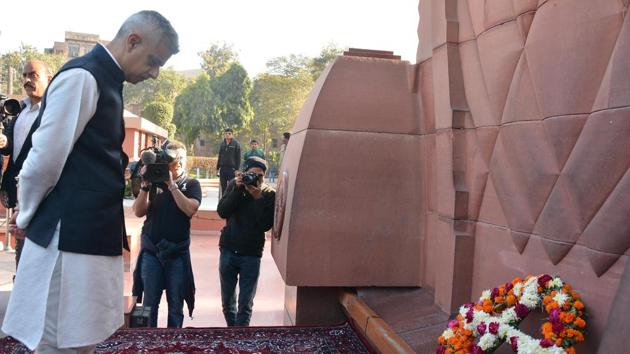
It takes more than an admission of wrongdoing to express real remorse. On Wednesday, Sadiq Khan, the first Asian-origin mayor of London, appealed to the UK government to apologise formally for the Jallianwala Bagh massacre by British Indian Army soldiers. On April 13, 1919, more than 1,000 people were killed and over 1,100 wounded when Brigadier General REH Dyer ordered 50 riflemen to shoot on peaceful protestors assembled at Amritsar’s Jallianwala Bagh on the festival of Baisakhi. In February 2013, on a visit to India, the then British Prime Minister, David Cameron, described the massacre as “deeply shameful”, falling short of a formal apology. During a ceremonial visit to Jallianwala Bagh in 1997, Queen Elizabeth had chosen not to leave any comment in the visitors’ book.
It may be tough for erstwhile colonial powers to own up to their mistakes, but it hasn’t been uncommon for heads of state to apologise publicly for historical injustices committed in the course of governance . These have included discrimination, slavery and mass murder. In the 1990s, on a visit to Africa, former American president Bill Clinton apologised for the world’s inaction during the genocide in Rwanda. In December 2015, Japanese PM Shinzo Abe reiterated his foreign minister’s apology to South Korea for having forced Korean women into sexual slavery during World War II. In May last year, Justin Trudeau apologised in the House of Commons for the 1914 decision by the then Canadian government to turn away the migrants on board the ship Komagata Maru after their arrival in Vancouver. Closer home, in his apology for the 1984 anti-Sikh riots, former prime minister Manmohan Singh told Parliament in 2005: “I apologise not only to the Sikh community, but to the whole Indian nation because of what took place in 1984 is the negation of the concept of nationhood enshrined in our Constitution.”
Although former British prime ministers, including Cameron and Tony Blair, have apologised for a variety of wrongs (from the transatlantic slave trade to the Irish potato famine), they’ve been slow on the draw when it comes to admitting the excesses of colonial rulers during the 200-year period when they ruled India. No similar apology came for the 1943 Bengal famine in which more than four million people perished or the ghastly Jallianwala massacre. It is time that the Queen or the British prime minister tendered an unequivocal apology for the incident and owned up to similar atrocities committed by its forces on the people it colonised. A good time to do it could be before the centenary of the Jallianwala Bagh massacre in 2019. The gesture may not provide closure to the nation, but it may lend a healing touch to the descendants of the victims, many of whom have migrated to Britain.
{{/usCountry}}Although former British prime ministers, including Cameron and Tony Blair, have apologised for a variety of wrongs (from the transatlantic slave trade to the Irish potato famine), they’ve been slow on the draw when it comes to admitting the excesses of colonial rulers during the 200-year period when they ruled India. No similar apology came for the 1943 Bengal famine in which more than four million people perished or the ghastly Jallianwala massacre. It is time that the Queen or the British prime minister tendered an unequivocal apology for the incident and owned up to similar atrocities committed by its forces on the people it colonised. A good time to do it could be before the centenary of the Jallianwala Bagh massacre in 2019. The gesture may not provide closure to the nation, but it may lend a healing touch to the descendants of the victims, many of whom have migrated to Britain.
{{/usCountry}}