Many of science’s most well-recognised symbols are related to one specific scientist. Be they equations (E = mc2), theories (that one about relativity), or even the most popular idea of the mad scientist look. This person is Albert Einstein, who died this past week in 1955 (and whose most famous theory, the General Theory of Relativity, was published this month in 1914). Albert Einstein — the scientist, the philosopher, the public intellectual — left such a mark on the society he lived in that his name has become synonymous with brilliance. That he was primarily a scientist did not keep him out of the politics of his time. At the age of 35, he had the gumption to be one of only four signatories of a manifesto against World War I. The reason this action is significant is because it was in opposition to another manifesto that defended the German war effort, which was signed by 93 of his peers.
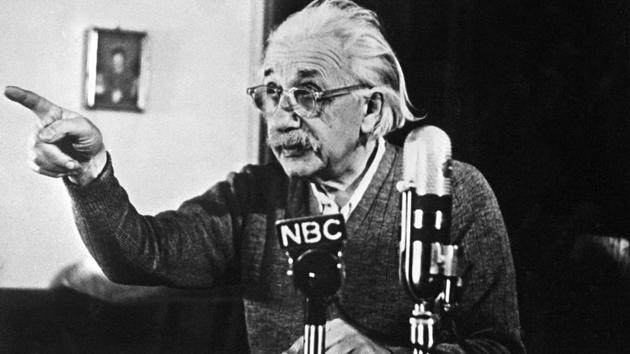
It was this steadfast dedication to world peace that led Einstein to collaborate with the British philosopher, Bertrand Russell, during the Cold War on what has come to be known as the Russell-Einstein manifesto. The manifesto recognised the dangers of nuclear weapons (even though he was part of the effort that led to their creation) and called for leaders around the world to seek peaceful resolutions to conflict. This manifesto resulted in the formation of the Pugwash Conferences on Science and World Affairs.
Einstein’s public disagreements with Niels Bohr about quantum mechanics have deeply influenced the study of the philosophy of science. Even though they disagreed vehemently, Bohr and Einstein were known to be full of admiration for each other — a model for scientific disagreement and, indeed, public discourse. As scientists responsible for taking physics beyond the Newtonian understanding and into the quantum revolution, both Bohr and Einstein have played significant roles in establishing the new rules of physical sciences. Much of modern research — including on black holes — continues to build on their work.
It is not often that scientists become proper celebrities or are able to bring their scientific expertise to the common people. Einstein, winner of the Nobel Prize in Physics (1921, “for his services to theoretical physics, and especially for his discovery of the law of the photoelectric effect”) was one of the few scientists who was able to bring high science into public prominence. Without it being about individual celebrity, the public discourse in our present times could use more serious and more rigorous participation by those who are considered experts in their fields. Einstein’s unique position as a scientist statesman, whose word was taken as seriously by the international scientific community as well as by the international political establishment, creates a template for future scientists to follow.
{{/usCountry}}It is not often that scientists become proper celebrities or are able to bring their scientific expertise to the common people. Einstein, winner of the Nobel Prize in Physics (1921, “for his services to theoretical physics, and especially for his discovery of the law of the photoelectric effect”) was one of the few scientists who was able to bring high science into public prominence. Without it being about individual celebrity, the public discourse in our present times could use more serious and more rigorous participation by those who are considered experts in their fields. Einstein’s unique position as a scientist statesman, whose word was taken as seriously by the international scientific community as well as by the international political establishment, creates a template for future scientists to follow.
{{/usCountry}}